(1) The lives of elderly women in poverty
Seniors scraping by on scrap and cardboard
Average age of scrap collectors: 78.1 — half are women
For women who spent their lives at home, it is the only work left
Editor's note: South Korea's elderly poverty rate stands at 2.7 times the OECD average. Elderly women fare worse than men. For decades, women were expected to devote themselves to caring for their families, setting aside careers outside the home. That break from formal employment left them with little professional standing and no path to financial independence. In old age, they worry about getting through each day. The Herald Business examined how the sacrifices women made in their youth are now being "billed back" to them in the form of poverty and insecurity.
"A person can't just die."
A woman in her 80s appeared at a scrap dealer's yard, trembling as she hauled a cart. Two sacks stuffed with cans, frying pans and other scrap metal were piled on top. The two sacks came to 10,000 won.
Her hands and body shook badly — from diabetes and high cholesterol, she said. On Sept. 22, the day before a national holiday, she was spotted outside a resource recycling facility in Eunpyeong-gu, Seoul. "I have to survive somehow… a person can't just die," she said, before disappearing into an alley.
For elderly women with little education and failing health, the options for making a living are few. That is what pushes them toward collecting scrap and cardboard.
According to the Ministry of Health and Welfare's 2024 nationwide survey of elderly scrap collectors — the most recent of its kind — the average age of those who collect cardboard and scrap is 78.1, and women account for 55.3 percent, outnumbering men. It is elderly women who are shouldering this grueling work, hauling carts weighing tens of kilograms.
Grandchildren to raise, a husband bedridden — why they have no choice but to collect scrap
① Losing a husband, losing a son — a life of unending caregiving and physical labor
Ko Sun-ok (80, pseudonym), whom this reporter met at the Eunpyeong-gu recycling facility on Sept. 22, is one of them. Old age should have brought some relief from life's burdens, but Ko remains trapped in a cycle of caregiving and physical labor.
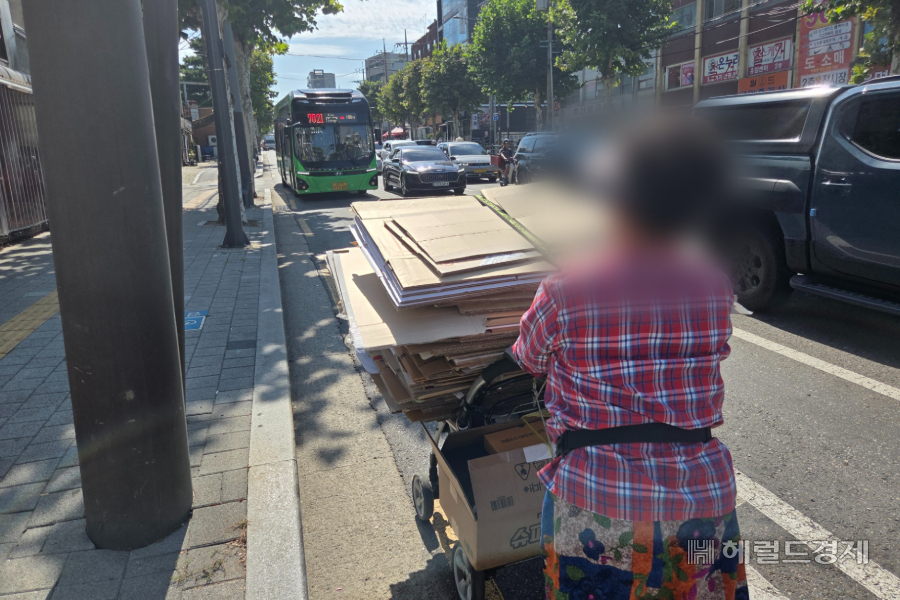
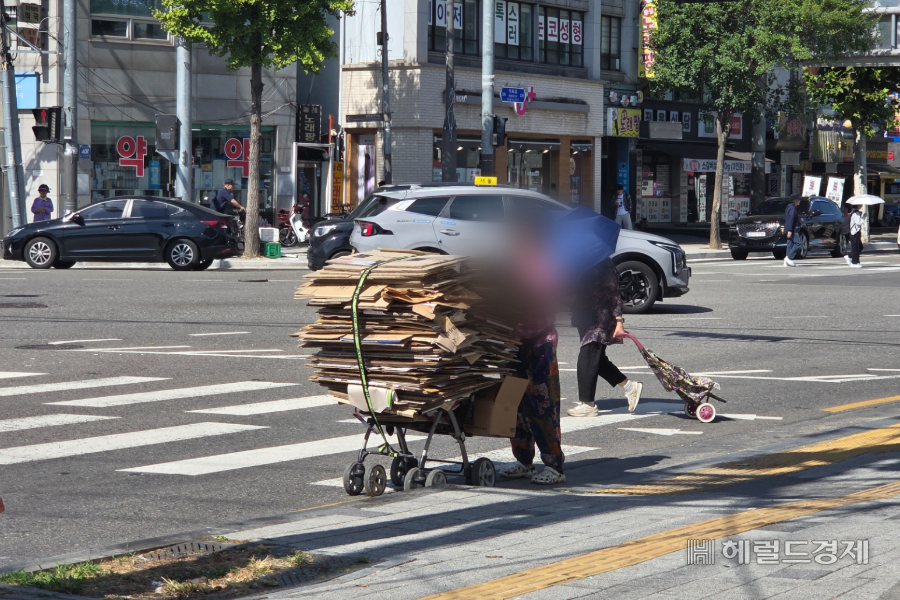
She arrived pushing a modified baby stroller piled so high with cardboard that it looked ready to topple. She had been traveling against traffic on the road and caught her breath as she explained: "I simply don't have the strength to push it up onto the sidewalk, so I go on the road even though it's dangerous."
3,700 won. That is what Ko earned collecting scrap from 8 a.m. to 11 a.m. It is also all the money she and her two grandchildren have to get through Wednesday.
About 60 years ago, Ko was 21 when she and her husband, four years her senior, moved to Seoul. With no particular skills or education, the couple made ends meet doing "gombang" work — carrying construction materials on job sites. It was her first job.
In time, they had a son and then two daughters. The work was hard, but the family of five crowded into a small home and got by without feeling the weight of it too much. There were days, she said, when she felt a surge of hope that a more comfortable life lay ahead.
That hope came to nothing. When Ko turned 40, her husband died, leaving her with three children. She kept doing construction labor to survive. When her body gave out in her 60s, she moved to building cleaning work — her second job. She never paid into the national pension.
She cleaned buildings here and there until she was 75. Only when she could no longer manage that did she begin picking up scrap around her neighborhood.
In the meantime, her two daughters had married and had children of their own. Her son, who had married late — to a Vietnamese woman — also had children. Ko thought she could finally grow old without worry in the row-house unit she had scraped together her savings to buy.
That hope collapsed again. Her son, who had been ill, died last year. His Vietnamese wife said she could no longer stay and left, abandoning her two children. Ko is now raising a middle school student and an elementary school student.
Collecting scrap brings in at most 200,000 won ($147) a month. Adding about 450,000 won in basic pension and other benefits, that is her total monthly income — nowhere near enough to raise two grandchildren. At least the community center's welfare office learned the grandchildren were being raised by their grandmother and began providing a subsidy of 1.2 million won a month for the two of them.
"Young people, earn money so you can live comfortably when you're old," Ko told this reporter. "I tell my grandchildren all the time: your grandmother has sacrificed like this all the way into old age, so you work really hard and live a comfortable life."
② When her husband was bedridden — a 60-year-old housewife enters the workforce
Yang Gyeong-ja (82, pseudonym) was also at the facility that day. Yang had spent her entire life as a housewife. At 25, she moved from Dangjin in South Chungcheong Province to Eungam-dong in Eunpyeong-gu. On her carpenter husband's earnings, she raised two sons and bought a home in the neighborhood. The sons married without causing trouble and gave her three grandchildren. Those were worry-free years.
But around the time Yang turned 60, she was forced into the workforce. Her husband's severe spinal stenosis had already pushed him out of work early, and then one of her sons caused a traffic accident that required a large sum of money.
Yang had spent more than 40 years raising children and keeping house. Suddenly thrown into the working world, there was little she could do.
She was introduced to farm work — riding out to the fields at 4 a.m. "I spent all day bent over, and by the time I finished my back hurt beyond words," she recalled. "I couldn't straighten up at all, so I crawled up the stairs on my hands and feet."
Her body could not take it. Yang quickly quit the farm work and started her current job: collecting scrap and cardboard. She said she has been at it for nearly 20 years. Over 60 years — as a housewife, a farmhand and now an elderly scrap collector — she has never held a job within the formal employment system. She receives no national pension.
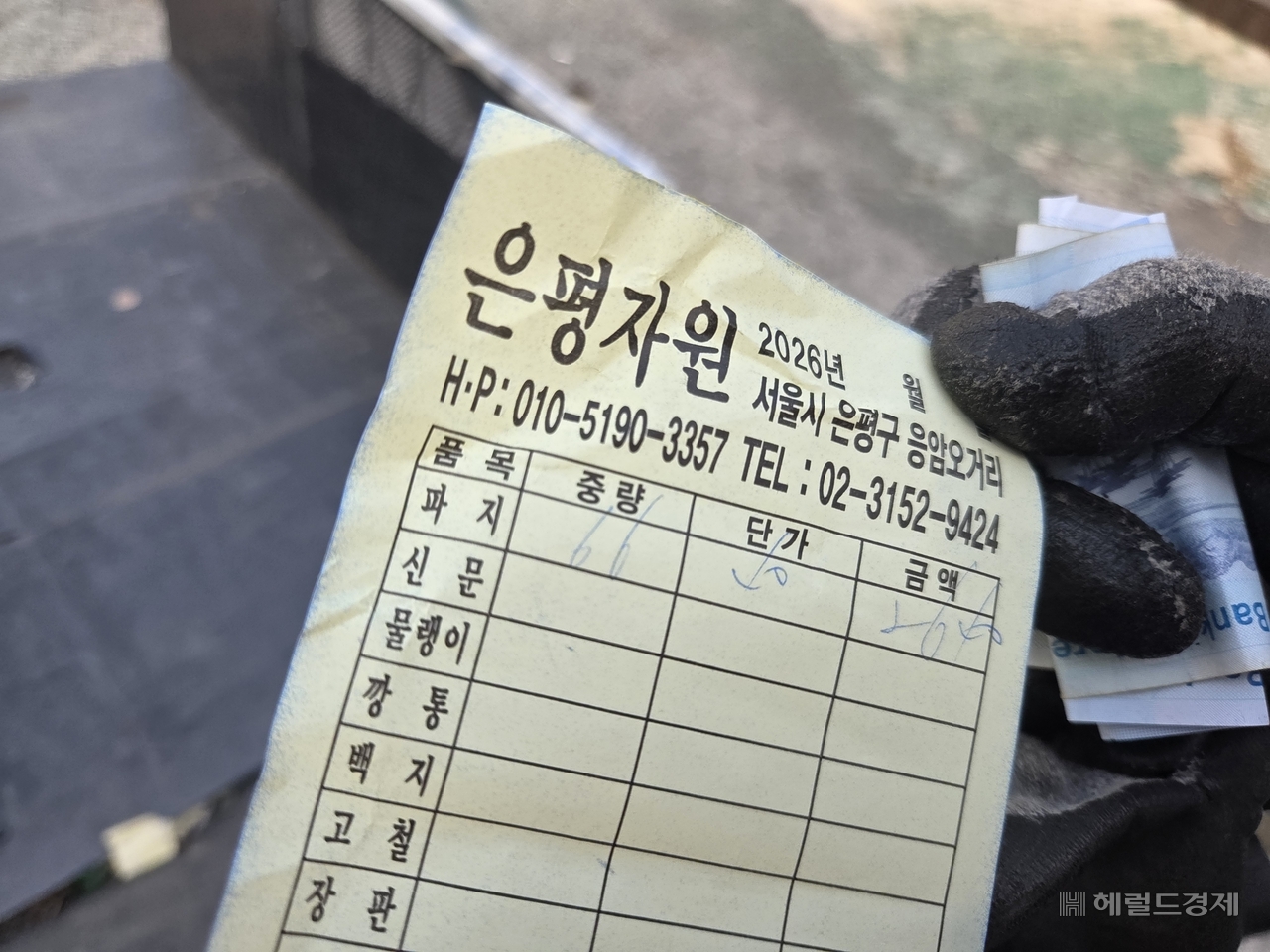
When this reporter met Yang, she had just finished selling 66 kilograms of cardboard. At 40 won per kilogram, she walked away with 2,640 won — the earnings from five hours of collecting since before dawn.
![A reconstructed table of Yang Gyeong-ja's monthly income and expenses [produced with AI]](https://wimg.heraldcorp.com/news/cms/2026/09/30/9/news-p.v1.20260929.b9fbdb9ea8e44a72a3ed16a8efa91091_P1.jpg)
After finishing her morning rounds, Yang goes home to prepare lunch for her husband. She eats with him, then heads out again in the afternoon for another circuit. A full day of collecting, morning and afternoon, brings in about 6,000 won, she said — at most around 150,000 won a month. Combined with 500,000 won in basic pension for the elderly couple, their monthly income comes to 650,000 won ($479).
The couple is fortunate to own their home, so they pay no rent. Their sons cover insurance premiums, gas and other utility bills.
Medical costs are the constant headache. Her husband's spinal stenosis injections run 90,000 won ($66) each, and he has had four recently. There was also a sudden liver ultrasound and bone density test not long ago. Yang herself suffers from severe hip and knee pain and regularly undergoes physical therapy at 5,900 won a session. Whatever is left after all that goes toward food. She says she makes do with however little remains.
Yang said she is looking forward to seeing her grandchildren over the holiday, but feels sorry she cannot give them even a small amount of pocket money. Still, she said: "All I hope for now is that things don't get worse — that I can live on like this a little longer, and go in my sleep one night without getting sick somewhere. That would be a blessing for me and a blessing for my children."
20ki@heraldcorp.com