Liftbound pop-up at Yongsan iPark Mall tops 1.1 billion won in sales; Pokémon card shop draws 200-person daily queues since April; a single Pikachu card sold for 48 million won on KREAM
Kim, a man in his 30s who has played trading card games since his 20s, recently found himself drawn to Liftbound — a newly released TCG based on the world of League of Legends. He has been a fan of Pokémon and Yu-Gi-Oh! cards for years.
"There's something special about having a deck you built yourself exist as a physical object," Kim said. "When I was young, buying cards felt like a financial burden. Now that I'm earning money, I find myself wanting to get better and better cards."
LoL-based TCG pop-up draws 17,000 visitors; Pokémon shop sees daily open runs
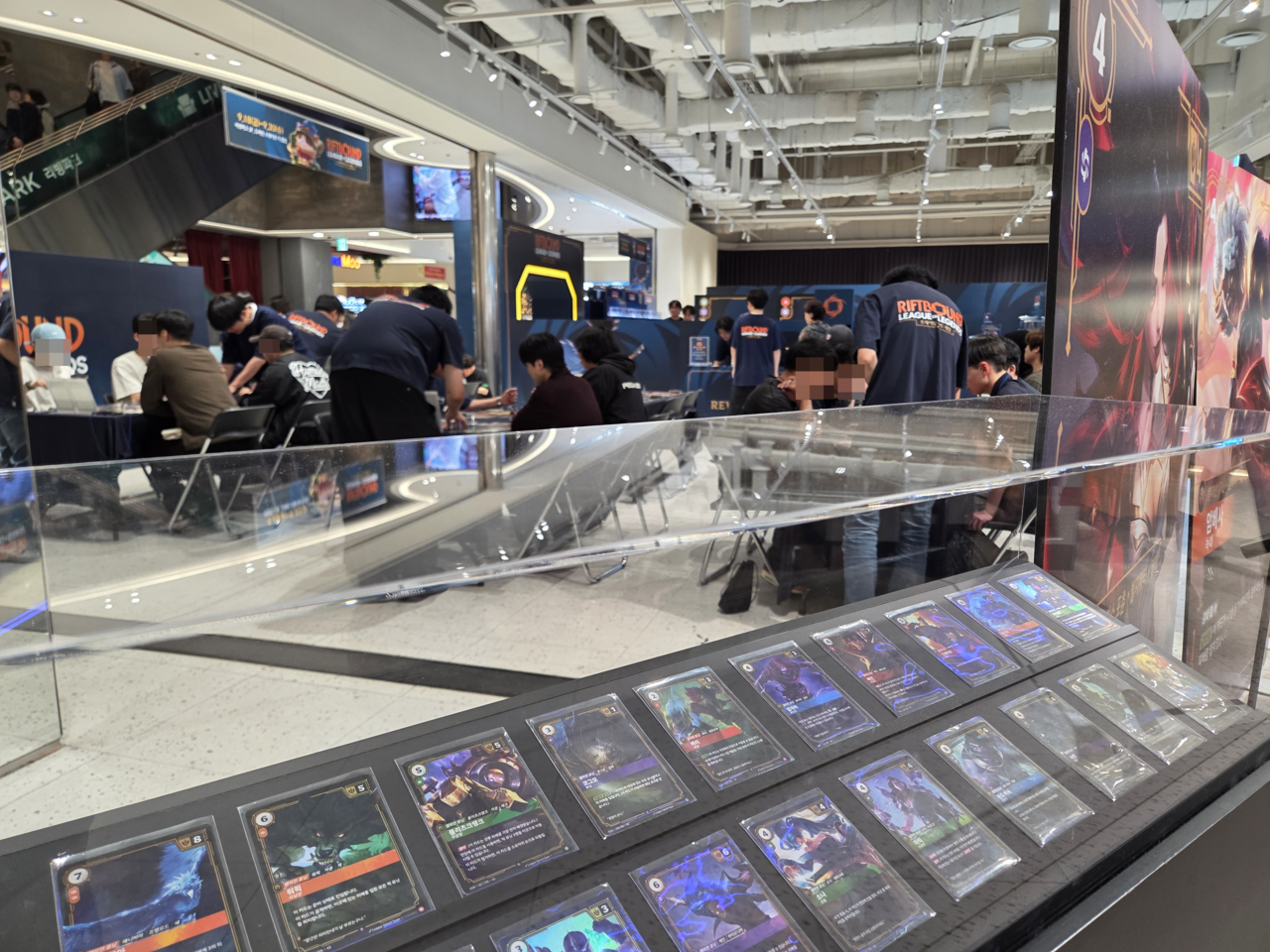
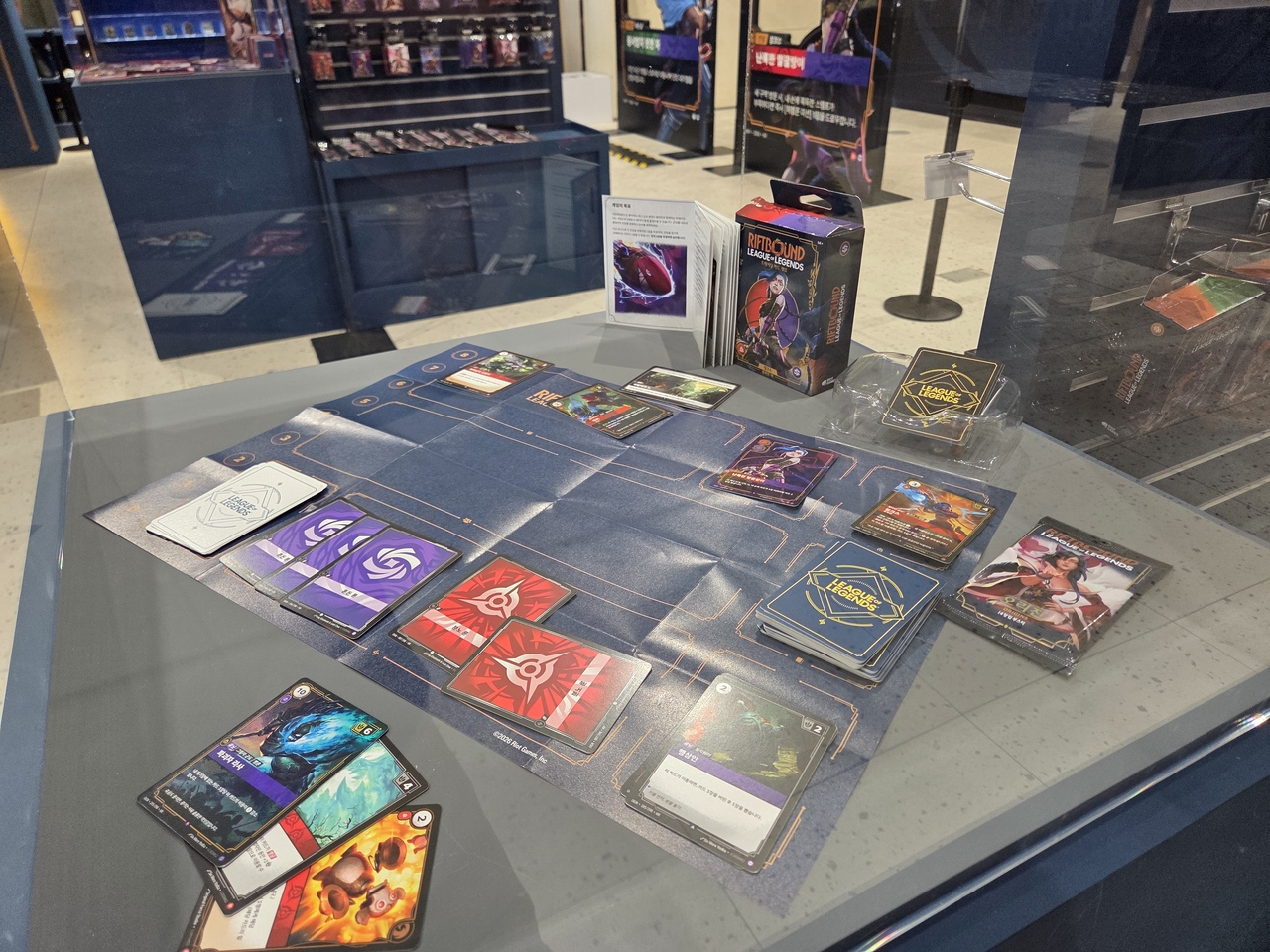
The Liftbound pop-up store at iPark Mall in Yongsan, Seoul, was packed with visitors on Tuesday afternoon — a weekday — all eager to try the game's hands-on experience programs. Men in their 20s and 30s made up the bulk of the crowd, most of them there to get their first taste of the title, which launched in South Korea on Sept. 18.
A man in his 20s from Gwanak-gu said he had pre-booked a trial session after hearing that a card game based on League of Legends had come out. "I play LoL regularly, so I was curious," he said. "Once I tried it, the characters felt familiar and the rules were easier than I expected."
iPark Mall has been running the Liftbound pop-up since Sept. 18. Liftbound is a TCG developed by Riot Games using the lore and champions of League of Legends. Beyond selling products, the pop-up offers programs where first-time players can learn the rules and play a full game on the spot.
The response has been strong. According to iPark Mall, the pop-up drew about 17,000 visitors in the 11 days from Sept. 18 through Monday. Sales over the same period surpassed 1.1 billion won ($810,000), averaging more than 100 million won a day — a daily figure the industry considers exceptional.
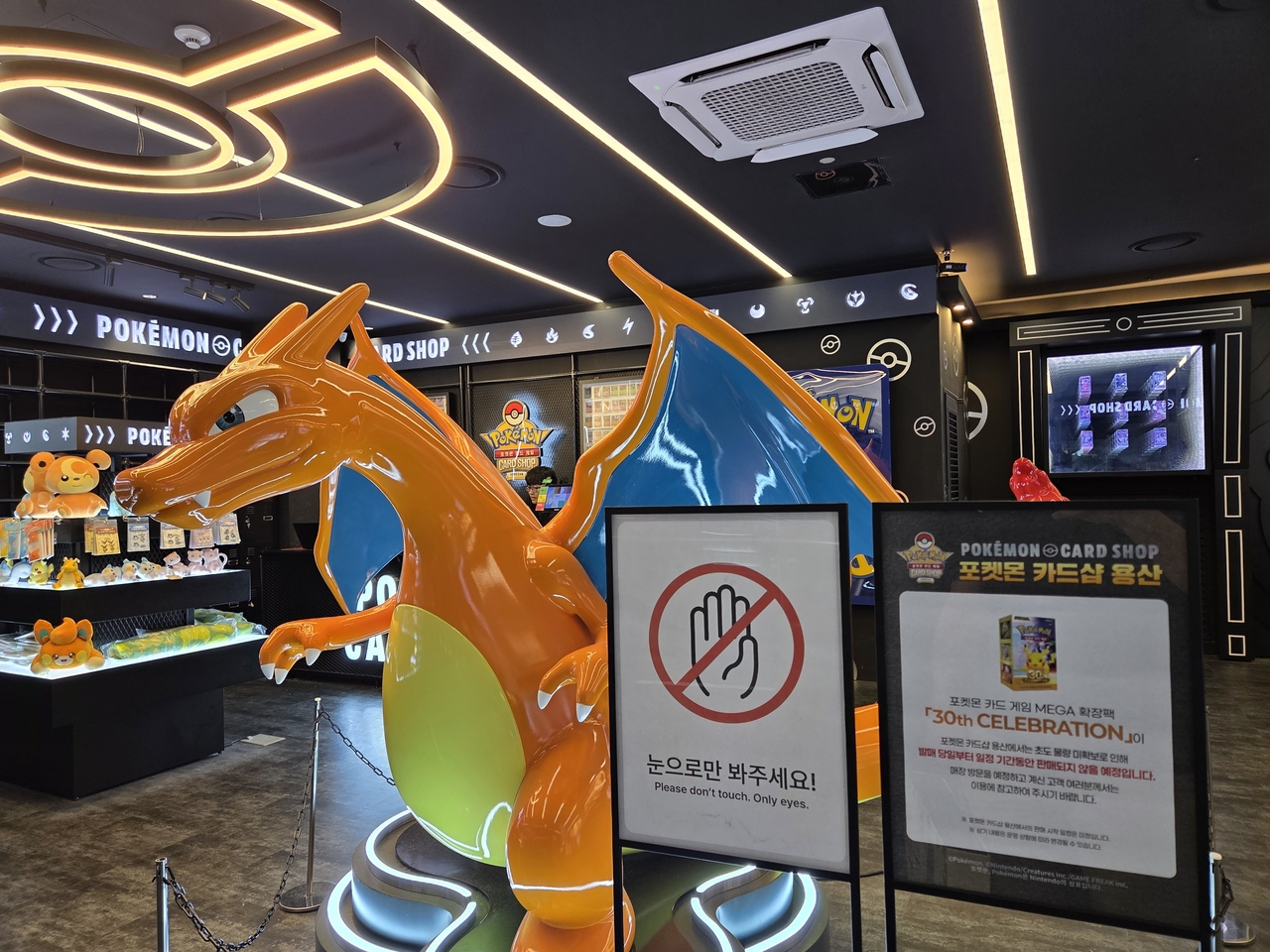
iPark Mall is also home to a permanent Pokémon Card Shop operated directly by Pokémon Korea. Because the store receives a fixed daily stock, it triggers an "open run" — a rush to be first in line at opening — every single day. According to iPark Mall, about 200 customers have been lining up before the store opens every morning since April. Some arrive in the early hours and wait through the night.
To prevent a stampede at opening, the store uses a waitlist system: customers register upon arrival and are called in one by one. Purchases are currently capped at one box per series per customer. Assuming a single customer buys two to three boxes across different series, the store is estimated to generate more than 30 million won in sales each day.
What makes TCGs so compelling — and why one card fetched 22.2 billion won at auction
So what is driving the TCG craze? A trading card game is a card game in which players collect cards to build their own "deck" — a curated set — and then compete against others. Think of it like poker, except players go out and buy the specific cards they need to assemble their ideal hand. Each card carries a unique character, ability and set of skills, and the combination of cards in a deck shapes the player's strategy and style of play.
At the heart of TCG is the act of collecting. New cards are released continuously, and players must constantly seek out better cards or ones that fit their deck. Most players start by buying a "starter deck" — a basic pre-built set. From there, they expand their collection by purchasing "booster packs" or "expansion packs," which contain a random assortment of cards. When a desired card does not appear, players trade with others or buy individual cards on the secondhand market.
For many, collecting has become the main draw — not the game itself. Some TCG cards feature special artwork or are produced in limited quantities, making them highly sought after. Cards featuring popular characters, limited-edition prints that are no longer sold, or cards distributed only at specific events can command steep prices as demand builds. Even among identical cards, condition and the grade assigned by a professional grading service can significantly affect the transaction price.
The official retail price for the Pokémon TCG 30th-anniversary "Mega Expansion Pack," which went on sale Sept. 16, is 70,000 won per box. On secondhand platforms, however, the same product is already trading at around 140,000 won — double the retail price. The "Tag Bolt Expansion Pack," released in 2019 and since discontinued, originally sold for 15,000 won and is now listed at 1.19 million won, roughly 79 times its original price.
Individual rare cards command even higher prices than sealed expansion packs. A "Mario Pikachu" promotional card — depicting Pikachu in Super Mario's cap and overalls — sold for 48 million won on the limited-edition platform KREAM in July. A "Munch Pikachu" card reimagining Edvard Munch's "The Scream" sold for 25 million won in May. A "Pikachu Illustrator" card that US influencer Logan Paul acquired in 2021 for $5,275,000 sold in February this year for $16,492,000, setting a new all-time record for a trading card at auction — equivalent to 22.2 billion won.
Trading activity is also surging. According to secondhand marketplace Bungaejangter, listings for Pokémon cards from Sept. 1 through Sept. 17 jumped 272 percent year-on-year, while the number of users searching for them rose 337 percent. People in their 30s and 40s accounted for 58.7 percent of total transaction value — more than half. Among high-value transactions of 150,000 won or more, that age group's share reached 67.2 percent.
![Pokémon cards. [AFP]](https://wimg.heraldcorp.com/news/cms/2026/09/30/news-p.v1.20260624.3e1622dbdb504fc7941c9748453594d2_P1.jpg)
Convenience stores and department stores take notice; specialty shops multiply
The TCG boom is spreading to convenience stores. Industry data show that GS25's Pokémon card sales jumped 494 percent year-on-year in the first eight months of this year. E-mart24 and Seven-Eleven posted gains of 259 percent and 85 percent, respectively, over the same period. Seven-Eleven also began selling limited quantities of Liftbound "Origin" card packs on Sunday.
Department stores are getting in on the action too, using TCG as an experiential draw. The Hyundai Seoul hosted a Liftbound exhibition zone at its "Wild Fan Fest" last month, while Hyundai Department Store's Pangyo branch set up a tutorial zone for beginners and a play zone for competitive matches. The Pangyo branch also held a Pokémon card game tournament on Sept. 12.
Dedicated card shops are proliferating as well. Specialty stores carrying not only Pokémon but also One Piece, Yu-Gi-Oh!, Digimon and other franchises have taken root in major commercial districts such as Hongdae and Konkuk University. Round-the-clock stores and unmanned card vending machines are also expanding the range of offline buying options.
The retail industry sees TCG as a content category capable of driving repeat visits from fandom customers. New card releases prompt fresh rounds of purchasing, and the collecting, trading and in-person gameplay that follow keep customers coming back. Because these activities happen primarily offline, retailers view TCG as a powerful tool for extending customer dwell time and encouraging return visits.
"TCG stores are not a one-time destination — customers come back every time a new product drops," a retail industry official said. "The ability to pull in a highly loyal fandom built around popular intellectual properties and bring them into physical stores means the industry will keep expanding its TCG offerings."
korean@heraldcorp.com