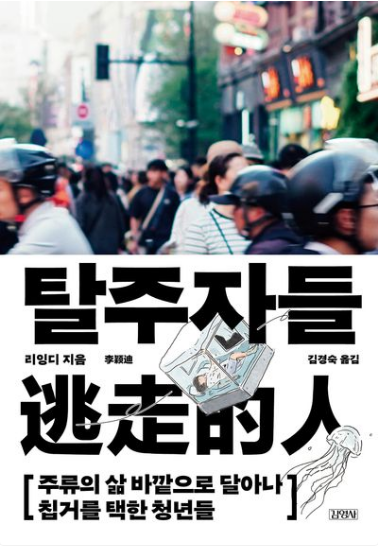
Chinese nonfiction writer Li Yingdi's 'The Fugitives'
Shines a light on the 'tang ping' generation that emerged around 2019
Author: peripheral small cities offer escape, but not a real alternative
![[Generated by ChatGPT]](https://wimg.heraldcorp.com/news/cms/2026/10/01/news-p.v1.20260930.8f13b8c24efa42ebb6d04d307a76584b_P1.png)
Lin Wen (29, a pseudonym) lives alone with two cats in Hegang, Heilongjiang Province. She moved there from Changzhou, Jiangsu Province — Hegang sits almost at Russia's doorstep — because she had grown worn out by the hamster-wheel pace of life in a major city. A lifetime of wages would never be enough to buy a home; the cost of living was crushing; and the life her elders called "normal" had stripped her of any hope for the future. So she came to Hegang, where rent and living costs are low, and shut herself inside.
Young people like Lin Wen — known in China as "tang ping" ("lying flat") — are emerging as a serious social concern. The term refers to young people who relocate to low-cost provincial cities such as Hegang, Hebi and Huainan, cut off contact with the outside world and get by on the bare minimum. Left behind by China's economic boom, these urban youth have grown worn down by skyrocketing housing prices, soaring monthly rents and high living costs in major cities. They migrate to peripheral small towns where an entire home can be had for the price of a car, and spend their days watching television or playing video games in a state of listless withdrawal.
Li Yingdi, a Chinese nonfiction writer and former journalist, turns her lens on these young people in her new book "The Fugitives" — a portrait of those who have abandoned mainstream life in search of a place they can call their own. Li focused on "Yinju Ba," a community on the Chinese web portal Baidu where burned-out urban youth gather, and spent three years visiting five peripheral small cities where members of the community had settled, reporting from the ground. In 2022, she traveled to Hegang — on the Russian border — and lived alongside those who had retreated there.
According to Li, the young people who have left China's major cities relocate to provincial towns where they have no ties but where a home can be bought for 20,000 to 30,000 yuan ($2,980 to $4,470) and live in near-total isolation, forgoing social lives and romantic relationships to satisfy only the most basic needs. Some who plan to stay long-term earn a minimal income through online channels: playing video games for hire, running delivery-only ghost kitchens, or making small share investments.
They do maintain some contact — chatting in group messaging rooms on Yinju Ba or gathering for the occasional simple meal. But the bonds within these groups are loose, even faint. Jokes like "let's make sure none of us dies alone and unknown" circulate freely, yet no one makes any real effort toward deeper connection. Li describes them as "fugitives" — people who have fled not only the big city but also the traditional web of human relationships.
Tracing their lives, Li identifies their hypersensitivity, fragility and sense of being at odds with the world. The desire to escape the life their parents expect of them, the wounds inflicted by clashes with those parents over life choices, the anguish of young people who refuse to follow a predetermined path — all of it ultimately drove them to choose withdrawal. Li argues this is not the deviance of a particular social class but a gesture of refusal by young people who reject the way of life the social system demands of them.
Did the places these young people fled to actually become the refuge they were looking for? Li recounts the suicide of Wang Li, who had settled in Hegang, and concludes that even there, "nothing could replace the connection and communication between people." Yet she still addresses those who found the courage to resist the world's pace and seek a different path: "I hope you find a living room and a space of your own."
If you're thinking about self-harm or suicide, dial the Suicide Prevention Hotline at 109, available 24 hours a day, seven days a week. Please request a translator for English-language services.
"The Fugitives" / Written by Li Yingdi / Translated by Kim Gyeong-suk / Gimm-Young Publishers
carrier@heraldcorp.com