'A meaningful achievement that protected national interests through intense negotiations'
Concerns within ruling camp over stranded-asset and legal risks
Rebuilding Korea Party: 'Talks collapsed two weeks ago; LNG has least commercial value'
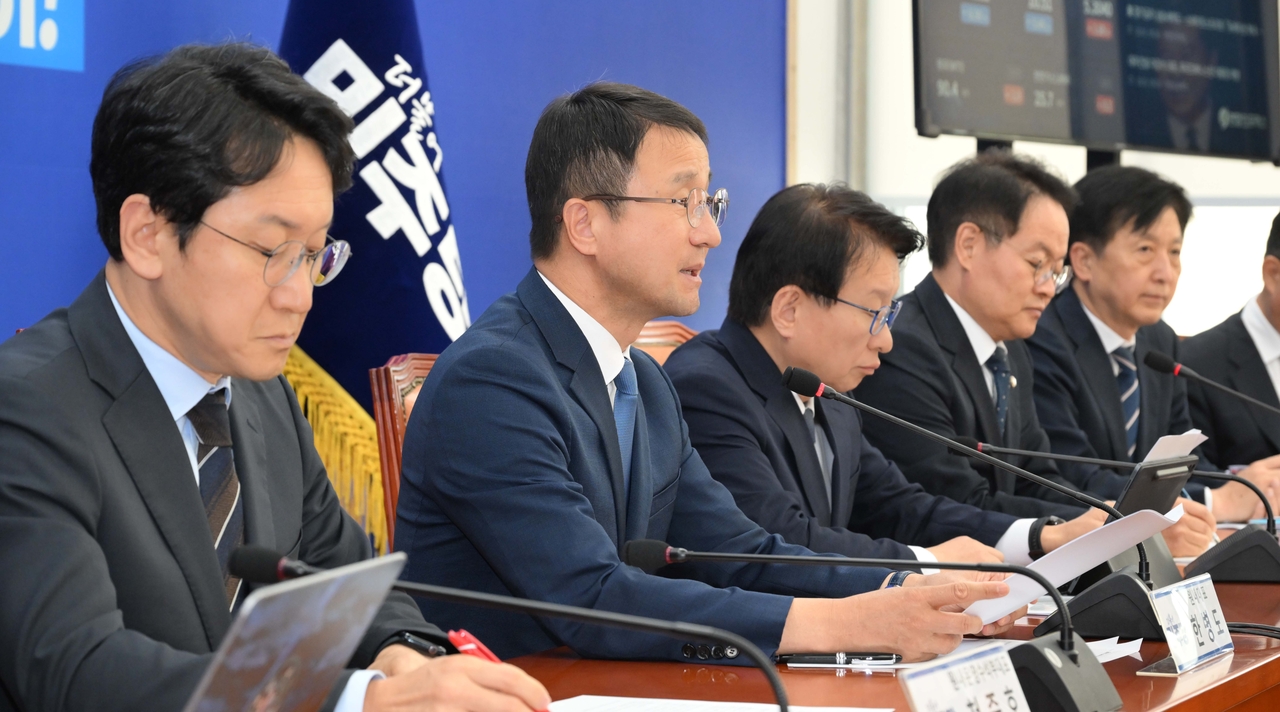
With South Korea and the United States showing subtle differences over the Alaska liquefied natural gas development project — one of the strategic investment initiatives targeting the US market — the Democratic Party of Korea offered a measured response Thursday, saying the matter had been agreed upon for "continued review going forward."
Democratic Party policy chief Kwon Chil-seung, speaking at a party policy coordination meeting at the National Assembly on Thursday, described the strategic investment package officially announced that day by US President Donald Trump as "a meaningful achievement that protected national interests on the basis of commercial rationality, reached through intense negotiations between the two countries amid continued US trade pressure and uncertainty in the global trade environment."
On the Texas gas combined-cycle power project and nuclear power plant construction, Kwon said he expected "principal and interest to be recoverable within 20 years" and that the projects would "help broaden the foundation for entering global markets, building on business experience gained in the US market." He made no additional remarks on the Alaska LNG development project.
A subtle gap between the two sides has emerged as Trump officially confirmed the Alaska LNG development project — designated only at the level of "commencing review" on the Korean side — as a confirmed investment target.
Kwon urged the government to "produce tangible results through the seamless implementation of the first-priority project, while consistently upholding the principles of commercial rationality and national interest in negotiations over follow-on projects." He added that "the safeguards agreed upon between the two countries must be managed so that they function faithfully throughout the actual project implementation process."
He went on to say that "the National Assembly will also continuously monitor whether the strategic investment in the United States is being pursued in accordance with the principles and procedures set out in the original agreement and the special act."
Rep. Oh Ki-hyung of the Democratic Party, who leads his party's side on the National Assembly's Finance and Economic Planning Committee, said "commercial rationality is the standard by which US-bound investment should be judged." In a Facebook post Thursday, Oh wrote that "the US government must also propose a project structure with commercial viability, and our government must present the basis for its judgment on commercial rationality," adding that "the National Assembly will review and assess projects based on whether they meet that standard."
Concerns about the commercial viability of the Alaska LNG project continue to be raised from within and around the ruling camp. Rep. Park Ji-hye of the Democratic Party, a member of the National Assembly's Climate, Energy, Environment and Labor Committee, said "we must also examine the possibility that it could become a stranded asset — one from which the enormous investment costs cannot be recovered — if LNG demand declines faster than expected."
In a Facebook post Thursday, Park wrote that "given long-term global and Asian LNG demand outlooks, we must carefully assess whether the commercial viability of infrastructure set to operate for more than 30 years can be adequately secured," adding that "the legal and political risks are also significant, as the debate surrounding this project has continued even within the United States."
Rebuilding Korea Party floor leader Kim Jun-hyung also appeared on KBS Radio Thursday, saying that "about two weeks ago, Minister of Trade, Industry and Energy Kim Jung-kwan returned from the US — at that point it was essentially a breakdown in talks," and that "of the three projects in the strategic investment package, LNG has the least value. Many US companies went in and then all pulled out."
Within and around the party, however, a note of caution is also detectable, given that the Alaska LNG project is tied to the broader strategic investment package and tariff negotiations with the United States. One official noted that "the United States made its position unmistakably clear — nearly half of Thursday's announcement was devoted to the Alaska LNG development project."
addressh@heraldcorp.com