Interview with Kim Eun-young, head of SK Intellix's Design Center
Company establishes design center this year to sharpen product and brand competitiveness
'Beyond function — robots that forge emotional bonds'
'Wellness AI home' vision links robots and home appliances
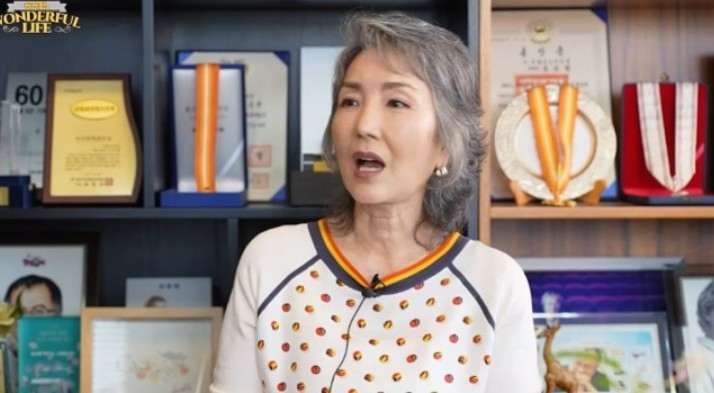
![Kim Eun-young, head of SK Intellix's Design Center, speaks in an interview. [SK Intellix]](https://wimg.heraldcorp.com/news/cms/2026/10/02/news-p.v1.20261002.f66c9321c6844a9d90e87952dc6b6045_P1.jpg)
"If a robot has soft shapes and a warm feel, you find yourself walking up to it and talking to it. It gives you the sense of another family member."
Kim Eun-young, head of SK Intellix's Design Center, made the remarks in a recent interview, sharing her vision for home AI robot design. Her goal is to build robots that go beyond performing tasks — machines capable of forming genuine emotional bonds with people.
SK Intellix established its Design Center this year and brought Kim on board to lead it. She previously handled mobile design at Samsung Electronics before moving to product design and branding roles at Motorola Mobility in the United States and other companies. She later joined Hongik University as a professor, where she continued research into design for high-tech fields including robotics.
SK Intellix rebranded from SK Magic in July last year and has since been pushing to transform itself from a home-appliance company into an AI-based wellness platform. The design overhaul aims to sharpen competitiveness not only in the look of its existing environmental appliances but across the entire user experience — from the moment a consumer sees a product to the moment they finish using it — while expanding into AI and wellness.
"The mission given to the Design Center is not simply to change how products look, but to strengthen design competitiveness," Kim said. "We have to design the experience of every step — seeing the product, pressing a button, using it." She added that robots in particular demand more than surface design. "Experience design matters even more for robots. The goal is to raise overall design competitiveness."
At the heart of Kim's vision for home robots is what she calls "emotional presence" — the idea that a robot must be capable of forming an emotional relationship with people, not merely completing assigned tasks.
"Even if a robot is fully functional, if it feels scary and you don't want to go near it, it lacks emotional presence," she said. "You need a design with soft shapes and a warm feel that makes people want to keep coming closer and talking to it."
SK Intellix's wellness robot, the NAMUH X A1, embodies that philosophy. Its rounded, flowing curves evoke a traditional Korean moon jar, giving it an aesthetic that blends naturally into a home rather than reading as a mechanical device.
Beyond the A1, SK Intellix is already thinking about what it calls the "next NAMUH X." "Right now you're seeing all kinds of form factors — humanoid robots, dog- and cat-shaped ones, wheeled designs with a human silhouette," Kim said. "There's no fixed image yet of what a robot is supposed to look like, so every company is still in the research phase."
The ultimate ambition stretches well beyond a single robot. SK Intellix wants to build an "AI home" ecosystem in which robots, home appliances and the Internet of Things are all connected. "We're envisioning SK Magic products working in tandem with NAMUH X to create the home ecosystem of the future," Kim said.
The differentiating keyword SK Intellix is staking out in the robot market is "wellness." Rather than focusing solely on physical assistance — carrying objects, cleaning, doing laundry — the company wants its robots to concentrate on improving quality of life through clean water and air, health support and emotional well-being.
"We can offer not just clean water and air and a healthy life, but also mental wellness — meditation, mental care and a psychologically healthy way of living," Kim said.
The role of design itself is shifting in the AI era, Kim said. As the functions and technology packed into products grow ever more complex, the surfaces people interact with and the experience of using them must become simpler and more intuitive, not more complicated.
Those changes are already being applied to existing SK Magic products. The Design Center is reworking not just appearances but the full user experience — UX, UI, materials and color — across every stage of product use.
"A water purifier doesn't have to be something you want to hide. It can be designed like a coffee machine — something you want to put out on display," Kim said. "It's not about spending more on design. It's about that one small difference that makes the experience feel premium and emotionally resonant."
Kim said consumers will begin to feel the full impact of these changes by late next year. "We've already set the direction — not just for appearance but for every aspect of the experience design," she said. "Given the time it takes to develop products, consumers should start noticing the difference in design competitiveness by the end of next year."
boo@heraldcorp.com