None of the 354 cases detected this year resulted in a criminal referral; only 1.5% of all violations ever referred
Lawmaker Eo Gi-gu warns lax enforcement is undermining public trust in government certification
More than 5,000 cases of unauthorized use of the government's environmental label — a certification mark for eco-friendly products — have been detected since 2021, yet enforcement has remained largely toothless. Of the 354 violations caught through August this year, not a single case was referred for criminal prosecution, drawing criticism that authorities are letting offenders off with a slap on the wrist.
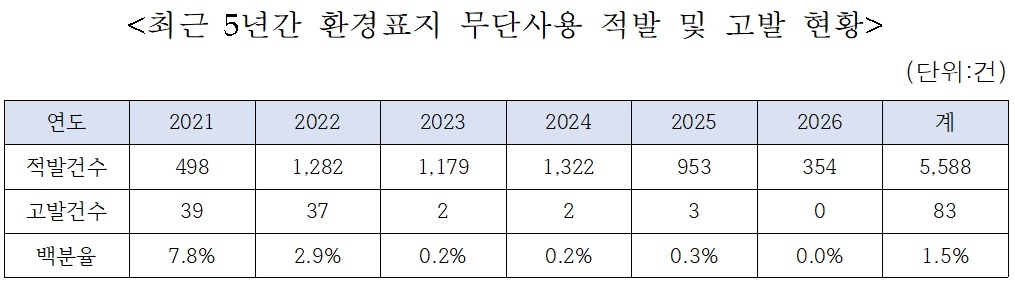
According to data submitted to Democratic Party of Korea lawmaker Eo Gi-gu of the National Assembly's climate, energy, environment and labor committee by the Ministry of Climate, Environment and Energy, a total of 5,588 cases of unauthorized environmental label use were detected between 2021 and August 2026.
Yet follow-up action after detection has consisted almost entirely of correction recommendations. Of the 5,588 cases, 5,505 — or 98.5% — resulted only in a recommendation to correct the violation, while just 83 cases, or 1.5%, were referred for criminal prosecution.
The referral rate has fallen sharply over the years. In 2021, 39 of 498 detected cases were referred, a rate of 7.8%. That figure dropped to 2.9% in 2022, fell further to 0.2% in both 2023 and 2024, and edged up only slightly to 0.3% in 2025. This year, 354 violations were detected through August with zero referrals.
The environmental label serves as a government-backed guide for consumers who cannot easily verify a product's raw materials, production process or environmental impact on their own, allowing them to choose eco-friendly products based on official certification.
With enforcement after detected violations concentrated almost entirely on correction recommendations, critics say stronger measures are needed to restore consumer confidence in the environmental label regime and make sanctions more effective.
The stakes are particularly high because certified products enjoy a range of benefits — including mandatory purchase requirements for public institutions, support for product promotion and retail distribution, and eligibility for registration as a superior product with the Public Procurement Service. This makes it all the more important to tighten oversight and follow-up action against unauthorized use, so that properly certified companies and those using the label without certification can be clearly distinguished in the market.
"The environmental label is both the standard by which consumers trust the government to choose eco-friendly products and the competitive edge of companies that have invested time and money to earn certification," Eo said. "The system must be strengthened so that violations carry consequences proportionate to the offense — ensuring consumers are not deceived and that companies that play by the rules are not the only ones who suffer."
thlee@heraldcorp.com