Lecture by Agigom, head of Agigom Economic Academy
'Watch ground-breaking data, not permit approvals'
Tailored strategies for non-owners, single-home owners and multi-home owners
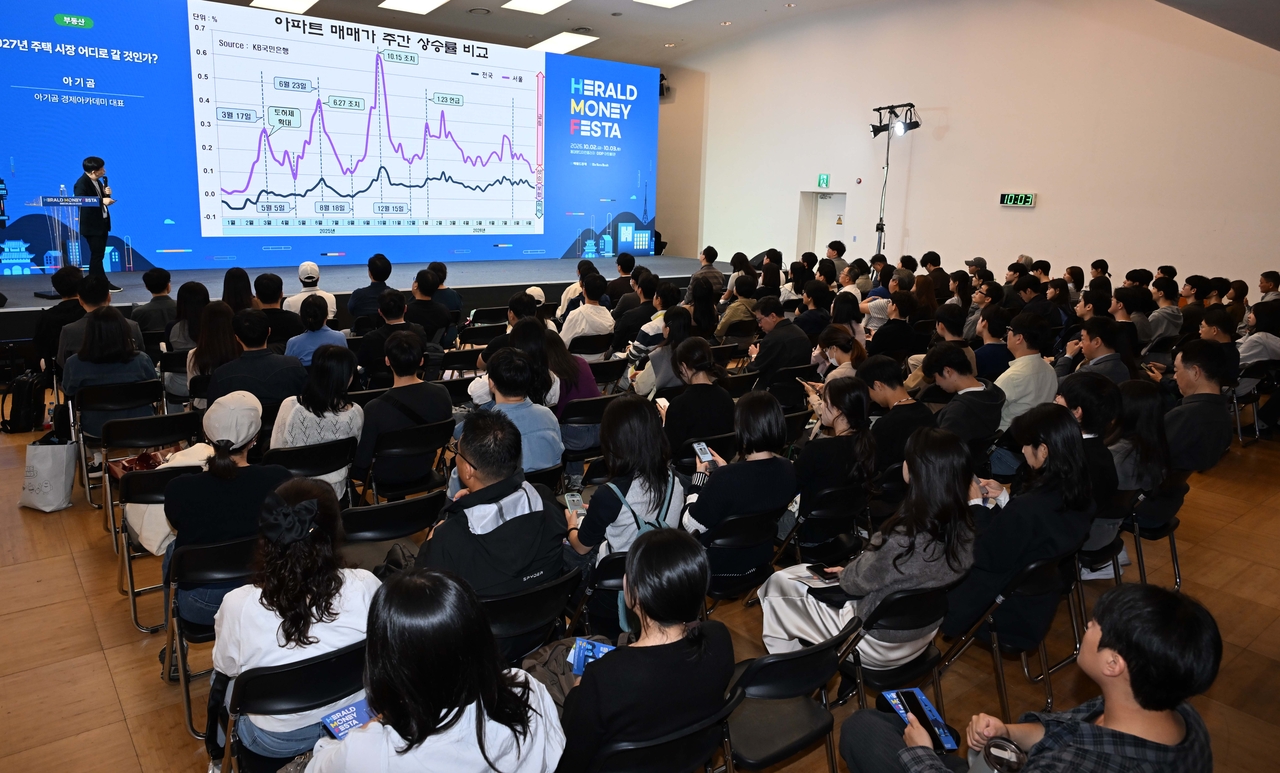
"All 27 areas designated as regulated zones saw home prices rise after the Oct. 15 measures. Even in unregulated areas, a balloon effect pushed prices in Gunpo's Sanbon district up more than 12 percent. Liquidity is set to grow even further — so how should we respond?" said Agigom, head of Agigom Economic Academy.
Agigom, one of South Korea's leading real estate columnists, forecast that housing price increases driven by a supply shortage will begin in earnest from next year. Speaking Saturday at Art Hall 1 of Dongdaemun Design Plaza (DDP) in Jung-gu, Seoul, at Herald Money Festa 2026, he delivered a lecture titled "Where is the housing market headed?" and said investors should pay close attention to ground-breaking statistics — a key supply indicator — alongside rising liquidity.
Agigom cited historical cases in which home prices rose in tandem with money supply growth, stressing the importance of holding real assets as a hedge against expanding liquidity. "From 2006 to 2025, South Korea's money supply (M2) grew at an average annual rate of 7.7 percent," he said. "Over the past decade in particular, the money supply more than doubled — meaning you had to double your assets just to keep pace. Greater Seoul apartments delivered an investment return of 225 percent over that same period."
Agigom said home prices in regulated zones had consistently risen even after the Oct. 15 measures, arguing that the government's regulatory policies had failed to stabilize prices. "Looking at cumulative sale price increases from Oct. 13 last year through Sept. 28 this year, based on KB Kookmin Bank data, Gwangmyeong topped the list at 27 percent," he said. "Even Gunpo's Sanbon district — an unregulated area — saw sale prices climb 12.4 percent due to the balloon effect."
Agigom warned that a sharp deterioration in ground-breaking activity pointed to a deepening supply cliff over the next three years. "The monthly average for apartment ground-breakings over the previous decade, from 2012 to 2021, was 33,208 units based on Ministry of Land, Infrastructure and Transport data," he said. "But ground-breakings began falling sharply from 2022, dropping to 20,123 units last year — a 39 percent decline."
"For non-apartment housing, the monthly average fell 80 percent to 2,601 units, compared with 12,763 units in the 2012–2021 period — an even steeper drop," he said. "If rising liquidity was the main driver of the 2020–2021 price surge, going forward it will be supply shortages that push prices higher."
Agigom said the gap between permit approvals and actual ground-breakings was a key reason not to take comfort in improved approval figures alone. "The 10-year average for permit approvals was 422,830 units, but ground-breakings came in at around 400,000 — a gap of nearly 6 percent," he said. "Even when approvals improve, a significant number of projects never break ground due to variables such as construction costs and interest rates. Since most of the supply for Seoul apartments comes from the private sector, permit figures alone are not enough to feel reassured."
"Money is being pumped into the market at a rapid pace right now," he added. "Employee loan programs at companies, starting with Samsung Electronics, will expand, and liquidity from the disposal of existing assets such as shares could flow into the housing market as well."
He also said investing in unregulated areas could be an option for those living outside the capital region. "Even after the Oct. 15 measures, there were notable price increases in Gyeonggi Province areas including Gunpo, Anyang's Manan-gu, Suwon's Gwonseon-gu and Bucheon's Wonmi-gu," he said, adding that gap investment was feasible in those areas even for buyers who could not move in immediately, making them worth watching.
Agigom said those without a home would face growing pressure to choose among three options: switching to buying, moving to an outlying area, or opting for monthly rent. "For single-home owners, I recommend selling the existing property and upgrading to a better location where you can actually live," he said. "Multi-home owners should sell one property a year, take advantage of the temporary two-home household tax benefit, and consolidate into one quality home."

hope@heraldcorp.com