All four back diversifying revenue through donations and commercial ventures; three of the four will advance to the final round on Wednesday
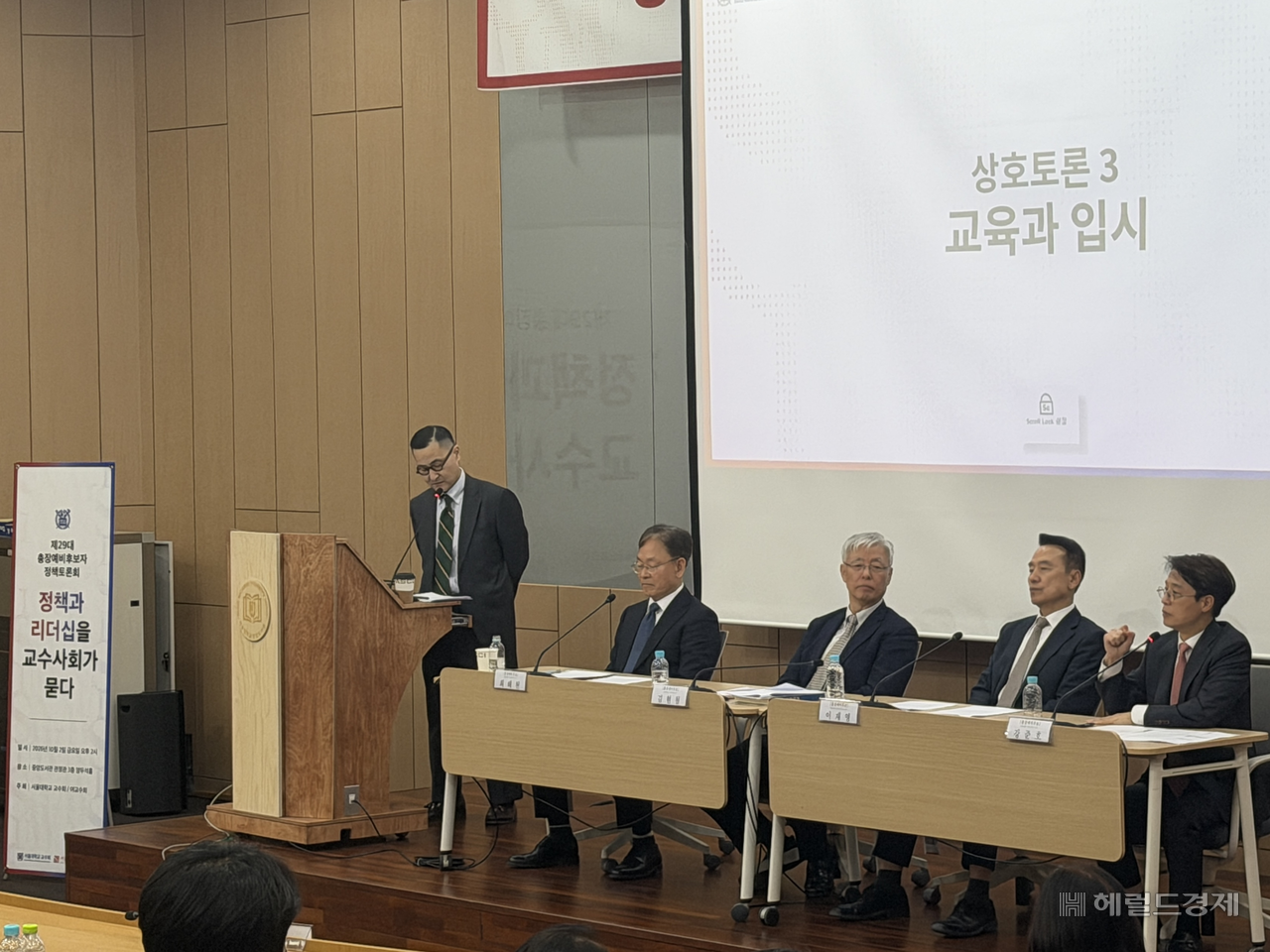
The four preliminary candidates for president of Seoul National University squared off Friday over major policy issues facing the institution.
The SNU Faculty Council and the Association of Women Faculty hosted the policy debate for the 29th university president Friday afternoon at the Gwanak Campus. The four candidates — Choi Hae-cheon, a professor at the College of Engineering; Kim Hyun-chul, a professor at the Graduate School of International Studies; Lee Jae-young, a professor at the College of Humanities; and Kang Jun-ho, a professor at the College of Education — took part in panel discussions and open exchanges on key issues.
The debate covered panel questions and candidate responses on industry-academia cooperation, strategies to strengthen the university's competitiveness and internationalization, and diversity and inclusion policy. The subsequent open exchange addressed fiscal sustainability, global talent recruitment, admissions reform and reform of the presidential selection process.
The candidates diverged on how best to expand the university's finances. Choi proposed a "Mega Frontier Partnership" that would have professors actively approach companies to secure funding, rather than waiting for government grants or donations. "It is true that we cannot compete with universities around the world by relying on government subsidies," he said, adding that the university must proactively propose collaborative projects to businesses to generate new revenue.
Kim put forward an "EFG" strategy combining restructuring of the central administration, corporate fundraising and fiscal negotiations with the government. His plan calls for the administration to generate internal funds and attract outside capital, then distribute the proceeds to individual colleges to give them greater autonomy. "Centralized control by the administration can no longer continue," he said. "We need to shift to a system of autonomous management at the college level."
Lee said he would recruit a private-sector chief financial officer and establish a committee to build up the university's asset base. "I believe finance must be handled by experts," he said. "We need to create a fiscal structure that we have not been able to build until now."
Kang said the university's biggest financial problem is that its strategy has not changed since its incorporation as a legal entity. "We have not benefited at all from incorporation and remain dependent on government subsidies and development funds," he said. He proposed generating revenue through commercial ventures using university-owned assets and issuing bonds as alternatives.
Candidates split on pledge accountability, presidential selection
The debate also turned contentious over accountability for campaign pledges. Kim challenged the other candidates to sign a written oath committing to cover any fundraising shortfall out of their own pocket, arguing that pledges must be enforceable. "Without such an oath or a system of accountability management with regular annual performance reports, pledges will not be kept," he said.
Kang pushed back, saying a written oath would prevent candidates from making ambitious commitments. His argument was that a binding mechanism could discourage the kind of bold goal-setting needed for long-term change at the university.
All four candidates agreed that the presidential selection process needs reform, but differed on how. Choi proposed that the university community first establish a long-term vision spanning more than 10 years, then recommend candidates capable of realizing it. Kim said campaign organizations tend to fuel disputes over administrative appointments and internal conflict after a president takes office. "The harm of dividing up positions after becoming president keeps repeating itself, so campaign organizations must be abolished," he said.
Lee said he would form an improvement committee to pursue a redesign of the system, while Kang called for assembling a TF to produce a reform plan within one year. "If it is not done within a year, it will be difficult to accomplish in the latter half of the term," Kang said, stressing that reform efforts must begin from the very start of the new president's tenure.
Meanwhile, on Wednesday a policy evaluation panel composed of SNU faculty, staff and students will select three of the four candidates as finalists. The SNU Presidential Recommendation Committee is scheduled to announce the results officially on Oct. 14.
The committee will then recommend the three finalists to the SNU Board of Trustees, which will select one by vote. The final candidate will be appointed by the president of South Korea upon the recommendation of the education minister.
newday@heraldcorp.com