Mayor outlines vision at 100-day press briefing
City aims to become hub for work, residence and leisure
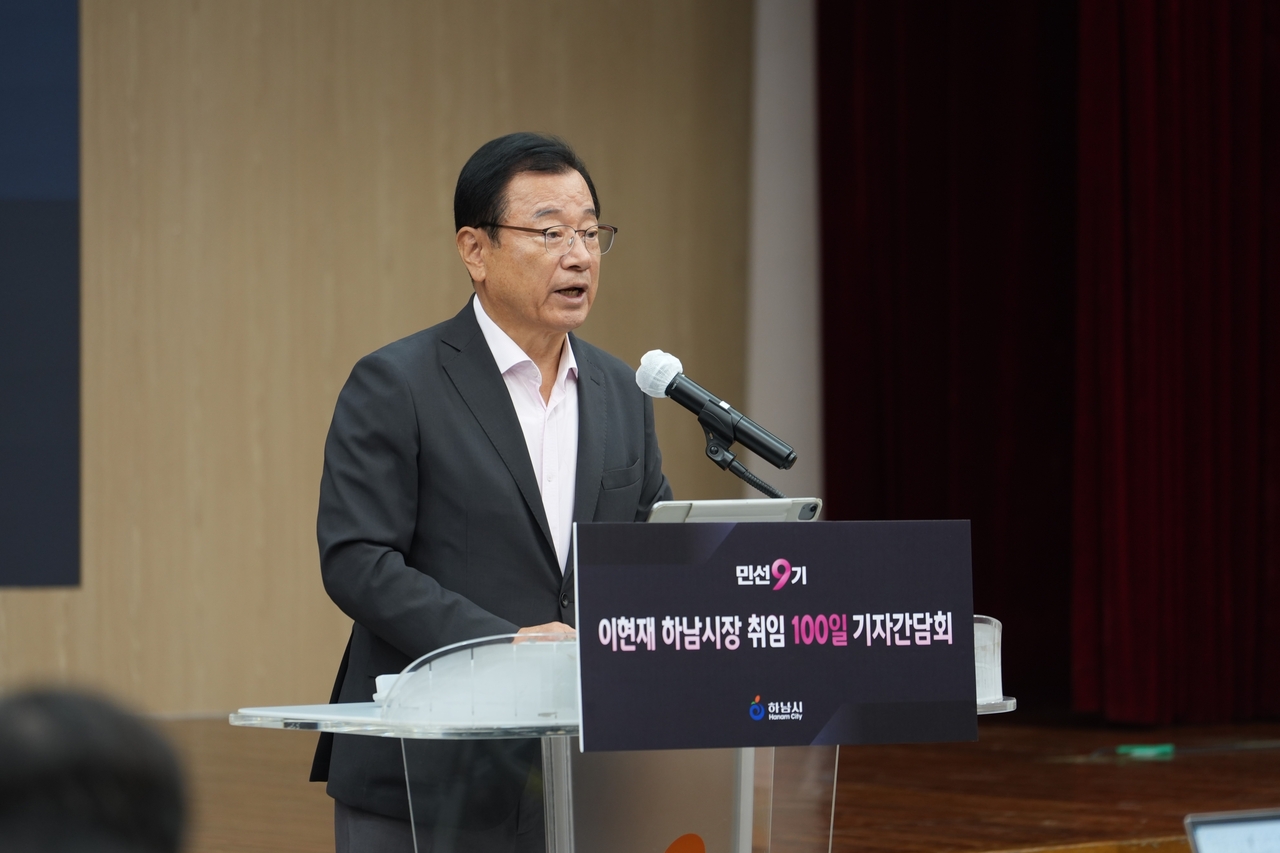
Hanam is marking 100 days since the launch of its ninth elected administration by placing businesses and jobs at the center of its governance agenda for the next four years, with a plan to attract 10 trillion won ($7.36 billion) in investment by 2030. The city intends to draw investment through a K-Culture complex, a K-Han River national garden and advanced-industry mixed-use development, then channel the resulting economic activity — corporate operations, employment, local consumption and tax revenue — into transforming Hanam into what Mayor Lee Hyun-jae calls a "work-live-play" city.
Lee laid out the administration's direction at a press briefing held Tuesday at Hanam City Hall, describing the first 100 days as a period of "everyday governance that changed residents' daily lives and brought the city closer to its citizens," and pledging to carry that momentum into four years of strengthening the city's competitiveness.
While the previous four years under the eighth elected administration focused on laying the groundwork for urban growth — transportation, education, welfare and the economy — the first 100 days of the ninth term concentrated on translating campaign pledges into concrete action, Lee said.
'Jobs are the next stage of urban growth' — 10 trillion won investment target by 2030
The most prominent challenge Lee raised at Tuesday's briefing was improving economic strength through businesses and employment. The city's per-capita gross regional domestic product stood at 28.04 million won as of 2023, ranking 24th in Gyeonggi Province and roughly one-sixth the level of Seoul's Gangnam-gu, which recorded 180 million won. Corporate local income tax — a gauge of the tax base generated by business activity — came to 33 billion won in 2025, about one-ninth the figure posted by Icheon, which recorded 303.1 billion won.
The city's assessment is that while rapid population growth has steadily driven up demand for transportation, education, welfare and everyday infrastructure, the industrial and tax base needed to support that demand remains comparatively weak.
Lee proposed attracting businesses and expanding quality employment as the solution. Simply cutting spending to manage finances has its limits, he said; the goal is to build an economic structure in which bringing in companies creates jobs and simultaneously grows local production, consumption and the tax base.
During the eighth elected term, Hanam secured 13 companies — including Sungwon Adpia — laying the groundwork for around 1 trillion won in investment and roughly 2,500 jobs. The ninth term sets a far more ambitious target: 10 trillion won in investment by 2030.
In advanced industries, the city plans to develop an AI innovation cluster worth around 3 trillion won on the self-sufficient land of the Gyosan new town, with Postech, Carnegie Mellon University, the National University of Singapore and KT Corp's cloud unit among the expected participants. Camp Colburn is also to be developed as a mixed-use economic hub with shopping, cultural, retail and office functions, with completion targeted for 2032.
K-Culture complex and national garden pursued simultaneously — culture and tourism as 'job industries'
Among the investment and job-creation initiatives under the 10 trillion won target, Lee said he is placing particular emphasis on the simultaneous pursuit of the K-Culture complex and the K-Han River national garden. Shortly after taking office, Lee made organizing a K-Culture city task force his first official act. The public-private task force, which discusses the direction of the K-Star World and national garden projects, officially launched in July.
That same month, at a Gyeonggi Province governor-and-mayors meeting, Lee proposed a dual-development plan for the Misa Island area: roughly 70 percent would become the K-Han River national garden and the remaining 30 percent the K-Culture complex. The national garden would feature themed gardens and trails making use of the Han River waterfront ecology, while the K-Culture complex would host a K-pop performance venue, film production studios and a cluster of culture and media companies.
Behind the city's push to pursue both projects simultaneously is the ambition to transform culture and tourism from amenities for residents' leisure into industries that drive the local economy. The plan is to attract performance and content companies along with production capabilities to create permanent jobs, and to draw concertgoers and tourists to the garden and Han River waterfront at the same time, extending their length of stay.
The city believes that linking accommodation, dining and shopping to those visits could generate new economic returns from the culture and tourism sector. Plans also call for connecting nearby assets — a five-star hotel in Mangwol-dong and a musical fountain and water screen at Misa Lake Park — to build a stay-and-spend tourism economy.
Interest from overseas private investors is also tied to the investment attraction strategy. Eric Trump, executive vice president of the Trump Organization and the second son of US President Donald Trump, visited Hanam twice in February to tour potential development sites. In August, Base Group announced it would pursue a project with the Trump Organization to build a Trump International Golf Club in Hanam, and the city said it welcomed the initiative.
First 100 days focused on 'everyday governance' — 13 key campaign pledges advanced
While the medium- and long-term growth strategy centers on jobs and urban competitiveness, the first 100 days of the ninth term prioritized everyday tasks that residents could see making a difference in their daily lives.
The ninth-term campaign pledges are organized around five areas: economy and culture, housing and urban development, transportation, education, and welfare. The city said it has implemented or moved into full execution 13 key pledges within the first 100 days of taking office.
A flagship project is the Gyosan school complex facility. The facility, to be built on the site designated for Namhan Middle School in the Gyosan new town, was selected in August through a Ministry of Education competition. With a total floor area of 8,789 square meters and a total project cost of about 48.1 billion won, it will include an indoor swimming pool, childcare facilities, a community culture center and a multipurpose gymnasium, with completion targeted for 2030. It is designed to serve as an education, childcare, culture and sports hub shared by students and local residents. On the childcare front, the city opened a community childcare center and a public kids' cafe inside the Wirye sports complex, and consolidated childcare services for infants, children and elementary school students — previously spread across multiple departments — under the childcare policy division.
The city has also drawn up a plan to expand free influenza vaccinations to all age groups in stages, starting this year with residents aged 60 to 64. Additional first-100-day achievements include an 18-hole park golf course at Dangjeong neighborhood park, expansion of everyday sports infrastructure in Gamil, installation of smart shelters across different districts, noise reduction measures at the Wirye combined heat and power plant, expansion of city gas supply in Gambuk-dong, creation and maintenance of eco-friendly forest trails, installation of odor-reduction devices in the sewer system, and water bill discounts for multi-child households.
Transportation, education and welfare — filling in the rest of the 'work-live-play' puzzle
Lee said that completing the work-live-play city vision requires a strong residential and living environment every bit as much as jobs. The ninth-term strategy is to connect the "work" of employment, the "live" of convenient daily life, and the "play" of leisure in nature and culture — all within a single city.
On transportation, the city is pushing to expand its metropolitan rail network, including early completion of the subway Line 9 extension between Gangil and Misa, on-schedule opening of Line 3, extension of the Wirye-Sinsa line into Hanam, and inclusion of GTX-D stops at Hwangsan and Gyosan in the national rail network plan.
On education, the city is pursuing the establishment of a Hanam education support office. A temporary office has been set up on the sixth floor of the Hanam comprehensive welfare complex, and the city plans to expand age-specific education infrastructure — including a children's English library in 2026 and a children's center in 2027 — while strengthening tailored education support programs.
On welfare, the city will strengthen lifecycle support spanning childbirth and childcare through to youth and senior citizens. Plans call for connecting childcare services from birth through elementary school into a single system, and for gradually expanding youth transportation subsidies, coming-of-age grants, senior transportation subsidies and veterans' honorary allowances.
Improving living conditions by neighborhood is also part of the plan. In the original downtown area, the city will extend underground utility cabling — following the first phase around Sinjang traditional market — to the areas around Namhan High School, Dongbu Elementary School, Deokpung Market and Namhan Middle School, while also strengthening administrative support for redevelopment, reconstruction and local housing cooperative projects.
Gamil will see reinforced transportation, welfare, cultural and safety infrastructure, including on-schedule opening of subway Line 3, construction of a comprehensive welfare complex and museum, and the addition of a police substation; a riverside trail will also be extended in stages from Neungan Stream and Beolmal Stream through to Gami Stream and Seongnae Stream. Wirye will expand everyday infrastructure — a sports complex, childcare facilities and a forest library — while pursuing the Wirye-Sinsa line extension into Hanam and building an integrated transfer system linking the Wirye tram with community buses and public bicycles. Misa is to be developed as an economic hub connecting culture, tourism, accommodation and consumption, while Gyosan will be equipped with an AI innovation cluster worth around 3 trillion won, quality corporate tenants, and transportation infrastructure including subway Line 3 and arterial roads — all timed to coincide with the area's move-in schedule.
'Turning the first 100 days of execution into four years of urban competitiveness'
The vision Lee presented at Tuesday's 100-day briefing ultimately converges on a single logic: attract businesses and investment to create quality jobs, ensure that the resulting local production and consumption contribute to a broader tax base, and then reinvest those returns into improvements in transportation, education, welfare, culture and the living environment.
The "work-live-play city" is the shorthand for this ninth-term strategy — building a city where residents have jobs, live comfortably and can enjoy culture and leisure, so that their daily lives and economic activity can be sustained fully within Hanam.
"I will build on the execution of the first 100 days to sustain urban competitiveness over the next four years, and increase the number of businesses and quality jobs," Lee said. "I will also continue to improve transportation and the educational environment, and create a living environment where residents can enjoy health and leisure in nature."
pjh@heraldcorp.com