Upper-process facility completed; Argentina lithium capacity reaches 48,000 tons
MOUs signed for plants 3 and 4; 100,000-ton goal set for 2033
Lithium carbonate output expanded to target ESS and LFP battery markets
Argentina's presidential chief of staff attends; 5,000 jobs highlighted
A decade of commitment by Chang In-hwa bears fruit in South America
Chang: Posco to become Korea's leading resource-development company
![Officials from Posco Group and the Argentine federal and provincial governments take part in a completion ceremony for the second lithium plant of Posco Argentina's Sal de Oro Project, near the Hombre Muerto salt flat in Argentina, on Tuesday (local time). [Provided by the Argentine government]](https://wimg.heraldcorp.com/news/cms/2026/10/07/news-p.v1.20261007.63e41a48a42a44759a4928dfee29fce5_P1.jpg)
Posco Group Chairman Chang In-hwa has fired the starting gun on an expansion of the company's lithium business in Argentina, one of the world's most contested battlegrounds for critical minerals. Posco Holdings completed the upper-process facility of its second brine lithium plant and formally announced a target of 100,000 tons of annual production capacity by 2033. With demand spreading from electric vehicles to AI data centers, energy storage systems and lithium iron phosphate batteries, Chang is personally overseeing the South American lithium hub as the group accelerates its "resource patriotism" strategy.
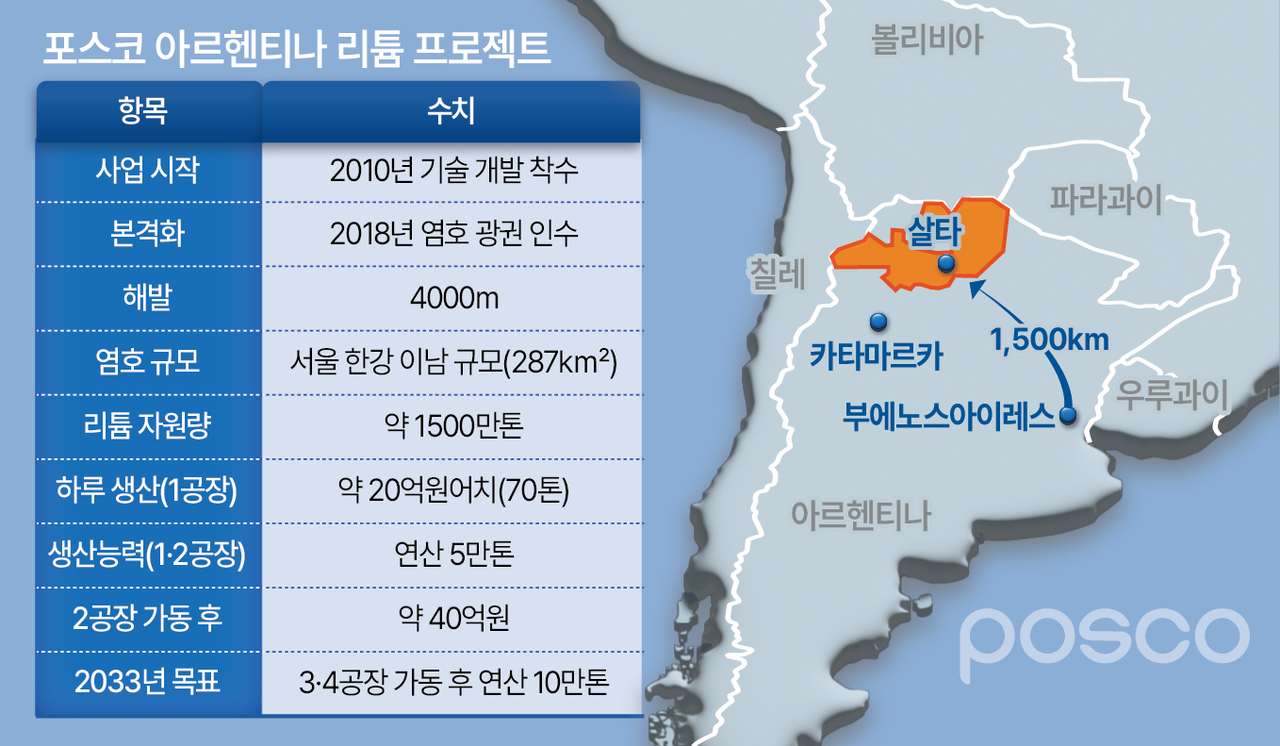
Posco Holdings held a completion ceremony for the upper-process facility of its second brine lithium plant on Tuesday (local time) near the Hombre Muerto salt flat in Argentina. Situated at an altitude of 4,000 meters above sea level, the plant is the second commercial production base Posco has secured since acquiring local salt flat mining rights in 2018 — eight years in the making.
The ceremony was attended by Chang and Park Hyun, head of Posco Argentina, along with Karina Milei, chief of staff of the Argentine presidential office; Diego Santilli, federal cabinet chief; Gustavo Sáenz, governor of Salta Province; Raúl Jalil, governor of Catamarca Province; and Lee Jong-hwa, South Korea's ambassador to Argentina. The Argentine presidential office also announced the completion through its official channels, lending further weight to Posco's lithium project.
![Officials from Posco Group and the Argentine federal and provincial governments hold a commemorative event at the completion ceremony for the second lithium plant of Posco Argentina's Sal de Oro Project, near the Hombre Muerto salt flat in Argentina, on Tuesday (local time). [Captured from the Argentine presidential office's X account]](https://wimg.heraldcorp.com/news/cms/2026/10/07/news-p.v1.20261007.c169b4abcf9c4f2a9288139440e9ccc7_P1.gif)
Over a decade in the making: Chang's 'resource patriotism' vision bears fruit
At the ceremony, Chang said the completion marked a step closer to Posco Group becoming South Korea's leading resource-development company. "Going forward, we will proactively secure competitive resources, translate them into production and profit, and stably supply the critical minerals that the national industry needs," he said.
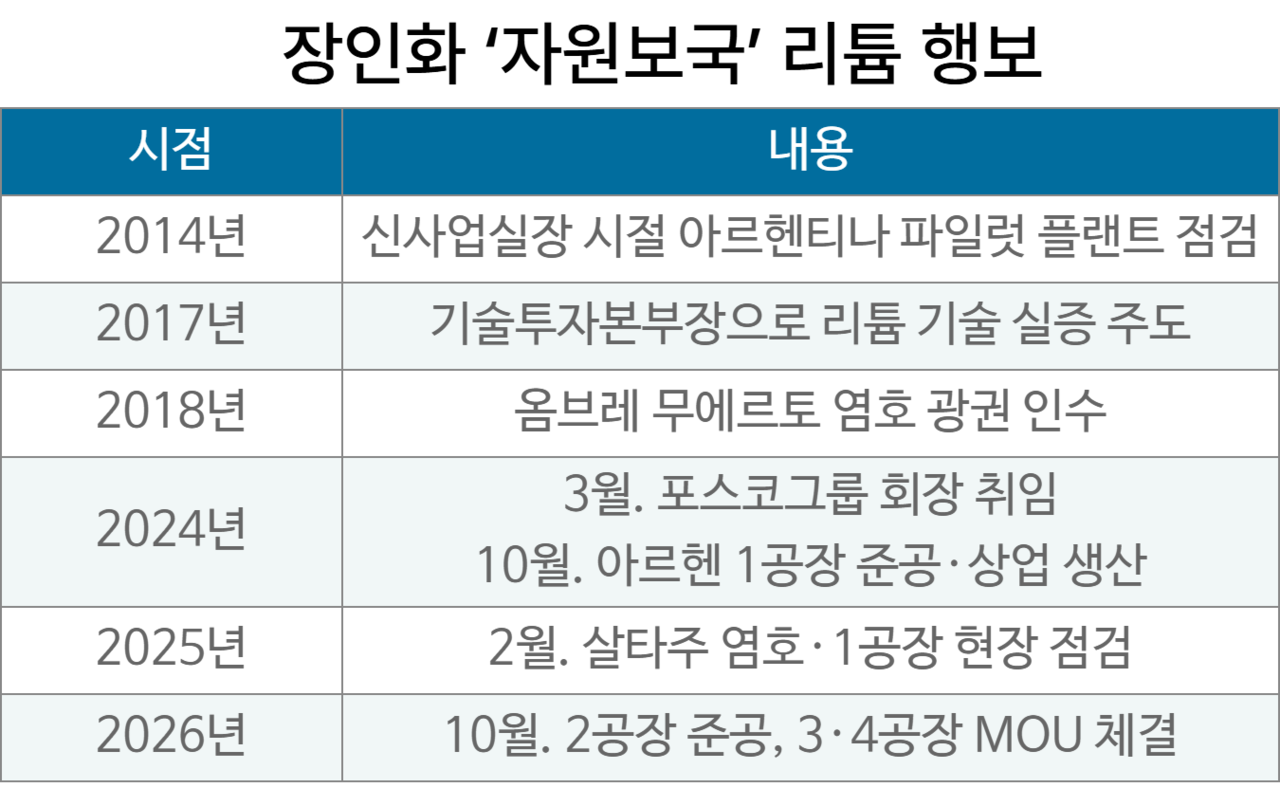
The completion also represents the tangible payoff of a vision Chang has pursued for more than a decade. In 2014, while serving as head of the new business division, he personally visited a pilot plant in the highlands of Jujuy Province, Argentina, to assess the commercial viability of Posco's proprietary lithium extraction technology. He subsequently played a role in identifying the optimal salt flat, laying the groundwork for Posco's lithium business.
![Posco Group Chairman Chang In-hwa inspects operations at the Hombre Muerto salt flat lithium pond in Argentina in February last year. [Provided by Posco Holdings]](https://wimg.heraldcorp.com/news/cms/2026/10/07/news-p.v1.20260824.8b6e3f5e61a44b9d8fa289f57bf0c18c_P1.jpg)
Chang's hands-on approach continued after he became chairman. In February last year, he visited the lithium salt flat and the first plant in Salta Province to review operations and the progress of the second plant's construction. During this latest visit, he went beyond attending the ceremony, reviewing key production facilities, plans for plants 3 and 4, and outstanding cooperation tasks with local authorities.
Chang's engagement reflects Posco Group's broader future strategy. The group is building lithium and other strategic resources into a core growth engine to succeed steel. The "Triple Core" strategy he has championed designates industrial resources, strategic resources and energy resources as the group's three pillars for future business. Posco aims to strengthen the value chain running from resource acquisition through development, production and profit generation — positioning itself as South Korea's leading resource-development company and contributing to the stabilization of the country's critical mineral supply chain.
Lithium hydroxide and carbonate on two tracks; 100,000-ton capacity targeted by 2033
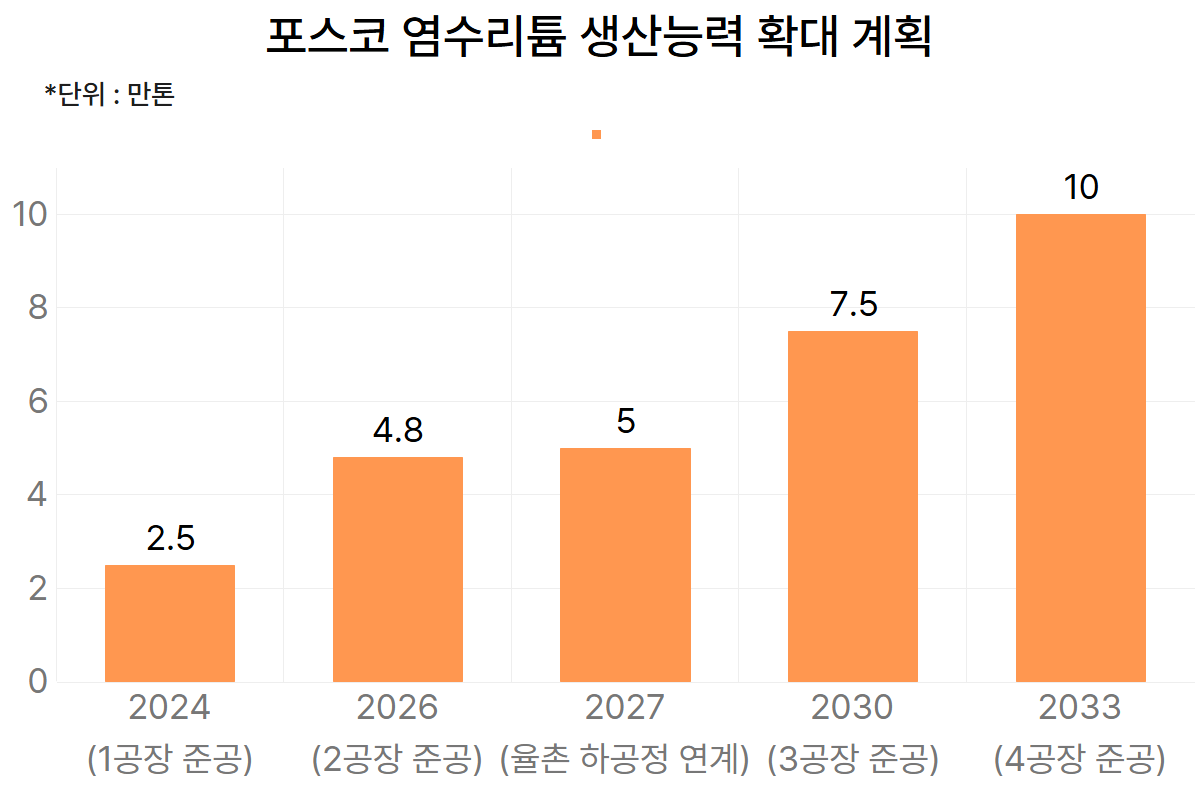
The completion significantly expands Posco's lithium production capacity in Argentina. The second plant's upper-process facility, which required a total investment of $954 million, has an annual production capacity of 23,000 tons of lithium carbonate. Combined with the first plant's existing annual capacity of 25,000 tons of lithium hydroxide, Posco now has a production base of 48,000 tons of lithium products per year in Argentina alone.
The lithium carbonate produced at the second plant will feed into a lower-process facility scheduled for completion next year at the Yulchon Industrial Complex in South Jeolla Province. Posco plans to convert the carbonate into battery-grade lithium hydroxide there, completing a brine-based lithium hydroxide production system with an annual capacity of 50,000 tons. The structure links raw materials secured in Argentina to a refining process in South Korea, strengthening the domestic secondary battery materials supply chain.
Lithium is well known as a key raw material for electric vehicle batteries, but its strategic value has grown further as the spread of AI data centers drives rising demand for ESS batteries. The lithium carbonate market is also drawing renewed attention as the cost-competitive LFP battery segment expands — the backdrop to Posco's push to scale up carbonate production through additional investment.
Posco Argentina also signed MOUs with the governments of Salta and Catamarca provinces on Tuesday for the development of plants 3 and 4. Both provincial governments agreed to cooperate on administrative support and permitting required to advance the projects.
Plants 3 and 4 are each planned to have an annual lithium carbonate production capacity of 25,000 tons. If investment proceeds as planned, Posco will secure 100,000 tons of annual brine lithium production capacity in Argentina alone by 2033. The company intends to build a portfolio producing both lithium hydroxide and lithium carbonate, enabling flexible responses to shifts in the electric vehicle, ESS and LFP battery markets.
![Park Hyun, head of Posco Argentina, Salta Governor Gustavo Sáenz and Catamarca Governor Raúl Jalil pose for a photo after signing an MOU for the development of plants 3 and 4 at the Sal de Oro Project expansion signing ceremony near the Hombre Muerto salt flat in Argentina on Tuesday (local time). [Provided by the Argentine government]](https://wimg.heraldcorp.com/news/cms/2026/10/07/news-p.v1.20261007.4711b19bc50745a7b0d9b65f4f3ef6f4_P1.jpg)
Argentina takes note of Posco's investment
Posco's lithium business is now bearing fruit after years of preemptive investment. Posco Group recognized lithium's growth potential in 2010 and began developing its own extraction technology. It acquired the Hombre Muerto salt flat in Argentina in 2018, completed the first plant in 2024 to begin commercial production, and has now significantly expanded its production base with the completion of the second plant.
Policy and financial support have also bolstered the business expansion. Posco Argentina became the first Korean company to receive approval under RIGI, Argentina's large-scale investment incentive regime, in July, securing benefits including corporate tax reductions and tariff exemptions. In August, the US International Development Finance Corporation approved a $700 million short-term credit facility for Posco Argentina, establishing a funding base for operating capital.
![A congratulatory post on the completion of the second lithium plant of Posco Argentina's Sal de Oro Project, shared on the Argentine presidential office's official X account. The presidential office celebrated Posco's investment and job creation, conveying the message that "those who invest are the ones who create jobs." [Captured from the Argentine presidential office's X account]](https://wimg.heraldcorp.com/news/cms/2026/10/07/news-p.v1.20261007.78d4ffa514d14157b2bb168b9130f544_P1.jpg)
The Argentine government highlighted the project as a national industrial investment success. The presidential office shared footage of the ceremony on its official X account, noting that "the Posco project has created more than 5,000 jobs, is working with more than 270 local partner companies, and is running education and development programs for local communities." Posco Argentina's direct workforce has also surpassed 600 employees, and the company provides vocational training to local youth in areas including maintenance, instrumentation, safety and environmental management through a technical education center.
Presidential Chief of Staff Karina Milei conveyed President Javier Milei's gratitude at the ceremony, thanking Posco for its continued trust in Argentina. "This investment will lead to more production, more jobs and new opportunities for the region," she said.
![An aerial view of the Posco Argentina lithium pond at the Hombre Muerto salt flat in Argentina. The upper-process facility concentrates lithium by naturally evaporating brine. [Provided by Posco Holdings]](https://wimg.heraldcorp.com/news/cms/2026/10/07/news-p.v1.20260824.5d29851199cd46b9b787749b66f3a205_P1.jpg)
kwater@heraldcorp.com