Eight of 10 labor suppliers operated without a license; 162 million won in unpaid wages found
Ministry to accept reports through year-end; other industrial complexes to face additional inspections
Labor supply firms that illegally dispatched 136 workers to manufacturing production lines at an industrial complex in Ansan have been caught in a government crackdown. Authorities ordered eight manufacturers that used the workers to hire them directly and launched a criminal investigation into the illegal dispatch suppliers.
The Ministry of Employment and Labor said Wednesday it had conducted labor inspections over roughly three months beginning June 22 at labor supply firms near the Ansan industrial complex, uncovering 67 violations of labor law — including illegal dispatch — across 18 of the 19 workplaces examined.
The probe was triggered by complaints that businesses illegally supplying workers had become rampant near the Ansan complex. It initially targeted four unlicensed labor suppliers and two manufacturers, but expanded during the investigation to cover 10 labor suppliers and nine manufacturers.
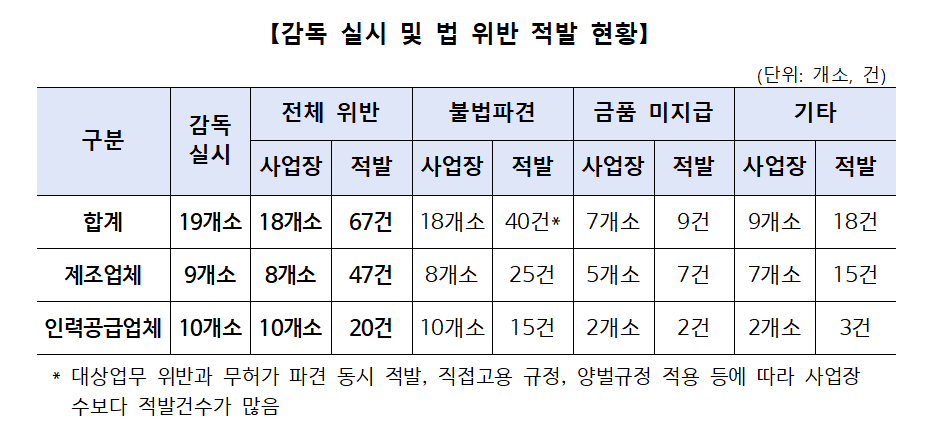
The inspections found that 10 labor supply firms had illegally dispatched 136 workers to the direct production lines of eight manufacturers. Worker dispatch to direct manufacturing production processes is generally prohibited unless there are exceptional circumstances, such as a sudden surge in orders. Eight of the 10 labor suppliers caught had not even obtained a license to operate a worker dispatch business.
The ministry immediately referred the unlicensed suppliers for criminal investigation and ordered the eight manufacturers that used the dispatched workers to directly hire all 136 of them.
Beyond the illegal dispatch violations, inspectors found 27 additional labor law breaches — including 162 million won ($119,000) in unpaid wages such as annual leave allowances and violations of overtime limits — and ordered them corrected. Of the 67 total violations, 40 were related to illegal dispatch.
To assess the situation at other industrial complexes, the ministry will run a focused reporting period for illegal labor supply firms from Thursday through Dec. 31. Anonymous tips can be submitted through the labor consultation and reporting center on the ministry's online portal, and additional inspections will follow based on the reports received.
The ministry also plans to address the underlying employment structure at industrial complexes, including chronic labor shortages and heavy reliance on outside workers. It will survey labor usage conditions at major complexes and work with regional labor-management-civil society councils and organizations supporting non-regular workers.
Seo Myeong-seok, the ministry's director of labor standards policy, said the crackdown would not stop at prime contractors and subcontractors. "Labor suppliers are not outside the reach of enforcement," he said. "We will continue to strengthen action against illegal labor suppliers while actively supporting improvements to the employment structure in industrial complex areas, so we can root out the chronic problem of illegal dispatch."
fact0514@heraldcorp.com