Special bill to follow farmland survey; minister calls for overhaul of 30-year-old land regime
Rural basic income to expand from 17 to 35 counties; national subsidy rate to rise to 50%
Support for CPTPP losses to match scale of damage; rice supply review set for Thursday
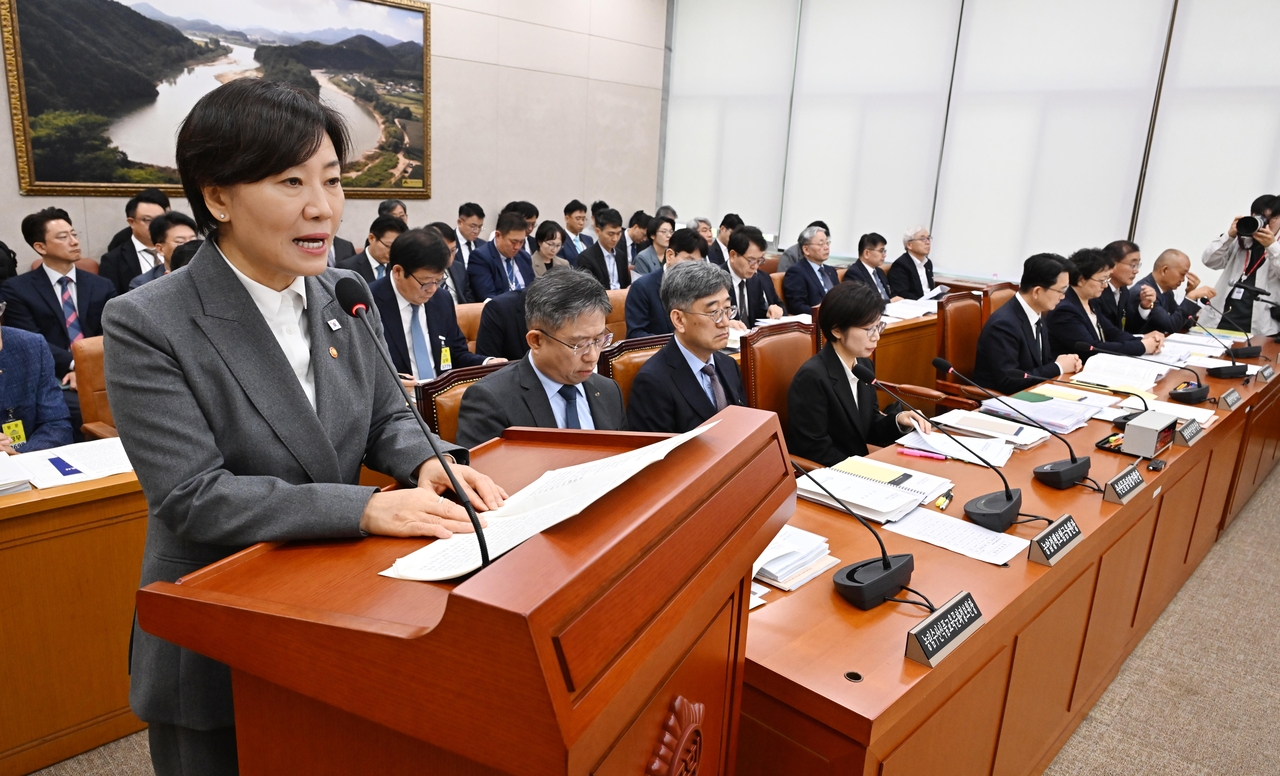
Agriculture Minister Song Mi-ryeong said Wednesday that minor and customary farmland violations uncovered during a nationwide survey would be given a chance at regularization through special legislation, while serious illegal activity and speculation would be punished. She also reaffirmed plans to more than double the coverage of a rural basic income program — from 17 counties this year to 35 next year.
Speaking at the opening of the National Assembly's Agriculture, Food, Rural Affairs, Oceans and Fisheries Committee national audit, Song said the government would not pursue penalties for violations that do not involve speculation or serious illegality, and would provide ample opportunity for those who do face action to explain their circumstances. "Regulations that are out of step with reality will be reformed in a rational way," she said.
Song also addressed concerns from farming communities about the survey. "The purpose of this investigation is to accurately understand the ownership and use of farmland nationwide, so that we can overhaul a farmland regime that has gone unchanged for 30 years and bring it in line with a changed rural environment — including an aging population," she said.
She stressed that the survey was not meant to punish farmers but to serve as a starting point for reforming the farmland system. "This investigation should not be a burden on farmers," Song said. "Our goal is to fix unreasonable rules to match reality and give farmers the peace of mind to focus on their work."
The government also plans a major expansion of its rural basic income program, which currently provides payments to residents of 17 counties facing population decline, including Boseong. The program will be extended to 35 counties next year — roughly half of the 69 counties designated as depopulation areas. The national subsidy rate will also rise from 40 percent to 50 percent to ease the fiscal burden on local governments.
The Ministry of Agriculture, Food and Rural Affairs said the program has already shown signs of reversing population decline and boosting local economies, including growth in affiliated merchants. The ministry plans to use the basic income as seed funding to nurture service providers and support the spread of a social solidarity economy in rural areas.
The ministry is also stepping up efforts to integrate AI into agriculture. This year, it is rolling out AI-based smart farming across 17 designated smart agriculture development zones and pushing to commercialize AI products for the sector, including crop harvesting and sorting robots. Going forward, the ministry plans to introduce physical AI, break ground on advanced AI greenhouses, and pilot smart farm models tailored to small and mid-sized farms starting next year.
To support young people entering farming, the ministry will launch a new "Youth Farming School" program next year. A plan to establish a retirement pension scheme for aging farmers will be drawn up before the end of this year.
On the Comprehensive and Progressive Agreement for Trans-Pacific Partnership, a key trade issue for the agricultural sector, Song emphasized the need to reflect the farming community's concerns and prepare adequate compensation measures. "We will do our utmost to ensure that the agricultural sector's position is properly reflected, given the sensitivity of the sector," she said. "If a decision to join is made through social deliberation, we will work with the National Assembly and the farming community to build a support package commensurate with the scale of the damage."
The ministry is also preparing measures to stabilize rice supply during the harvest season. The price of rice during the lean season stands at 227,348 won ($169) per 80 kilograms, or 28,419 won per 10 kilograms. The ministry plans to announce projected output Thursday and consult with producer groups to finalize a rice supply stabilization plan for the harvest period.
The ministry will also work with the National Assembly on enacting a food security law to strengthen national food security. A farm produce price stabilization scheme has been in effect since August, initially covering garlic and onions, with more crops to be added in stages. The number of crops covered by agricultural income insurance expanded from 15 last year to 20 this year.
"I will pay close attention to ensuring that newly introduced policies — including the rural basic income and the farm produce price stabilization scheme — as well as key legislative measures, work properly on the ground and translate into changes that people can feel," Song said.
adastra@heraldcorp.com