'Focused on livelihood recovery and essential services at 2.86 trillion won'
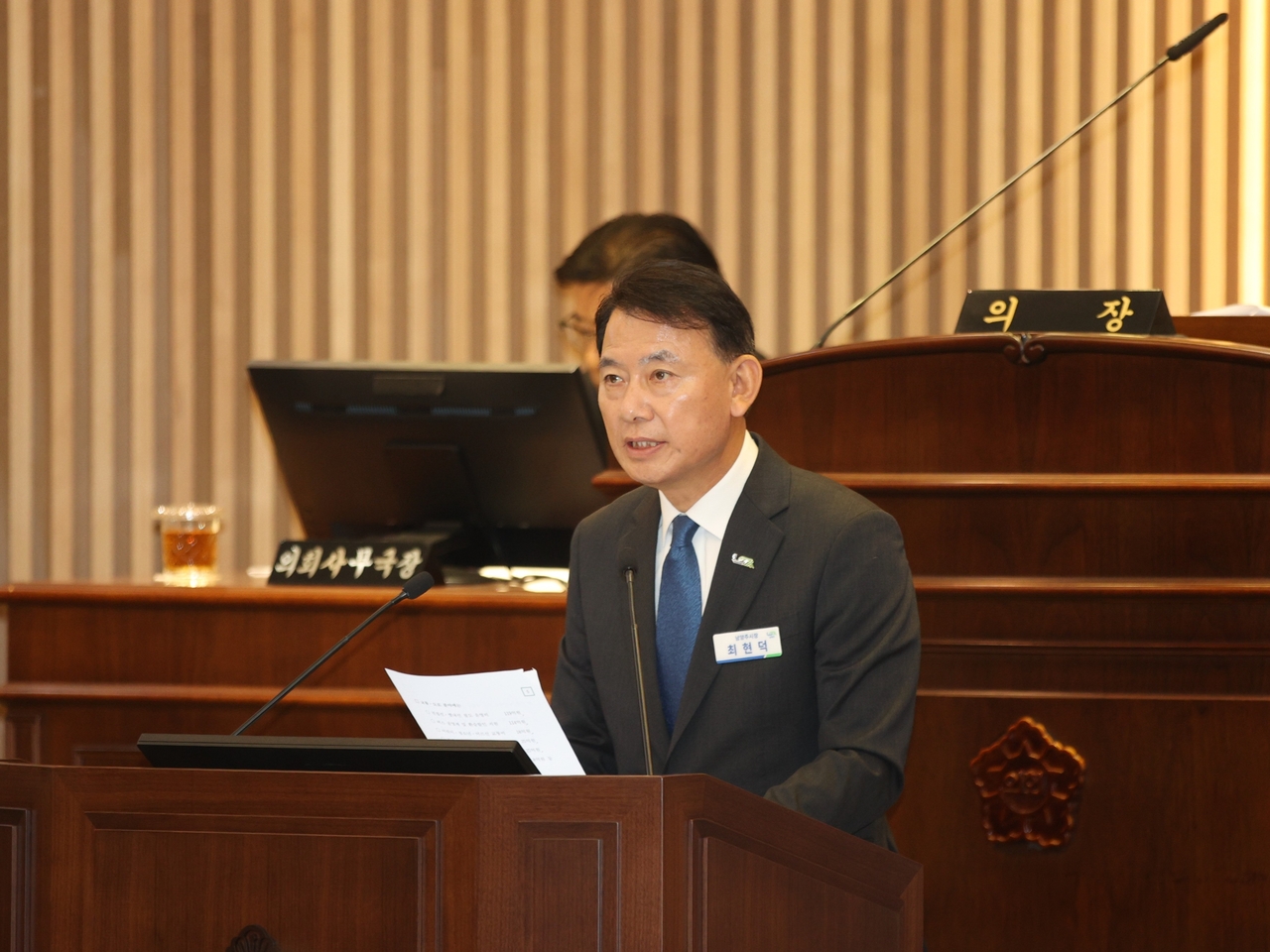
Namyangju Mayor Choi Hyun-deok on Wednesday presented the rationale and key details of the city's second supplementary budget for 2026, totaling 2.86 trillion won ($2.13 billion), at the 322nd extraordinary session of the Namyangju City Council.
The supplementary budget was drawn up to support livelihood recovery and strengthen community-focused administration. The city submitted the proposal to the council on Aug. 31.
If approved, the budget would represent a 10.8 percent increase over the first supplementary budget for this year.
The general account would rise by 216.3 billion won to 2.48 trillion won, while the special account would increase by 62.3 billion won to 384.8 billion won.
The city said it prioritized funding for livelihood support tied to the national supplementary budget, local economic revitalization, welfare demand, and traffic and road improvements.
To address sluggish tax revenue and rising mandatory expenditures, the city also reprioritized projects and sought to improve spending efficiency.
Some 90.3 billion won was allocated to easing the burden on ordinary residents and stimulating the local economy.
Of that, 86.9 billion won covers high fuel-price victim support funds, the K-Pass transit subsidy program, and fuel subsidies for freight vehicles. The budget also includes expanded incentives for the Namyangju Love Gift Certificate program and guarantee support for small business owners.
The welfare sector received 62.3 billion won.
The funds will support welfare benefits including basic pensions, elderly care allowances, and housing subsidies, as well as the construction of a senior welfare center in Byeollae and the expansion of other welfare facilities.
Transportation and road infrastructure will receive 36.6 billion won.
Of that, 11.9 billion won goes to operating the Jinjeop and Byeollae subway lines, 11.4 billion won to semi-public bus operations, public management systems, and transfer discount support, and 1.8 billion won to transit cost subsidies for children, teenagers, and senior citizens.
Alongside this, 2.5 billion won each was set aside for road widening projects — one connecting Jinjeop Jungmal to the Cheolma intersection and another near the Hwado Nokchon interchange — and 800 million won for the purchase of a site for a public bus depot in Byeollae.
Urban development and maintenance received 10.9 billion won, sports and culture 7.6 billion won, and public safety 9.3 billion won.
The city plans to improve parks and waterways, expand community sports and cultural infrastructure, and step up road and pedestrian safety management as well as flood and snow damage prevention.
"We put together the supplementary budget with a focus on livelihood recovery and projects that residents truly need," Choi said. "Once the budget is finalized, we will move quickly to carry out the execution procedures for each project."
The second supplementary budget proposal is set to be deliberated and approved at the 322nd extraordinary session of the Namyangju City Council.
pjh@heraldcorp.com