Probe launched into 12.2 billion won in suspicious Onuri voucher transactions
Online traditional market platform to restrict high-end imported goods
Supplier payment indexing system flagged as ineffective, to be reviewed
Reforms eyed for Yellow Umbrella health insurance fees; caution urged on minimum wage differentiation
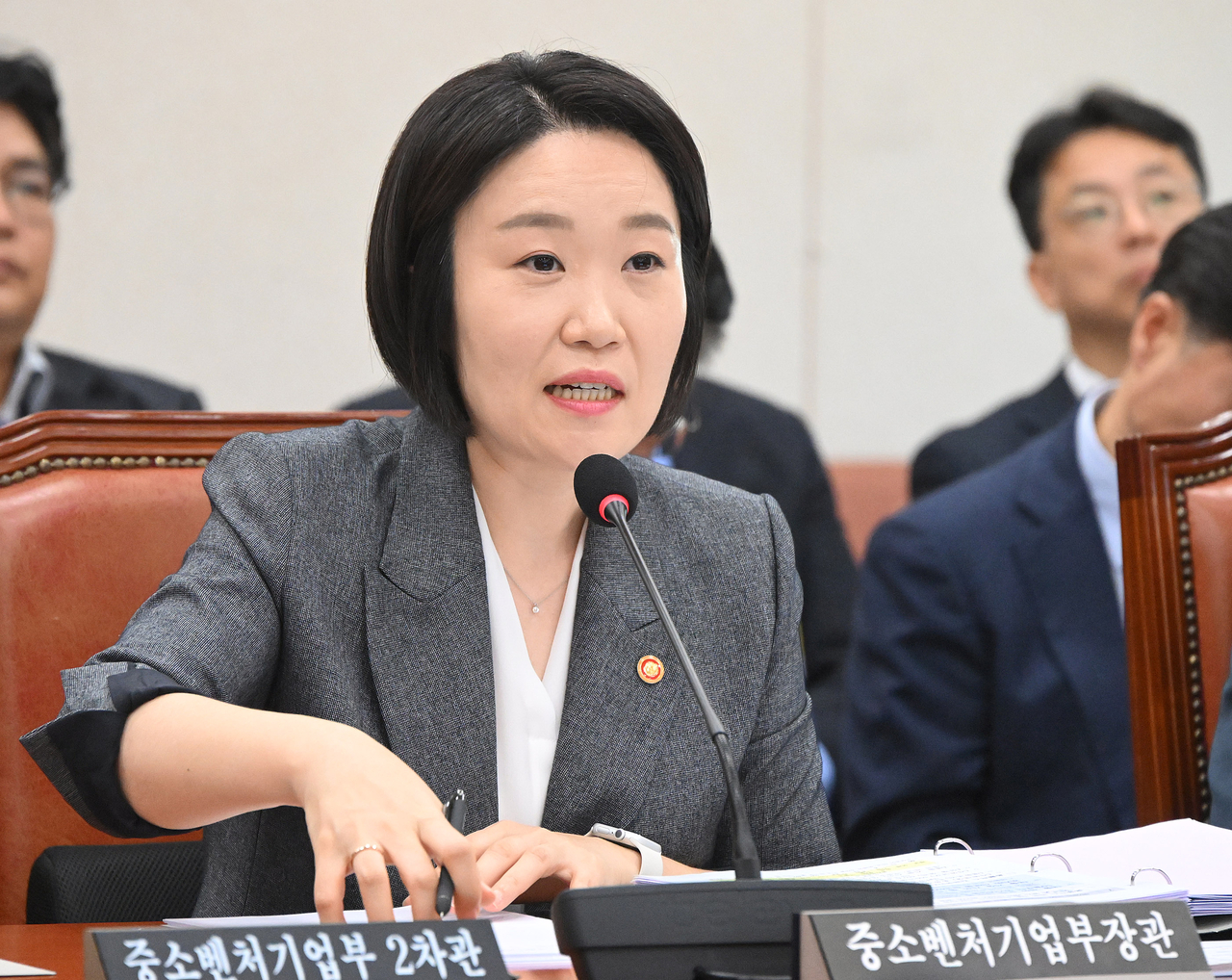
Minister of SMEs and Startups Lee So-young said Wednesday that her ministry would work with the National Tax Service and other relevant agencies to investigate allegations of fraudulent distribution of Onuri gift vouchers, and that she would review restricting the range of products available through the online traditional market platform. She also pledged a broad review of the supplier payment indexing system.
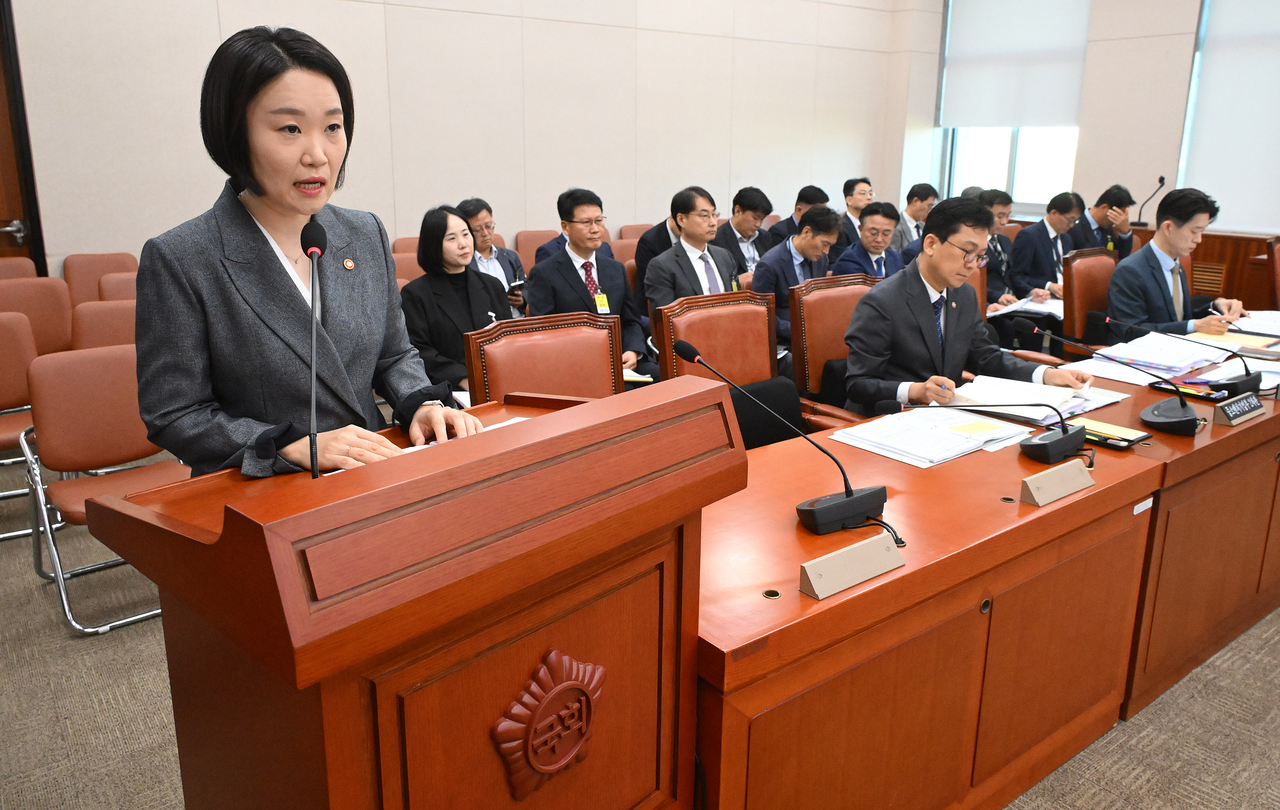
The National Assembly's Trade, Industry, Energy, SMEs and Startups Committee held a national audit of the Ministry of SMEs and Startups on Wednesday. Lawmakers raised a wide range of issues — from Onuri vouchers, the Yellow Umbrella mutual aid fund and the public food delivery app to the supplier payment indexing system, the family business inheritance tax regime and the minimum wage. Lee said she would review policy improvements in response.
12.2 billion won in Onuri voucher transactions under probe; online mall product restrictions eyed
The management and oversight of Onuri gift vouchers drew fire at Wednesday's audit. Democratic Party lawmaker Kim Won-i raised the possibility of fraudulent distribution, noting that 12.2 billion won ($9.08 million) worth of Onuri vouchers had been processed last year at a vegetable stall of about 16 square meters belonging to a traditional market cooperative in Gwangju that was registered as an affiliated merchant.
That cooperative ranked fourth nationwide among all affiliated merchants in Onuri voucher transactions last year. Its sales surged from 500 million won in 2023 to 11 billion won in 2024, and climbed further to 12.8 billion won last year.
Discrepancies between the registered merchant information and actual business operations were also flagged. When Kim's office visited the address and made a purchase, the receipt listed the name of a different retailer — not the Onuri-affiliated cooperative.
Kim said it was necessary to verify where and how the 12.2 billion won in transactions actually took place. Lee said her ministry would "work with the National Tax Service and other relevant agencies to conduct a thorough investigation" and would "look into the matter and report back before the comprehensive audit."
Concerns were also raised that the online traditional market platform allows shoppers to use Onuri vouchers to buy high-end imported goods and travel products.
People Power Party lawmaker Park Sung-min pointed out that the platform was selling imported audio equipment priced at 7.95 million won and speakers at 3.67 million won.
Lee said it was not in keeping with the program's intent for sellers who import or purchase electronics and resell them to gain access to the platform — and the ability to generate discounted Onuri voucher sales — simply because they operate a shop inside a traditional market.
She added that restricting the range of products that can be sold through the online traditional market platform was "technically and contractually feasible" and said she would review the option.
Supplier payment indexing system flagged as ineffective; full review pledged
Lee also signaled plans to strengthen the effectiveness of key small business policies. On the supplier payment indexing system, which took full effect in 2023, she said she still considered it "lacking in effectiveness," adding that "because the actual sanctions are weak, there are cases where it does not work in practice."
The supplier payment indexing system requires that fluctuations in the price of key raw materials beyond a certain threshold be reflected in supplier payment amounts.
Lee said she would "conduct a comprehensive review of the supplier payment indexing system, including improvements to the trigger conditions, sanctions and the automatic application of the system in contracts."
On the government's planned overhaul of the family business inheritance tax regime, Lee said the ministry would incorporate feedback from small business operators. On the conditions for changing the business category of companies claiming the family business inheritance deduction, she said there was "reasonable merit to the view from the field that the current rules are unfair" and that the ministry would "adopt some of those views and submit its position during the tax review process."
On the separate question of extending the minimum operating period required for a business to qualify as a family business, however, Lee said "10 years alone was somewhat short" under the existing rules and that she considered the extension "reasonable."
Yellow Umbrella health insurance fees to be reformed; caution on minimum wage differentiation
Lawmakers also pressed the minister on the social safety net for small business owners and their operating costs. Democratic Party lawmaker Jeon Eun-su raised the problem of small business owners being charged national health insurance premiums twice — first on the income used to pay Yellow Umbrella contributions, and again when they receive a refund upon early cancellation, as the returned funds are classified as miscellaneous income.
Lee said the situation "appears to have the character of double taxation" — paying health insurance premiums on income used to make contributions, only to have the refund classified as new income subject to premiums again — and said she would "consult with the Ministry of Health and Welfare on improving the system."
On the differentiated application of the minimum wage by industry, Lee struck a cautious tone. She said she was "aware that the minimum wage issue is a conflict between the vulnerable and the vulnerable" and that she was mindful that minimum wage increases were pushing small self-employed business owners toward working alone without employees.
On the possibility of industry-specific differentiation, she said it was "a matter that requires careful consideration." On calls for small business owners to have a greater voice on the Minimum Wage Commission, she said two small business representatives were already participating as employer delegates, and that she was aware of calls for small business owners to hold a larger share of seats than large corporations.
Lee also drew attention when she was unable to immediately answer a question about next year's minimum wage. When People Power Party lawmaker Jo Ji-yeon asked how much the minimum wage would be next year, Lee could not respond right away. Jo then told her: "It's 10,700 won. You really need to know this."
Changes to the public food delivery app support model were also flagged. Democratic Party lawmaker Heo Sung-mu raised concerns about the structure of the 124 billion won budget allocated for the public food delivery app next year, noting that 120 billion won of that amount was concentrated on discount coupons.
Lee said the ministry was "gathering ideas on how to restructure the 120 billion won coupon budget" and that it would review various options, including incentives for delivery workers.
Lee also said she would discuss with the National Assembly ways to keep the Youth Startup Academy program alive, after it was left out of the government's draft budget for next year.
boo@heraldcorp.com