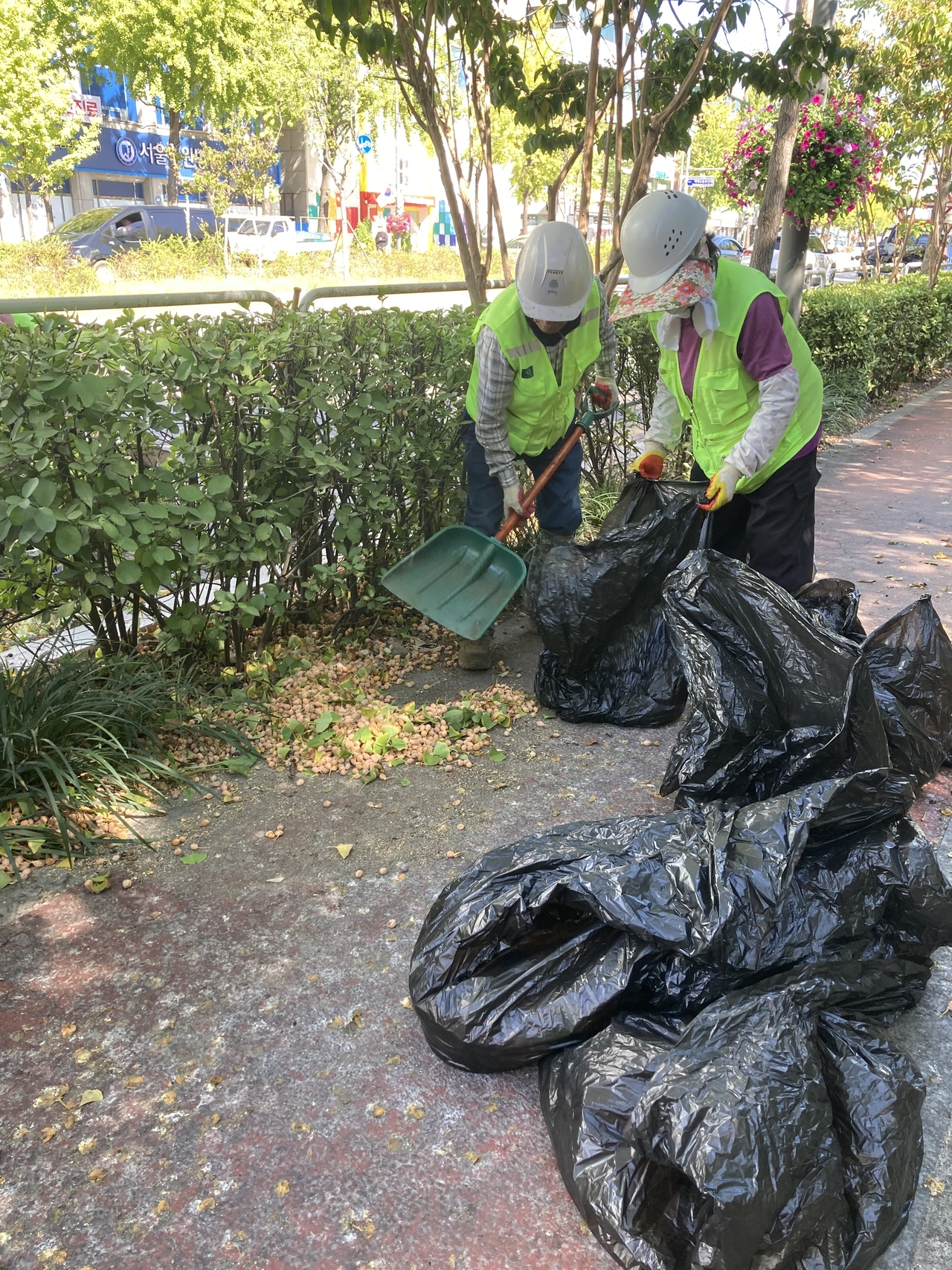
A look at ginkgo fruit collection in Songpa-gu, which has more ginkgo street trees than any other Seoul district. Workers haul away about 6 tons of fruit a day — more than 100 tons expected this fall alone. The trees are prized for their looks and resilience, but female trees and their foul-smelling fruit remain a stubborn problem. Seoul has cut the number of female ginkgo street trees by 19 percent over four years.
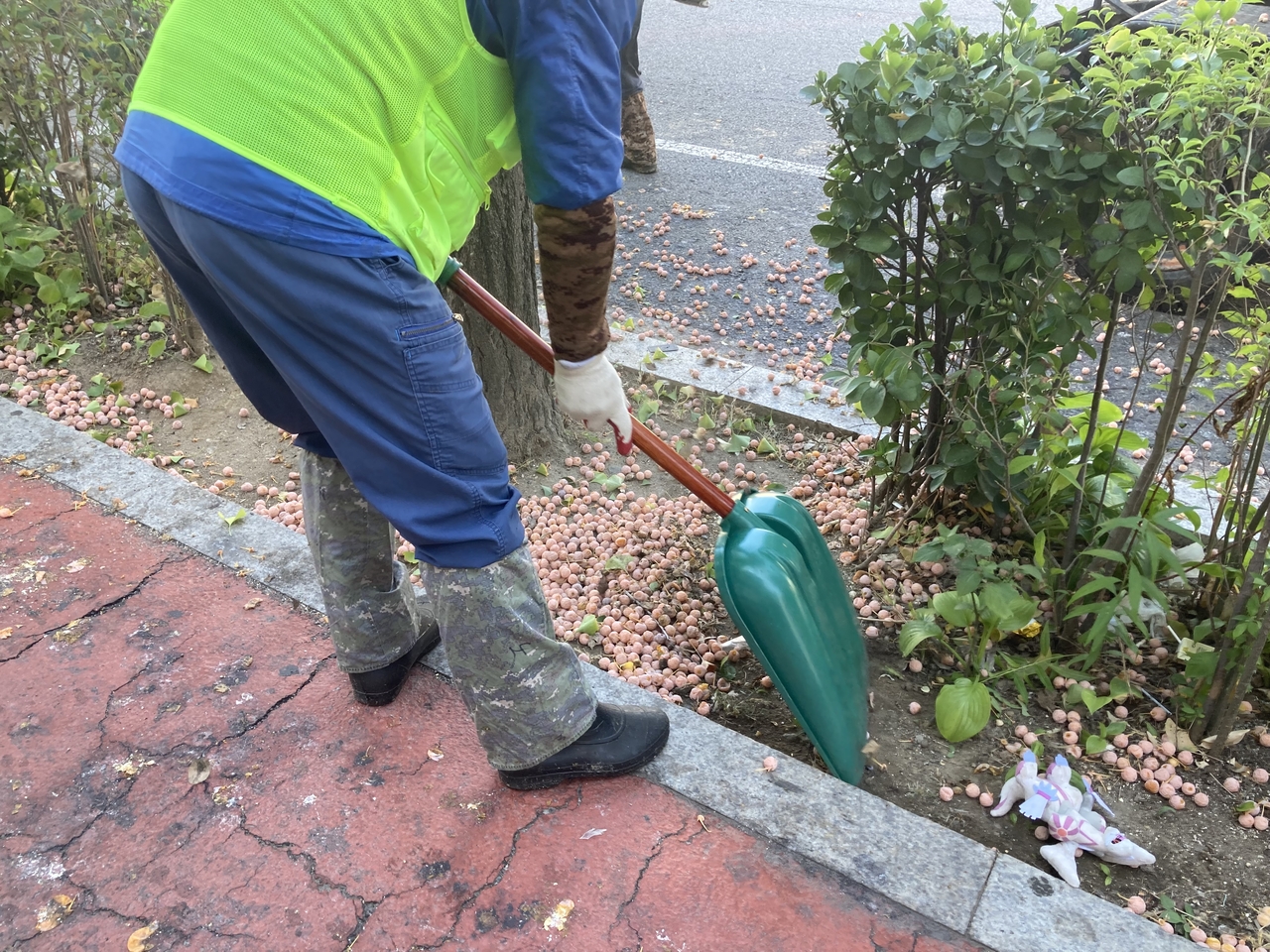
An excavator fitted with large clamps pulled up to a stretch of street near Seokchon Station in Songpa-gu, Seoul, on Tuesday morning. When the machine grabbed a ginkgo tree and shook it, plum-colored fruit rained down like hail, hundreds of them hitting the pavement in an instant. Workers moved in and began scooping them into black plastic bags.
The Herald Business joined the fruit-removal crew for the day — a job that ranks among the most common resident complaints every autumn in the district. Songpa-gu has more ginkgo street trees than any of Seoul's 25 autonomous districts. The district began collecting ginkgo fruit in the last week of September, after the chuseok holiday, and Tuesday marked the sixth day of operations.
Kwon Young-dae, the on-site supervisor for Songpa-gu's street tree maintenance team, said crews planned to start on Ogeum-ro in the morning, move to Baekje Gobun-ro, then work from Macheon-ro to Munjeong-ro in the afternoon. "We plan to work on 150 to 200 ginkgo trees a day," he said.
Work had begun at 8 a.m., and within two hours three one-ton trucks were already packed with black bags of fruit. "Each bag weighs about 10 kilograms, and we fill around 600 bags a day," Kwon said. "That works out to roughly 6 tons of fruit collected per day."
Songpa-gu has scheduled 17 working days for this fall's collection effort. At 6 tons a day, that adds up to more than 100 tons of ginkgo fruit removed in a single season.
Each autumn, the district receives a flood of complaints about the smell. "We get requests not just about trees on major roads but about ginkgo trees right outside people's homes," a Songpa-gu official said. "October is our busiest month for ginkgo fruit removal."
The source of the notorious odor is the fruit borne by female ginkgo trees. The smell is especially sharp when fallen fruit is stepped on.
Kim, a 46-year-old Songpa-gu resident, said she watches the ground when she walks this time of year to avoid stepping on the fruit. "If you accidentally step on one, the awful smell ruins your mood," she said. "I really don't understand why they plant ginkgo trees."
According to Seoul's street tree database, ginkgo trees make up the largest share of the city's street trees. As of the end of last year, Seoul had 287,684 street trees in total, of which 83,673 — or 29.1 percent — were ginkgos. Plane trees (platanus) came second at 43,672 trees (15.2 percent), followed by zelkova trees at 40,122 (13.9 percent). Female ginkgo trees, the source of the odor, numbered 15,359, accounting for 5.3 percent of all street trees in the city.
Songpa-gu, which has more street trees than any other district in Seoul, also leads in ginkgo numbers. Of the district's 23,331 street trees, 9,490 are ginkgos and 1,313 are female ginkgos — meaning ginkgos alone number more than 10,000.
So why were ginkgo trees planted as street trees in the first place, given that they generate one of the city's most persistent seasonal complaints? There are reasons. Seoul designated the ginkgo as the city's official tree in 1971. Academics, the Seoul Metropolitan Government and district officials all point to the same qualities: ginkgo trees typically live 40 to 50 years, resist pests and disease, and are visually appealing.
"They cast a wider shade than most other trees, and they put on a beautiful display when the leaves turn in autumn," a Songpa-gu official said. "They also absorb more carbon dioxide than other species, which makes them well suited as street trees. Honestly, if it weren't for the smell, they would be the ideal street tree."
Those advantages pushed out trees that were once popular choices. Plane trees fell out of favor because their large leaves blocked building signs and high-rise windows, while weeping willows were gradually eliminated from Seoul's streets after complaints that their airborne seeds triggered allergies in residents.
The question remains: why were female trees planted from the outset? In the past, it was difficult to tell male from female ginkgo trees before they flowered and fruited, so many were planted without regard to sex. That changed in 2011, when the National Institute of Forest Science developed a DNA analysis technique to determine the sex of young ginkgo trees from their leaves, making it possible to select male saplings before planting.
The number of female ginkgo street trees has been falling steadily since then. Existing female trees are being replaced with males, and all newly planted ginkgos are male. According to Seoul Metropolitan Government data, the number of female trees dropped from 28,216 in 2022 to 26,510 in 2023, then to 24,934 in 2024, and to 22,982 last year — a decline of 18.5 percent over four years.
"We are aware that odor complaints recur every year, but replacing all female trees with male ones is difficult, partly because of budget constraints," a Seoul Metropolitan Government official said. "The city plants and manages a variety of tree species as street trees, taking into account aesthetics, the environment and many other factors."
ikson@heraldcorp.com