From Yoo Jeong-bok and Park Nam-chun to Park Chan-dae — will a string of locally born mayors translate into a higher profile for the city?
From the 'Gyeongin Line' to 'Seoul Incheon Airport' — a city identity obscured by Seoul
Park Chan-dae's 'Incheon re-rating' must move beyond slogans to results
With an airport, a port and a biotech hub, should Incheon still be seen as just part of Greater Seoul?
Whose city is Incheon? It is home to Incheon International Airport and the Port of Incheon — the country's main gateways to the world — and has built a globally significant biotech industry base and the international district of Songdo. Yet the city's name and standing have never fully escaped the long shadow cast by Seoul.
The sense that Incheon's capabilities and its contribution to the national economy go underappreciated is not new. What makes the current moment worth examining is that the city has now been led, in succession, by mayors who were born and raised there.
Mayor Yoo Jeong-bok in the sixth directly elected term, Mayor Park Nam-chun in the seventh, Yoo again in the eighth, and now Mayor Park Chan-dae — who took office in July — in the ninth: all are Incheon natives. That thread runs through 12 consecutive years of city leadership.
What does it mean for a city to be governed by a politician who grew up there and has seen its realities up close?
A mayor who knows Incheon — and one who can raise its standing
The hope is that such a leader can understand the city's history and the distinct challenges of each district, and translate that knowledge into policies that address the neglect and imbalances Incheon has long endured.
But hometown roots alone do not guarantee results. What matters more is whether that understanding feeds into concrete policy decisions, budget allocations, negotiations with the central government and changes that residents can feel in their daily lives.
That is precisely why attention is now focused on Mayor Park in the ninth term.
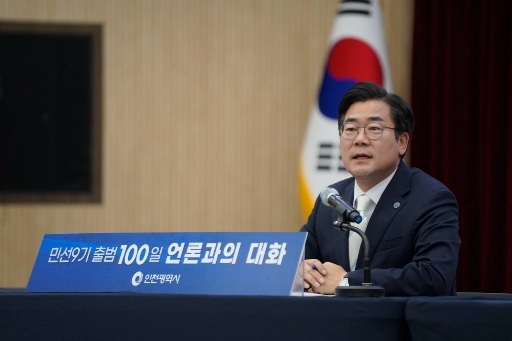
On Wednesday, marking 100 days since the ninth administration took office, Park unveiled what he calls an "Incheon re-rating" — a plan to win the city a fresh and higher valuation. He frames Incheon as an undervalued blue-chip asset: a city of three million people anchored by an international airport, a major port and a biotech industry, whose true worth has gone unrecognized within a policy landscape centered on Seoul and constrained by the reality of a divided Korean Peninsula.
Park's diagnosis touches on a question Incheon has carried for a long time. Is the country's gateway city genuinely recognized as having its own distinct identity? Does it receive policy treatment that reflects its unique character and needs, or is it simply lumped in with the broader metropolitan area while quietly shouldering the infrastructure that keeps the national economy moving?
The question shows up even in place names. The railway connecting Incheon and Seoul is known to most Koreans as the Gyeongin Line — "Gyeong" referring to the capital — and the expressway linking the two cities is the Gyeongin Expressway. Park has also pointed to the way Incheon Airport is labeled in international aviation systems under a name tied to Seoul as evidence of the city's chronic undervaluation.
Naming conventions alone do not define a city's standing, and the reality is that Seoul and Incheon share an integrated living and economic zone. But every time Incheon's name is subsumed under "Seoul" or "the metropolitan area," it raises the question of how well the city's own history — as a treaty port, a maritime hub and an aviation gateway — is understood on its own terms.
Incheon is not simply a city that happens to be close to Seoul. It is the starting point of Korea's modern opening to the world, a critical node in international logistics, and a city that has built a global biotech production base centered on Songdo. It is also a place where old urban cores, new towns, border areas and island communities coexist — a complexity that cannot be adequately captured by the single label of "metropolitan area."
From nurturing future industries to balanced development across old districts and island communities
So what concrete changes should demonstrate that having a succession of homegrown mayors has mattered?
The first is establishing Incheon's name and identity on its own terms. That means going beyond listing the airport, the port and the biotech sector, and making clear — at home and abroad — what role Incheon actually plays in Korea's growth and international competitiveness. The city needs to be seen not as Seoul's backyard but as a place that charts its own growth strategy and drives national development.
The second is connecting the city's potential to residents' everyday lives. Announcements of high-tech industry deals and large-scale development projects mean little if they do not translate into local jobs, higher sales for small businesses, better transport and improved housing. Balanced development — raising living standards not just in the new towns of Songdo and Cheongna but also in the old urban core, the border areas and the islands — remains an unfinished task.
The third is turning slogans into action. Park's plans — nurturing future industries in AI, biotech, content and energy; bidding to host the 2028 G20 summit; and a vision for a trans-Korean Peninsula east-west peace logistics corridor — are all ideas that could expand Incheon's role. But announcements and outcomes are different things. At every stage — from winning bids to construction, from investment to job creation, from securing funding to executing projects — residents should be able to see specific timelines, clear accountability and a tangible return.
Having a mayor from Incheon does not by itself resolve the city's long-standing challenges. The records of Yoo and Park Nam-chun deserve an honest assessment: policies that worked should be continued, and problems left unsolved need fresh approaches.
What matters more than political affiliation or a mayor's origins is what choices are made for Incheon's future — and how those choices and their consequences are explained to the people who live there.
Mayor Park Chan-dae's "Incheon re-rating" is, at its core, a declaration that the city will prove its own worth.
The succession of homegrown mayors must answer to residents through change they can feel
The benchmarks, then, should be equally clear: how widely Incheon's name becomes known, how much its future industries grow, how much life improves in the old districts and on the islands, and how much pride residents feel in calling Incheon home.
For 12 years, the sixth, seventh and eighth administrations were all led by Incheon natives, and the ninth continues that pattern. Residents' attention has shifted from the continuity itself to the change that continuity is supposed to produce. What they want, it seems, is not just a mayor who knows Incheon well — but one who can genuinely raise its standing.
Whether Park's "Incheon re-rating" can lift the city's name, sharpen its competitive edge and improve residents' lives — moving past the old perception of a city overshadowed by Seoul — is the question that now hangs over the ninth administration. The answer will have to come from results.
gilbert@heraldcorp.com