A public-private governance body launches on the district's 100th day in office, giving concrete shape to a campaign pledge to restore the stream's riparian ecosystem. Ecological considerations will be added to flood control and facility management as the district seeks a balance between residents' use and nature.
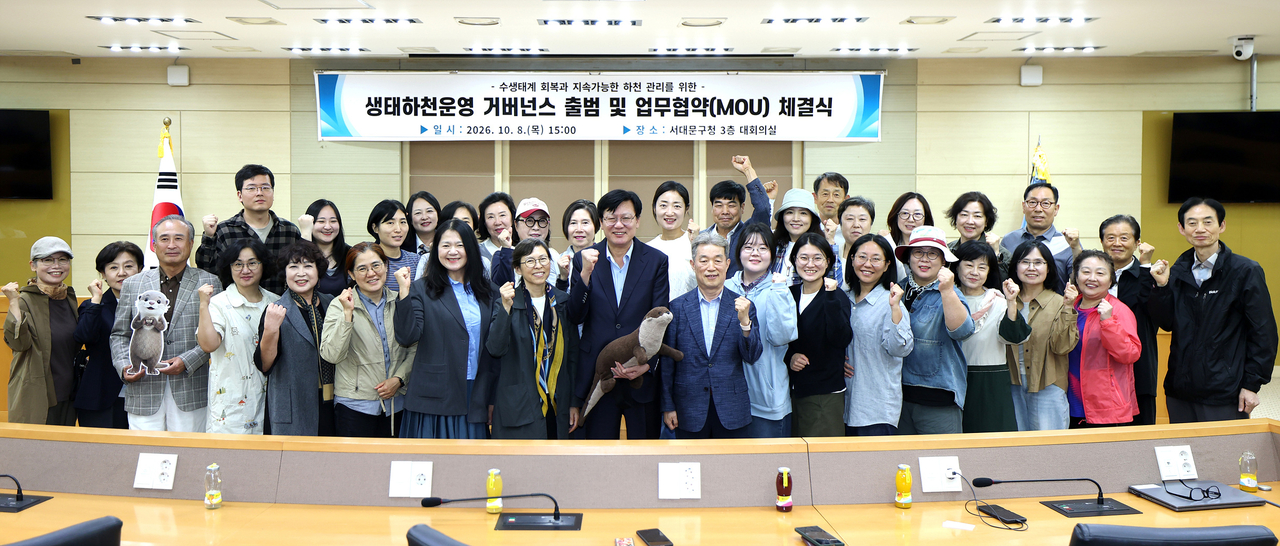
Seodaemun-gu and a group of environmental organizations have joined hands to transform Hongjecheon — a stream where residents walk and relax — into a waterway that supports a diverse range of life.
The partnership will look beyond flood prevention and facility upkeep to also monitor water quality and aquatic ecosystems, seeking a management approach that brings residents' daily lives and nature into harmony.
Marking the 100th day of the ninth directly elected administration, Seodaemun-gu held a launch ceremony and MOU signing for an ecological stream management governance body Thursday at the district office's main conference room. The newly established council brings together four district office departments and three private environmental organizations.
The council was formed to give concrete shape to a key campaign pledge of the ninth administration: expanding riparian ecosystem restoration and resident-use spaces along the stream. It links the district's experience managing waterways with environmental groups' on-the-ground expertise, creating a cooperative framework that weighs both ecological value and public access.
Participating district departments include the Climate and Environment Division, Sanitation Administration Division, Flood Control Division and Green City Division. On the private side, the council includes the Han River Social Cooperative, the Hongjecheon Action Group and the Maeul Eondeok Social Cooperative.
Stream management involves overlapping responsibilities across multiple departments — water quality, cleaning, flood prevention and green space upkeep. The council will bring departmental duties and community input together in one forum, jointly identifying improvement tasks and response strategies for Hongjecheon.
Under the MOU, participating agencies and organizations will share information on aquatic ecosystem restoration and management, provide policy advice, coordinate responses to major stream-related issues and jointly carry out measures agreed upon to enhance ecological value.
The district will manage Hongjecheon in a way that maintains flood prevention and facility safety while also attending to water quality and the aquatic ecosystem. Balancing residents' convenience with habitat conditions for wildlife is central to the approach.
District Mayor Park Woon-ki has discussed Hongjecheon restoration plans with residents and experts since his time as a district council member. The launch of the council marks a step toward channeling that longstanding interest into concrete action on aquatic ecosystem recovery and public-private cooperation.
The council will hold monthly meetings to discuss specific tasks such as stream ecology monitoring and water purification activities. By identifying needs in the field and developing cooperative measures together, the body aims to move beyond a one-time agreement toward sustained stream management and ecological recovery.
"On the 100th day of my term, we have laid the cooperative foundation to deliver on the promise I made to residents — restoring the Hongjecheon ecosystem," Park said. "We will incorporate field experience and community input into stream management so that Hongjecheon, a place where residents walk and rest, can also become a healthy habitat for diverse forms of life."
seouldream01@heraldcorp.com