Administrative focus to concentrate on five key areas: reconstruction, cultural tourism, transportation, AI and public facilities
Restructuring adds one bureau, one division and five teams, including a new Future Economy Bureau
Urban planning unit to gain independence, strengthening review expertise and objectivity
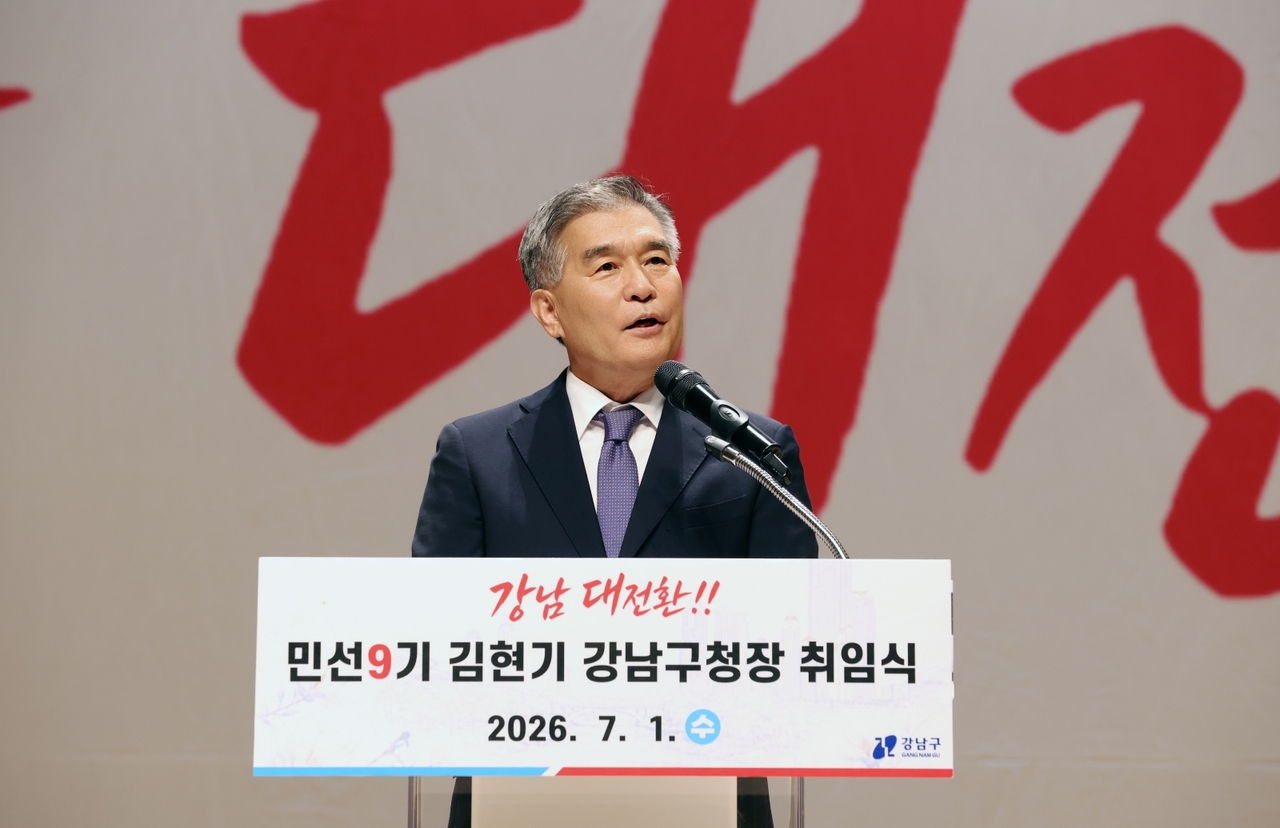
Gangnam-gu District Mayor Kim Hyun-ki has unveiled a sweeping organizational restructuring aimed at accelerating the "Great Gangnam Transformation," the signature policy agenda of his ninth-term administration.
The overhaul concentrates administrative resources on five priority areas — reconstruction, cultural tourism, transportation, AI and robotics, and public facilities — while comprehensively reorganizing the district's bureaucratic structure to meet future governance demands.
Gangnam-gu said it has drawn up a reorganization plan that expands the current structure by one bureau, one division and five teams. Once finalized, the main district office will operate under a framework of eight bureaus, one office, one director-general post, 42 divisions and 186 teams, while the public health center will run as one center with five divisions and 22 teams.
The district plans to submit the relevant ordinance to the 338th Gangnam-gu Council extraordinary session this month and, following a council vote and other required procedures, implement the changes in January 2027.
The restructuring is designed to underpin the "Great Gangnam Transformation" vision and a long-term development blueprint for the next 100 years. The district said it will expand staffing and organizational units only where strictly necessary, while consolidating fragmented departments to improve administrative efficiency and policy momentum.
Particularly notable is the decision to place reconstruction at the very top of the district's agenda, to cultivate AI and robotics as future growth engines, and to strengthen the operational framework for areas directly affecting residents' daily lives — including cultural tourism, transportation and public architecture.
The most significant change is the elevation of reconstruction-related units. The Housing and Urban Bureau and the Reconstruction Division will be repositioned as the leading bureau and division within the district office, signaling that expanding housing supply and stabilizing the residential market are the administration's top priorities.
The district will also reinforce communication channels with reconstruction associations, residents and other stakeholders, and reorganize housing-related units to encompass transit-oriented mixed-use development. The aim is to resolve emerging issues in reconstruction projects quickly and accelerate their progress.
In the cultural and tourism sector, the district will restructure the existing Future Culture Bureau into a Culture and Education Bureau, consolidating functions covering arts and culture, hallyu tourism and tourism marketing under one roof.
The plan links the construction of a K-content performance venue, the diversification of the Gangnam Festival and the expansion of recreational sports facilities to boost cultural and tourism competitiveness and stimulate the local economy.
Transportation, parking, automotive and road functions currently scattered across multiple departments will be integrated into a more cohesive structure. The consolidation is intended to support rail projects including the Wirye-Gwacheon Line and the Wirye-Sinsa Line, and to improve the district's capacity to address local transportation issues such as expanding public parking.
The goal is to pursue transportation policy comprehensively rather than as isolated departmental projects, realizing what the district describes as "seamless mobility and an enjoyable commute" in Gangnam.
A new Future Economy Bureau will be established to handle emerging industries and administrative innovation. It will bring together AI and robotics, local economy, employment and digital information functions under one umbrella to strengthen policy coordination and execution.
The district envisions AI not merely as a tool for internal administrative efficiency but as a broader driver of local economic growth — encompassing the robotics industry, attracting overseas AI research institutions and creating jobs.
A dedicated Public Facilities Division will also be created to take charge of public architecture. Work previously split between construction and facility-operating departments will be consolidated in the new specialist unit to raise the quality and efficiency of public building projects.
The Public Facilities Division will handle all construction work, while departments that actually operate the facilities will focus on resident services — a separation of roles intended to raise the standard of public architecture and clarify accountability throughout the project process.
Beyond the Public Facilities Division, the reorganization will establish dedicated units for corporate local taxation, landscape design, leisure and lifestyle, lifelong education, integrated care, and AI and robotics — reflecting the growing diversity of administrative demands and the need for clearer departmental mandates.
To strengthen the expertise and objectivity of urban planning reviews, the district will spin off the Urban Planning Standing Planning Team — currently housed within the Innovation Strategy Division — into an independent Urban Planning Standing Planning Group reporting directly to the head of the Housing and Urban Bureau.
The group pre-screens agenda items before they are submitted to the Urban Planning Committee. Operating as a standalone unit rather than a team within an existing department, it is expected to enhance the fairness and credibility of urban planning deliberations.
"This reorganization will lay the groundwork for staying ahead of future administrative demands and resolving key challenges with speed," Kim said. "The buck stops here with the district mayor, and I will build an organization where staff can work with conviction."
He added that the district would translate major priorities — reconstruction, transportation and AI — into tangible results so that residents can feel the difference in a transformed Gangnam.
seouldream01@heraldcorp.com