50,000-seat arenas hard to sustain even amid K-pop boom
Land grants from public sector not enough to ease financial burden
Ancillary revenue beyond ticket fees seen as essential
Venues must be designed as tourism and regional economic hubs
Ticket sales for large-scale concerts with more than 10,000 seats have tripled over three years on the back of the K-pop boom, yet a new study warns that a 50,000-seat arena cannot remain profitable without a rigorous ancillary revenue model and a verified financing structure. The report argues that such a venue must be conceived not merely as a performance space but as a complex tourism hub capable of drawing international visitors and generating extended consumer spending.
Yanolja Research published the findings Thursday in a report titled "Financial Feasibility of Building a Large 50,000-Seat Concert Venue: Conditions for Viability and Policy Challenges."
According to the report, ticket sales for concerts with more than 10,000 seats surged from 180.2 billion won ($133 million) in 2022 to 532 billion won in 2025, with popular music accounting for 99.5 percent of that total. Yet only six domestic indoor venues can accommodate more than 10,000 people, all with fewer than 20,000 seats, underscoring the growing demand for large-scale arenas.
The central obstacle is the enormous cost of construction. The report estimates that building a 50,000-seat venue in Seoul would require approximately 601 billion won in construction costs and around 1.21 trillion won in land acquisition, bringing the total to roughly 1.99 trillion won if pursued entirely by the private sector. Even if the public sector provides the land at no cost, the private investor's upfront burden — covering construction alone — remains substantial.
Annual operating costs, including depreciation, are estimated at around 40.7 billion won after opening. With maintenance and labor expenses recurring constantly, securing income beyond rental and ticketing fees through ancillary businesses is indispensable, the report says.
36 sellouts a year needed to break even — recouping investment a distant prospect
Generating a stable profit while absorbing such heavy fixed costs is, in practice, extremely difficult. The conditions under which a venue could actually turn a profit after opening are found to be highly limited.
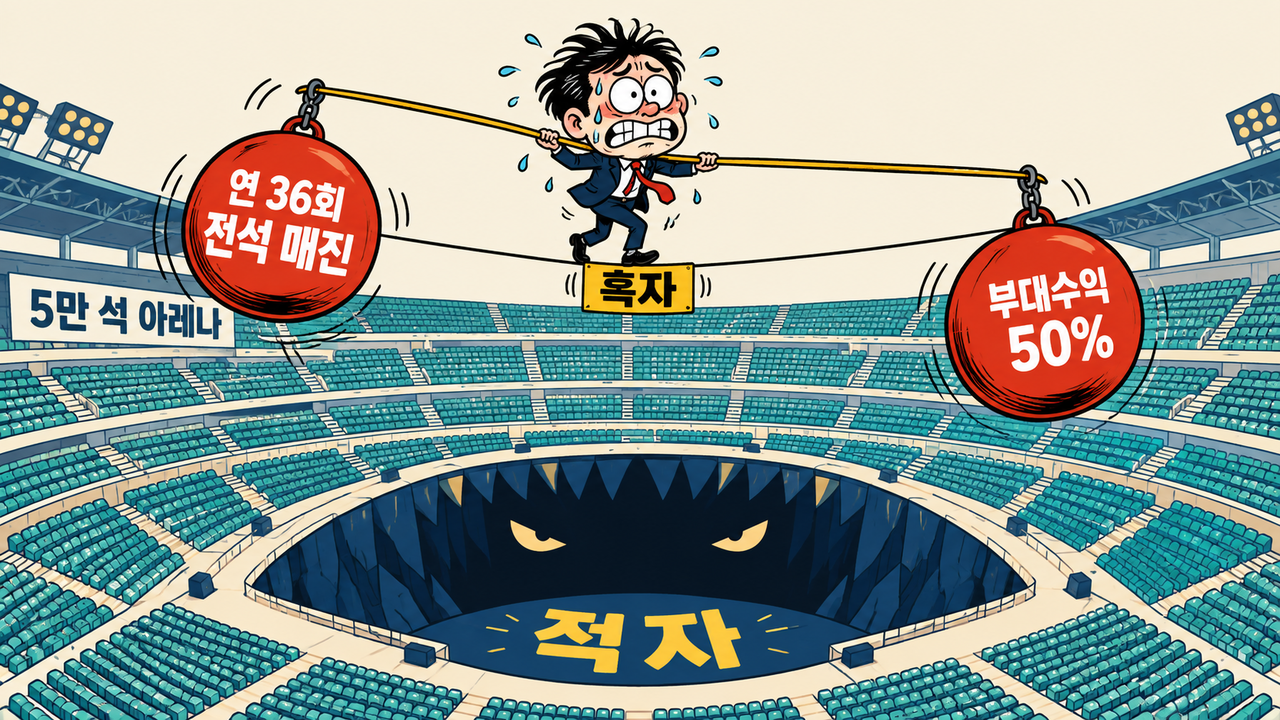
An analysis of 12 scenarios found that a profit was achievable in only one configuration: 36 fully sold-out performances per year, an average ticket price of 176,000 won ($129), a commission rate of 10 percent, and an ancillary revenue ratio of 50 percent — all met simultaneously, yielding an annual operating profit of 13 billion won. Under the least favorable conditions, the venue would post an annual loss of 12.7 billion won. All three variables — number of performances, ticket prices and ancillary revenue — must peak simultaneously for the venue to break even.
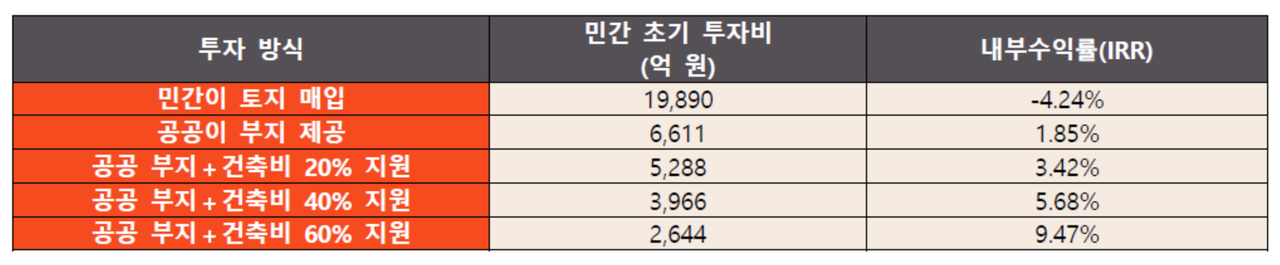
Even if operations turn a profit, recouping the enormous upfront construction costs is another matter. Private developers who purchase land themselves would find it nearly impossible to avoid losses, and even with public land provided free of charge, recovering the investment would be a tight proposition. The public sector would need to cover 60 percent of construction costs before a break-even outcome becomes conceivable — and even then, only if peak conditions such as 36 annual sellouts and strong ancillary revenue are sustained simultaneously. Any dip in attendance or rise in operating costs could quickly push the venue back into the red, making it difficult to press ahead on the strength of public subsidies alone.
Hong Seok-won, a senior researcher at Yanolja Research, said the key issue is not the specific 60 percent support rate but designing a structure that ensures public investment in the early stages actually translates into booked performances and revenue. "Before opening, long-term partnerships with domestic and international concert promoters must be secured to lock in the schedule, ancillary revenue streams must be contractually defined, and arrangements for sharing ramp-up losses in the early period must be agreed upon in advance," he said.
Venues must become platforms linking tourism and commerce, not just concert halls
The report identifies four conditions for improving the viability of such a project: a reasonable public-private cost-sharing arrangement; advance scheduling secured through long-term partnerships with domestic and international concert promoters; pre-opening design of diversified revenue streams, including naming rights, food and beverage, merchandise and tourism tie-ins; and a location that meets demand, transportation, accommodation, commercial and noise requirements.
The report recommends prioritizing areas where demand has already been validated, while calling for separate feasibility reviews for projects outside the greater Seoul metropolitan area that integrate transportation, tourism, accommodation and content strategies. It also proposes a "conditional decision-making" framework under which project approval would be granted only after passing phased demand verification, traffic impact assessments, private operating plans and ancillary revenue projections.
Jang Su-cheong, director of Yanolja Research, said a large concert venue is not a construction project but a platform that simultaneously activates performance content, transportation, tourism and commerce. "Rather than asking how many seats to build, the government and local authorities must first decide what level of concert demand can realistically be secured, and who will be responsible for sustaining operations over the long term," he said.
Analysts also argue that large concert venues should be viewed not simply as performance spaces but as anchor infrastructure integrated with urban tourism and the local economy. Beyond ensuring the facility's own profitability, a broader ecosystem must be built — one that draws international tourists and converts their visits into extended stays and spending.
Choi Gyu-wan, a professor at Kyung Hee University's College of Hotel and Tourism Management, said large concert venues serve as anchor facilities that draw domestic and international fans into a city. "From before opening, long-term partnerships with concert promoters must be in place to secure the schedule, and services for foreign attendees — covering airport transfers, accommodation and late-night transportation — must be designed in advance," he said. "Only then can concert attendance be extended into destination tourism."
terry@heraldcorp.com