Fed rate-hike bets fade, yet Treasury yields keep climbing — 10-year briefly tops 5.34%
Non-AI sectors take direct hit as internal market fractures widen
'Collapse of AI trade is the biggest risk'
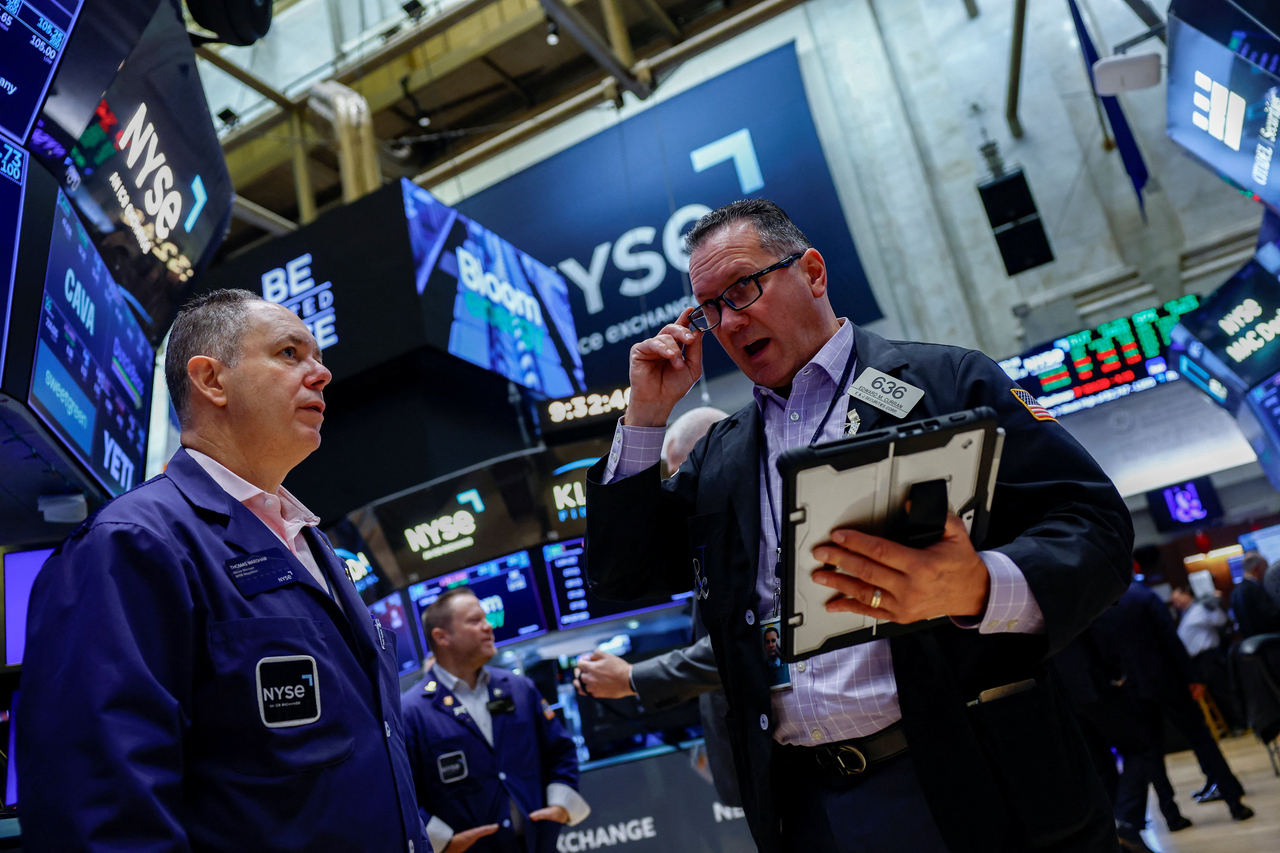
The US 10-year Treasury yield surged to 5.34% on Thursday (local time) — its highest level since 2002 — sending the shock of elevated interest rates rippling across the broader American stock market. While large-cap AI-related technology stocks continue to prop up the major indexes, analysts say small-caps, bank stocks, utility shares and other non-AI sectors have already suffered steep corrections.
The Dow Jones Industrial Average closed Friday up 250.40 points, or 0.49 percent, at 51,176.96. The S&P 500 rose 56.27 points, or 0.73 percent, to 7,722.72, and the NASDAQ Composite gained 319.27 points, or 1.19 percent, to close at 27,190.86. NASDAQ briefly set an all-time high during trading before paring its gains.
Bloomberg reported, however, that even as the S&P 500 hovers within 2 percent of its all-time high, a significant number of sectors and individual stocks are already down more than 5 percent from their peaks.
US Treasury yields initially fell after the release of employment data before reversing course and climbing again. Analysts attributed the rebound to a view that while hiring had slowed, it had not weakened enough to fully rule out further Federal Reserve tightening. The 10-year Treasury yield — the global bond benchmark — rose 4.93 basis points to 5.283 percent. The 2-year yield, which is more sensitive to monetary policy, climbed 4.6 basis points to 4.833 percent.
Bloomberg said "the US stock market has maintained a solid headline performance recently, driven by strength in AI-related shares," but added that "internal fractures are deepening as geopolitical risks mount alongside rising interest rates and uncertainty ahead of the US midterm elections."
Dan Suzuki, global investment strategist at investment platform iCapital, said "most of the market is down at least 5 percent from its highs, and some areas have fallen more than 15 percent," attributing much of the damage to "rising rates and the resulting tightening of financial conditions." Eric Diton, president of wealth advisory firm The Wealth Alliance, said "as long as the economy and corporate earnings growth remain strong, the stock market can withstand elevated rates for now," but cautioned that "the biggest risk is a disruption to the expansion of AI investment." He added that a sharp downward revision to the earnings outlook could broaden the market's decline.
Small-cap stocks have been among the hardest hit by rising rates. The Russell 2000 underperformed the S&P 500 by roughly 10 percentage points last quarter — its second-worst quarterly showing relative to the S&P 500 since 1999. The index has fallen 8.5 percent from its Aug. 14 peak and is on the verge of entering correction territory. Smaller companies carry heavier debt loads than large-caps and have less diversified business models, making them more vulnerable to rate increases. According to Bloomberg, so-called zombie companies — those that struggle to cover even their interest expenses — account for more than one-third of all Russell 2000 constituents.
Bank stocks are also struggling. The KBW NASDAQ Bank Index, which tracks 24 major banks, has fallen more than 12 percent from its mid-August peak, entering correction territory. Its gain for the year stands at just 3.3 percent, far behind the S&P 500's 12 percent advance, as higher borrowing costs, rising Treasury yields and credit-risk concerns weigh on the near-term earnings outlook for lenders.
Utility stocks have not been spared. The S&P 500 Utilities sector index has dropped roughly 17 percent from its February peak and is on the brink of a bear market. The sector fell 13 percent as the 10-year Treasury yield climbed nearly 1 percentage point last quarter to a 24-year high. Of the sector's 31 components, only Constellation Energy and AES posted gains. Bloomberg noted that while utility stocks have traditionally been regarded as a safe haven within equities thanks to their stable dividends, their relative appeal has dimmed as Treasury yields have risen.
Still, some corners of the market hold out hope that the Fed will not raise its benchmark interest rate much further. Weaker-than-expected jobs data has also reduced the perceived likelihood of additional rate hikes.
The US Department of Labor said that day that nonfarm payrolls rose by 29,000 in September, far below the market consensus of 84,000. Employment figures for July and August were also revised downward, reinforcing signs of a cooling labor market. The unemployment rate edged up to 4.2 percent. In response, interest rate futures markets raised the probability of the Fed holding rates steady at its October FOMC meeting to 77.9 percent that afternoon, up from 75.6 percent the previous day.
Jimmy Lee, CEO of Wealth Consulting Group, said he does not expect the surge in Treasury yields to spread beyond control, describing the current dynamic as investors rotating out of rate-sensitive stocks and back into technology shares that sold off sharply earlier in the year. He warned, however, that "the biggest risk to the S&P 500 is an unexpected collapse of the AI trade."
Debriefing: The Herald Business international desk breaks down the hidden stories behind the hottest global issues. Join the conversation — leave your questions in the comments.
yckim6452@heraldcorp.com