Seoul Mayor Oh Se-hoon pledges to judge all policy by what citizens actually feel
Many leaders prioritize quality of life and local residents' lived experience
Others focus on economic growth, future industries or pressing fiscal challenges
Mayors and governors across the country held press conferences and briefings around Thursday — the 100th day of the ninth round of directly elected local administrations — to present their blueprints for regional development.
While economic growth remained a central theme, a notable number of leaders said they would place greater emphasis on quality of life and infrastructure improvements that residents can tangibly feel. As in previous years, many outlined plans centered on securing new growth engines through future industries such as AI, pursuing administrative integration, and expanding everyday social infrastructure including airports and libraries. Yet the share of leaders who stressed quality of life and resident-centered outcomes was larger than expected. Some administrations also led with the most urgent challenges at hand, including fiscal pressures.
Quality of life takes center stage
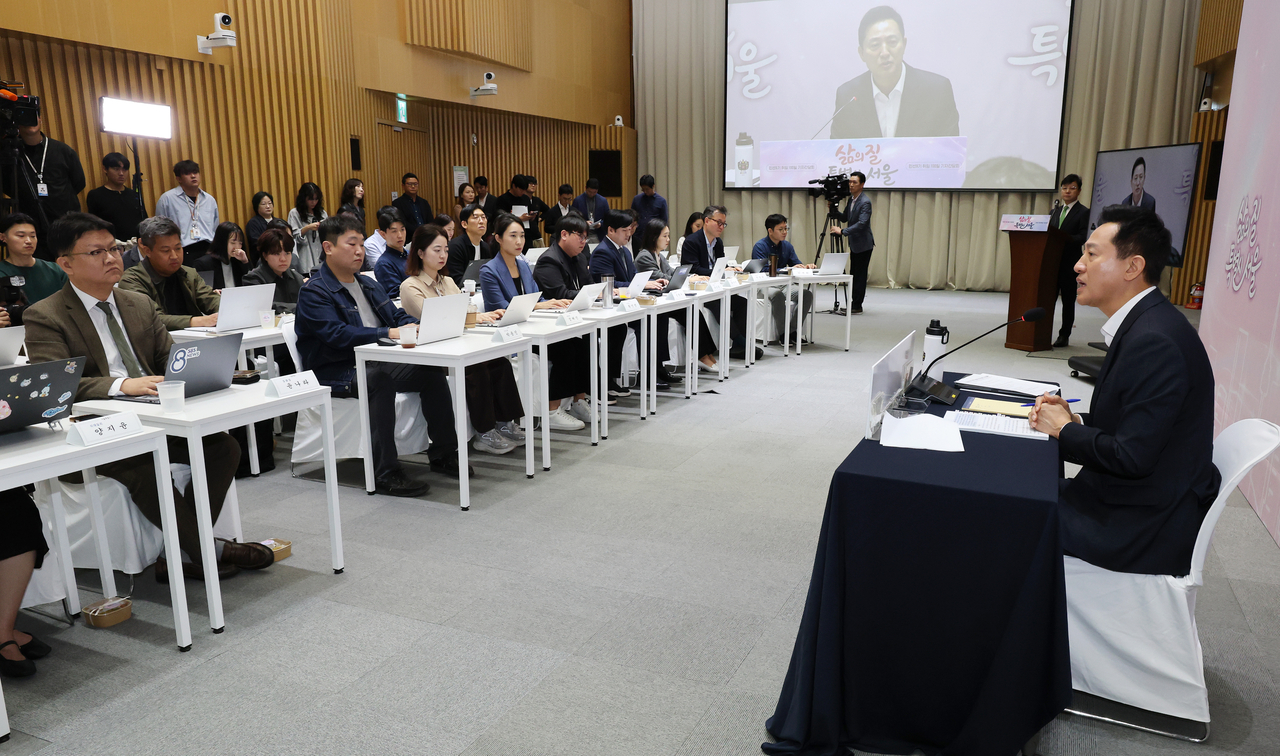
According to six metropolitan and provincial governments, Seoul, Busan and North Jeolla Province were among those that emphasized policies aimed at ensuring the benefits of growth reach and are felt by residents — a focus they framed as improving quality of life. Seoul stood out as the clearest example of a city committed to policies that citizens can experience directly.
At a press briefing Thursday marking his first 100 days in office, Seoul Mayor Oh Se-hoon said he would measure every policy outcome by whether citizens actually feel the difference. Rather than tracking the volume of housing supplied, he said, the city would assess how much residential anxiety has been eased; rather than counting the scale of transport network expansion, it would gauge how much more conveniently people can get around.
Busan Mayor Jeon Jae-soo, who made resolving livelihood issues his very first order of business on inauguration day, marked the 100-day milestone Thursday not with a formal ceremony but with an open weekly policy meeting designed to engage with citizens. At the session, Jeon discussed the administration's key achievements over its first 100 days — including a Busan-style youth guarantee program, a welfare safety-net strategy and a citizen-sovereignty city initiative — as well as the policy direction going forward.
North Jeolla Province put forward "tangible growth" as its guiding theme, identifying higher incomes for farmers and fishers and stronger welfare and care services for vulnerable groups as its main priorities. Governor Lee Won-taek cited the designation of a specialized cluster for semiconductor materials, components and equipment as the administration's biggest achievement so far, and announced plans to expand and reorganize the North Jeolla Development Corporation into a North Jeolla Energy Development Corporation. The aim is to link renewable energy from the Saemangeum area to grid competitiveness, and ultimately to welfare improvements and higher regional incomes.
Securing growth engines through future industries
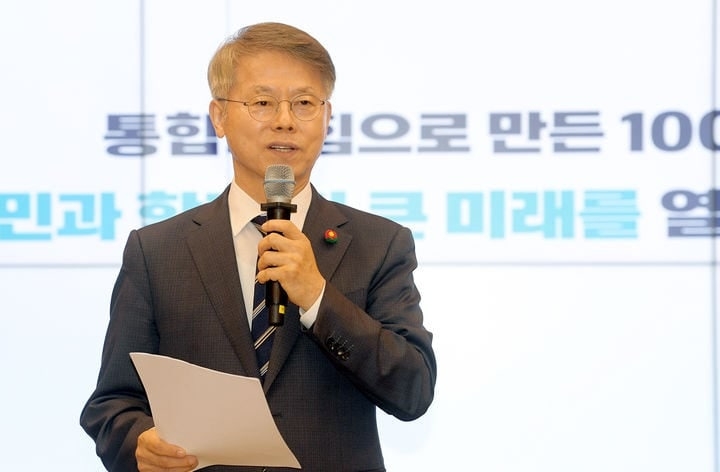
The merged South Jeolla-Gwangju city, Daegu, Incheon, Ulsan, Sejong, Gangwon Province, North Chungcheong Province and North Gyeongsang Province all kept their focus squarely on the economy, as in previous years, signaling plans to graft new industries onto existing ones to build fresh growth engines.
Min Hyeong-bae, mayor of the newly merged South Jeolla-Gwangju Special City, laid out a vision Thursday at a 100-day press conference for nurturing future industries including AI, semiconductors and batteries. He also presented a plan for an industrial ecosystem linking Gwangju's semiconductor sector, materials and components industries in the eastern part of the region, and renewable energy in the west.
Daegu Mayor Choo Kyung-ho set "change and growth, a better Oct. 10" as his administration's governing goal on Wednesday. His plan calls for transforming the city's industrial structure by building on a nationally designated advanced strategic industry cluster for humanoid robots and a smart-city specialized zone. "We will revive the local economy first," he said.
Incheon Mayor Park Chan-dae unveiled a concept he called "Incheon re-rating" — a drive to have the city's true value properly recognized. His vision involves developing Songdo, already a major global biotech production hub, into a place that also supports research and startups, while integrating AI into the city's existing airport and port logistics strengths to grow Incheon into a global industrial city.
He also outlined a vision to connect Incheon to the world through hosting the G20 summit in 2028 and building what he called a "Korean Peninsula East-West Peace Logistics Highway" stretching from Incheon International Airport to Goseong in Gangwon Province.
Ulsan Mayor Kim Sang-uk set a goal of delivering outcomes that citizens can feel by combining autonomous driving, humanoid robots and industrial AI transformation with the city's existing manufacturing-based industrial base.
Sejong Mayor Jo Sang-ho identified the relocation of key national government functions away from the greater Seoul area to Sejong as a springboard for the city's leap forward. He plans to leverage Samsung Electro-Mechanics' 8 trillion won ($5.97 billion) investment plan, the construction of a Daiso distribution center and a data center investment agreement as local growth engines, and said the city would work to ensure that local talent is hired as those investments are carried out.
Gangwon Province Governor Woo Sang-ho said the province would build on its momentum by attracting large corporate investment, starting with the Donghae AI data center, which is set to break ground before the end of the year. He said the province is in talks with SK Group over investment terms in Gangneung, with KT Corp in Wonju and with Shinsegae in Chuncheon. "Change in Gangwon Province has begun, just as I had planned," he said.
North Chungcheong Province Governor Shin Yong-han set a target of reaching 100 trillion won in gross regional domestic product by 2030, to be achieved by developing a cluster of projects including the Osong K-Bio Square, an advanced semiconductor back-end processing hub, a corporate AI transformation initiative, a K-Synchrotron Valley and a water-thermal energy specialized zone.
North Gyeongsang Province Governor Lee Cheol-woo said his administration would focus on administrative integration between Daegu and North Gyeongsang Province, the construction of a new airport, and broader infrastructure expansion.
Some leaders put pressing problems first
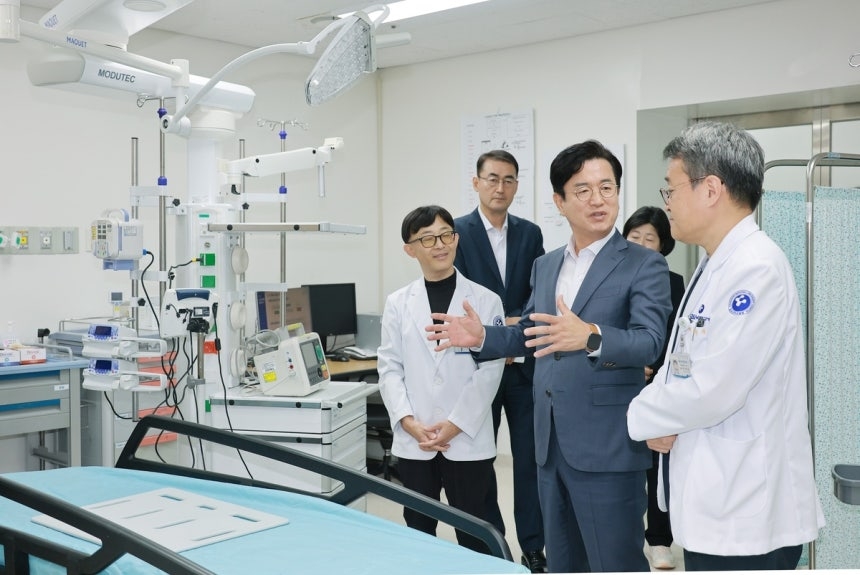
Daejeon, Gyeonggi Province, South Chungcheong Province, South Gyeongsang Province and Jeju all said they would focus on resolving immediate challenges, including fiscal difficulties, safety concerns and conflicts among local governments. Daejeon Mayor Heo Tae-jeong said he would review safety concerns surrounding the city's Urban Railway Line 2 — which was switched to a hydrogen-based system and divided into an excessive number of construction sections under the previous administration — while doing everything possible to honor the pledge to complete the line by 2030.
Gyeonggi Province Governor Choo Mi-ae postponed a press conference scheduled for Wednesday after her supplementary budget ran into trouble. A 42.24 trillion won supplementary budget incorporating 546.5 billion won in expenditure restructuring was submitted to the provincial assembly, but disagreements with the assembly prevented passage within the session, and a compromise has yet to be reached.
South Gyeongsang Province Governor Park Wan-su pointed to the limits of local finance, noting that of the province's annual budget of 14 trillion won, only 500 billion won can be allocated at the administration's discretion. He said the province would pursue its regional agenda without adding to its debt.
Jeju is weighing how to resolve the long-running dispute over a second airport. Governor Wi Seong-gon reaffirmed the existing plan to complete a public opinion-gathering process among island residents by the first half of next year through a conflict-mediation council and other deliberative channels, after which the province's position will be finalized and submitted to the Ministry of Land, Infrastructure and Transport.
ken@heraldcorp.com