
From hands-on ancient ruins to a 900-drone light show, Seoul's southeastern districts open back-to-back history festivals
Gangdong spotlights prehistoric life and nighttime light art; Songpa blends Baekje heritage with large-scale performing arts
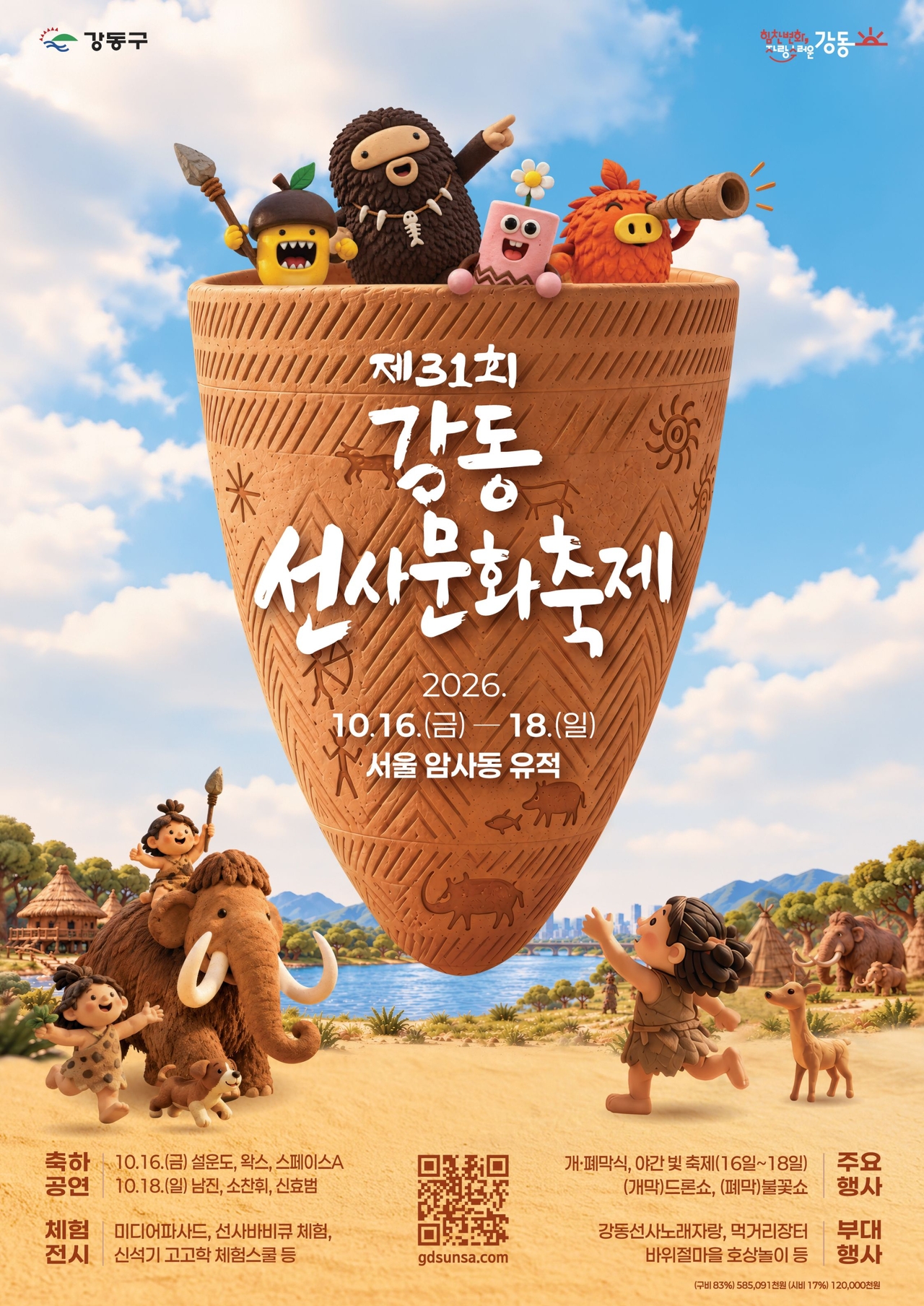
Two of Seoul's southeastern districts are set to host back-to-back history and culture festivals this autumn. Gangdong-gu will take visitors back to the Neolithic era, some 6,000 years ago, while Songpa-gu brings the cultural heritage of the Hanseong Baekje kingdom — dating back roughly 2,000 years — to life through contemporary performing arts.
Gangdong-gu will hold the 31st Gangdong Prehistoric Culture Festival from Friday to Sunday at the Seoul Amsa-dong Historic Site and Amsa History Park. Songpa-gu will follow with the 26th Hanseong Baekje Cultural Festival from Oct. 23 to 25 at the 88 Lawn area of Olympic Park.
The two festivals share a common goal: transforming Seoul's deep history and each district's local identity into cultural content that residents can enjoy. Yet they differ markedly in how they stage that history, how they use their venues, and what kind of experience they aim to deliver.
Gangdong puts the emphasis on direct, immersive encounters with actual prehistoric ruins, letting visitors experience ancient ways of life firsthand. Songpa takes a different approach, weaving Baekje history and traditional culture together with modern performing arts — classical music, gugak and K-pop — to reach a broader public.
Both festivals build local identity on a foundation of history
The most fundamental thing the two festivals have in common is that each treats its district's historical assets as its core competitive strength.
Gangdong-gu is home to the Seoul Amsa-dong Historic Site, a window into the daily life of Neolithic communities. Songpa-gu carries the historical distinction of having served as the capital of the Hanseong Baekje kingdom. Both districts are channeling these assets into cultural content that defines their local identity.
Neither festival confines history to written records or museum displays. Both bring the past to life through performances, hands-on activities and play, inviting residents to engage with history directly.
The Gangdong Prehistoric Culture Festival will offer programs that recreate Neolithic daily life — a Neolithic archaeology school, a pit-house building workshop and a prehistoric barbecue, among others. The Hanseong Baekje Cultural Festival in Songpa will lower the barrier to history through Baekje costume experiences, craft and cultural workshops, and a dedicated children's play area.
Both festivals also make resident participation a central pillar. Gangdong will stage community performances and a competition among neighborhood center programs, while Songpa will host a community gathering open to local residents. The aim in both cases is to position residents not merely as spectators but as co-creators of the festival.
The two events share yet another strategy: drawing in younger audiences and families who may have little interest in history by adding well-known singers, popular music performances and nighttime attractions.
Gangdong: 'A time trip 6,000 years back'
What sets the Gangdong Prehistoric Culture Festival apart is the venue itself — an actual historic site.
The Seoul Amsa-dong Historic Site, which serves as the festival's stage, is a historical space that illuminates the residential culture and daily life of the Neolithic period. Visitors can experience prehistoric life there firsthand, imagining the world of the people who once lived on that very ground.
This year's festival unfolds under the theme "The Beginning of Seoul, Amsa," offering a range of content from hands-on programs that reinterpret prehistoric life for a modern audience to community performances.
After dark, the festival takes on a different character. Each evening during the event, from 6 p.m. to 10 p.m., a nighttime light festival and media facade will run along the ruins' walking paths, rendering prehistoric stories in light. Projected imagery on the museum's outer walls, combined with live performances by actors on site, transforms the historic space into a new kind of nighttime cultural experience.
The result is a festival that offers two distinct appeals: history exploration and education by day, and light-and-video-driven cultural tourism by night.
The festival has not overlooked popular appeal. On opening day, singers Space A, Wax and Seol Undo will perform. The second day brings a prehistoric talk concert and a music festival. On the final day, Go player Lee Se-dol will host a talk concert, followed by performances by Shin Hyo-bum, So Chan-whee and Nam Jin.
Gangdong-gu has also highlighted that the festival is the only Seoul festival selected as a 2026–2027 preliminary festival by the Ministry of Culture, Sports and Tourism.
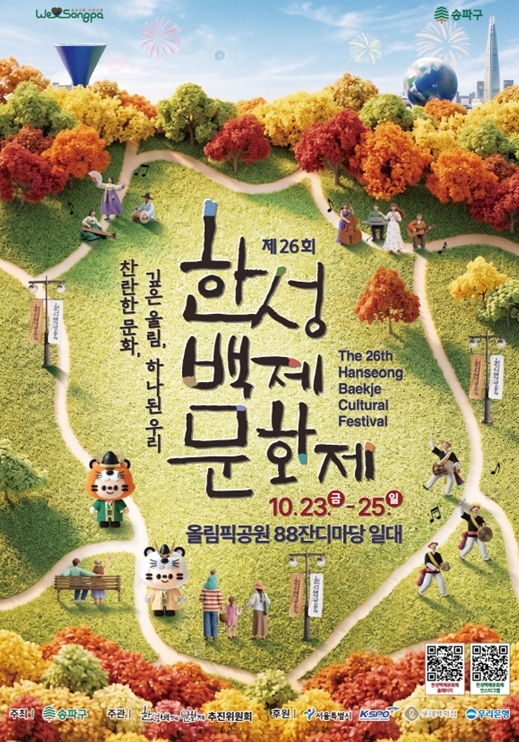
Songpa: 'Where 2,000-year-old Baekje meets K-culture'
The Hanseong Baekje Cultural Festival in Songpa is focused on expanding its historical subject matter into contemporary cultural and artistic expression.
Held under the theme "Brilliant Culture, Deep Resonance, One Community," this year's festival is defined above all by the fusion of large-scale performances and cutting-edge technology.
A multilevel main stage stretching 60 meters, an oversized LED screen, and a full lighting and sound system will heighten the atmosphere of the outdoor performances. The opening night will feature a show combining a drone display, media art and contemporary dance, with 900 drones lighting up the night sky.
The performance lineup is wide-ranging. The Songpa District Symphony Orchestra and choir will perform classical works, followed by a violin solo and a tenors' showcase. Hip-hop artist Loco and vocal duo Davichi will then bring a more festive energy to the crowd.
The final day features a 30-player geomungo ensemble performing alongside a live band, a multi-voice pansori performance by master singers, and a set by fusion gugak artist Lee Bong-geun. Global idol group Kep1er and hip-hop group Dynamic Duo will also take the stage, presenting a program that spans tradition and modernity across generations.
The goal is to connect Baekje history and culture with today's audiences not through traditional reenactment alone, but through classical music, gugak and popular music.
Families are also well catered for. More than 20 programs — including a Hanseong Baekje kids' cafe, a cypress wood playground, Baekje costume experiences, and craft and cultural workshops — along with a food market round out the festival's offerings.
The edge of a history festival lies in uniqueness, not scale
The festivals in Gangdong and Songpa are each building on distinct historical assets to develop their own competitive strengths.
Where Gangdong uses actual prehistoric ruins to offer the experience of stepping into history, Songpa reinterprets Baekje cultural heritage through large-scale performances and contemporary content. One leans toward the raw immediacy of a historic site; the other toward the fusion of history and performing arts.
That said, the success of a history festival cannot be measured by the size of its stage or its visitor numbers alone. Spectacular productions and famous performers help draw crowds, but the power to make visitors remember a district's historical value — and want to return — comes from content that is genuinely unique.
Encouraging festival-goers to also visit nearby businesses and tourism facilities remains a challenge. A festival's long-term viability depends on whether it can move beyond a one-off event to drive local economic activity and strengthen the district's identity as a destination.
Gangdong needs to keep developing its strategy of raising awareness of the Amsa-dong site's historical value and linking it to hands-on activities and nighttime tourism. For Songpa, the priority is connecting the historical significance of Hanseong Baekje to the district's broader tourism resources, rather than letting it rest on the success of big-name performances alone.
The two festivals unfolding this autumn in Seoul's southeastern districts show that history can be a genuine competitive asset for a modern city — where the stories of the Neolithic era 6,000 years ago and the Hanseong Baekje kingdom 2,000 years ago come alive for residents and visitors alike.
Ultimately, the true strength of both festivals lies not in who builds the bigger stage, but in how compellingly and sustainably each district can transform its own irreplaceable history into cultural content worth experiencing.
seouldream01@heraldcorp.com





