
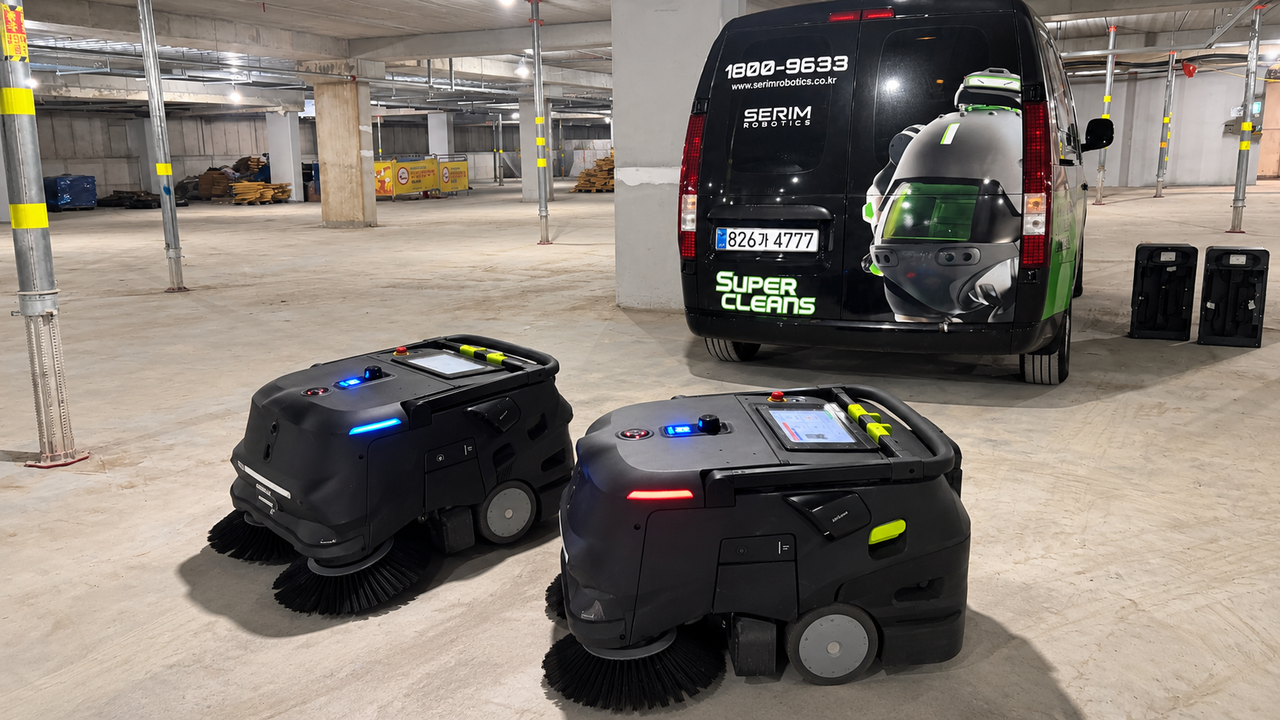
Industrial cleaning robots developed by domestic robotics firm Serim Robotics have been deployed at major construction sites run by GS Engineering & Construction and Posco E&C, marking a significant commercial breakthrough in one of the harshest working environments in the industry.
Until now, industrial cleaning robots have been used mainly in structured indoor spaces such as manufacturing factories, logistics centers and large retail facilities. Construction sites, by contrast, have long been considered inhospitable to robotic operations — they generate constant clouds of dust and cement powder, see steel reinforcements, materials and heavy equipment moved around at all hours, and undergo frequent layout changes as work progresses through different phases.
The key to Serim Robotics' success in this environment lies in its advanced autonomous driving and environmental recognition technology. The robots are equipped with high-performance AI cameras and multiple sensors that detect and avoid obstacles and shifting site layouts in real time. Rather than simply repeating pre-programmed routes, they respond flexibly to dynamic on-site conditions.
The robots also stand out for cleaning efficiency. A large-area dust-collection system allows them to travel continuously across vast concrete floors for extended periods, powerfully suctioning and filtering fine particles from construction waste. This addresses worker health protection and site cleanliness at the same time.
To serve sites of varying scale and operational needs, Serim Robotics offers a tiered product lineup — the Dusti, Dusti Pro and Dusti MAX — providing tailored automation solutions for settings ranging from dry warehouses to high-rise and large-scale construction complexes.
Industry observers say the deployments at GS Engineering & Construction and Posco E&C go beyond a simple equipment supply deal and could accelerate the broader "smart site management" trend across the construction sector. The rollout demonstrates that the benchmark for robotic capability has evolved from basic driving tests to real-world performance in the most demanding industrial environments.
"Construction sites are a high-difficulty stage that demands both hardware durability and software precision far beyond what ordinary indoor spaces require," a Serim Robotics official said. "Building on our deployment at major domestic construction sites, we will solidify our market leadership with a high-performance autonomous cleaning solution capable of operating flawlessly across a wide range of extreme industrial environments."
leechemy@heraldcorp.com





