
Hazardous substance reports for imported food rise 31.6%
'Item inspections must be strengthened, sanctions made more effective'
![A foreign object found mixed into malatang ingredients at the intake stage. [Ministry of Food and Drug Safety]](https://wimg.heraldcorp.com/news/cms/2026/10/13/news-p.v1.20261013.ad471bf8d3674c76abb0fd5b0ce46b97_P1.png)
Reports of hazardous substances found in imported food circulating in South Korea rose nearly 32 percent last year from the year before, with most complaints involving foreign objects such as insects or metal fragments. One in three reports involved food products from China.
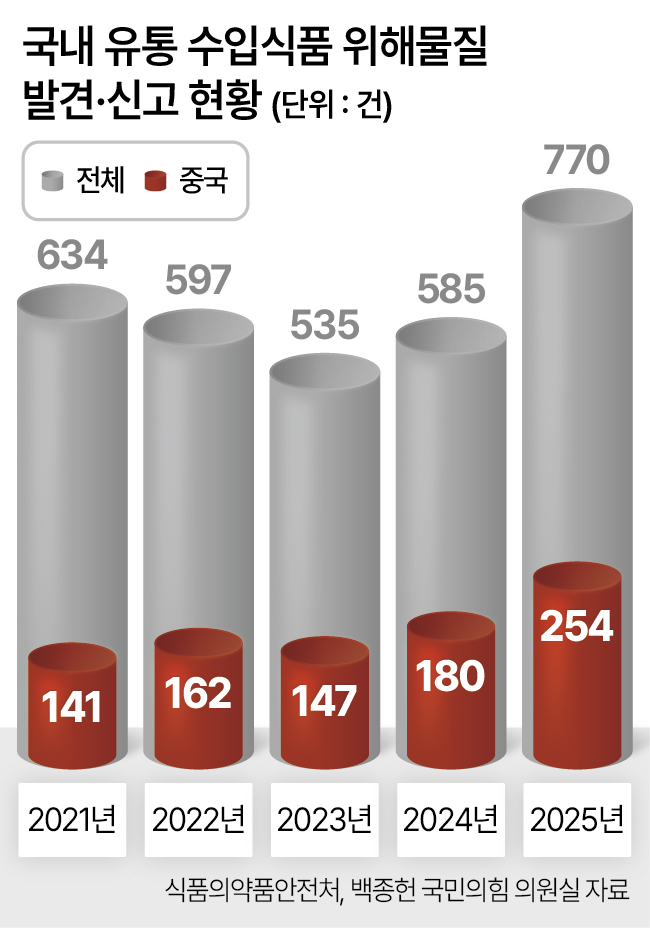
According to data submitted to the National Assembly by the Ministry of Food and Drug Safety, hazardous substance reports related to imported food reached 770 last year, a 31.6 percent increase from the previous year and the highest figure in the past five years. The data was released Tuesday by People Power Party lawmaker Baek Jong-heon, who leads the opposition party's side on the National Assembly's Health and Welfare Committee. The figures combine reports of foreign objects found in food with reports of abnormal color, taste or smell, and health problems following consumption.
Reports of foreign objects totaled 762, up 33.0 percent from the previous year. Common foreign objects include insects, mold, hair, metal fragments, plastic and glass shards. Typical cases involve insects mixed into raw ingredients that are not properly filtered out, or steel wool fragments entering food during the washing process. Wire has been found mixed into glass noodles or rice cakes used in malatang dishes, and metal or plastic fragments have turned up after cooking utensils broke during preparation.
By country of origin, Chinese food products drew the most reports. The 254 reports involving Chinese products last year accounted for 33.0 percent of the total, a 41.1 percent increase from the year before. The number of reports involving Chinese products has risen for two consecutive years, climbing from 147 in 2023 to 180 in 2024 and 254 last year.
The share of reports attributable to Chinese products has also consistently grown. It rose from 22.2 percent in 2021 to 27.1 percent in 2022, 27.5 percent in 2023, 30.8 percent in 2024 and 33.0 percent last year. Of the 3,121 hazardous substance reports filed over the five-year period from 2021 through last year, 884 — or 28.3 percent — involved Chinese products. New Zealand came second with 263 reports (8.4 percent), followed by the United States with 245 (7.9 percent), Germany with 162 (5.2 percent) and Vietnam with 153 (4.9 percent).
In the first half of this year, hazardous substance reports for imported food reached 357 in total. Reports involving Chinese products numbered 129, up 7.5 percent. The share of Chinese products also rose, from 33.7 percent in the first half of last year to 36.1 percent in the first half of this year.
Safety concerns over Chinese food ingredients have continued to mount. In August, it emerged that some Chinese cabbage buyers had used formaldehyde solution — classified as a carcinogen — to preserve freshness. Last month, reports that bamboo shoots from some regions of China had been processed by fumigation with sulfur sparked further controversy.
By food category, reports involving processed food rose 36.6 percent last year from the previous year to 597 cases, accounting for 77.5 percent of all reports. Livestock products followed with 153 reports, ahead of health functional foods with 12, and agricultural and fishery products with four each. Over the past five years, processed food reports totaled 2,411, representing 77.3 percent of all cases.
The number of imported food products in retail circulation that failed safety inspections reached 329 over the past five years. A failing determination is issued when the Ministry of Food and Drug Safety finds that a product does not meet safety standards or specifications. Agricultural products accounted for the largest share at 120 cases (36.5 percent), followed by processed food (31.6 percent), health functional foods (20.7 percent), fishery products (4.9 percent) and livestock products (2.4 percent).
Meanwhile, administrative sanctions related to hazardous substances — including foreign objects, pesticides and heavy metals — in imported food totaled 530 cases over the past five years. Correction orders made up the vast majority at 76.4 percent, while business suspension orders were limited to 125 cases (23.6 percent). Last year, correction orders accounted for 100 of the 124 total administrative sanctions, or 80.6 percent, with business suspensions making up only 19.4 percent.
A correction order requires a business to remedy a violation, while a business suspension bars operations for a set period. The share of business suspensions was the lowest in the past five years. With administrative sanctions concentrated in correction orders, questions have been raised about whether the current penalties are effective enough.
"Reports of hazardous substances in imported food reaching our tables are increasing every year," Baek said. "We need to strengthen item-by-item inspections for countries where reports are surging and find ways to make sanctions more effective."
![A Korea Customs Service official at the Seoul headquarters customs office in Gangnam-gu sorts through seized Chinese processed food products in a confiscated goods warehouse. [Newsis]](https://wimg.heraldcorp.com/news/cms/2026/10/13/news-p.v1.20261013.7d2ded501f51423ea670e915e893fca4_P1.jpg)
korean@heraldcorp.com





