2031 debt ratio outlook revised down from 63.1% to 51.3%, reflecting improved growth and revenue conditions; South Korea's growth rate seen outpacing global average for first time in 16 years
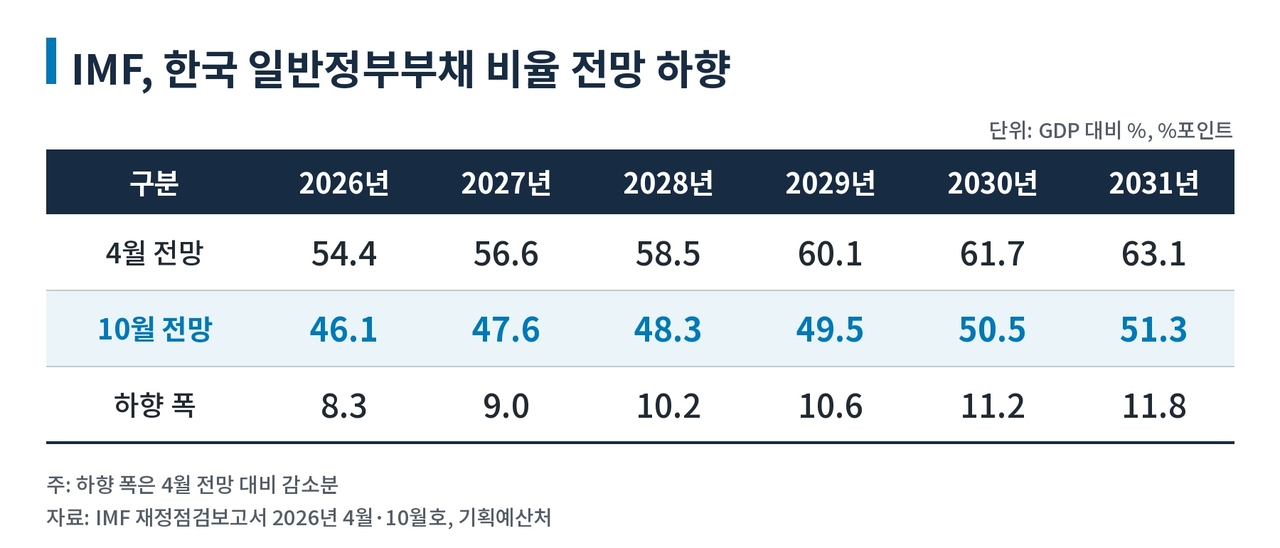
The International Monetary Fund has sharply revised down its forecast for South Korea's general government debt as a share of GDP, cutting the outlook for this year from 54.4 percent to 46.1 percent and the 2031 projection from 63.1 percent to 51.3 percent. The revisions reflect an upgraded economic growth forecast and the prospect of improved revenue conditions.
According to the Ministry of Planning and Budget, the IMF published the October edition of its Fiscal Monitor on Wednesday, projecting South Korea's general government debt ratio at 46.1 percent for this year — down 8.3 percentage points from its April forecast. The 2031 outlook was also lowered by 11.8 percentage points, from 63.1 percent to 51.3 percent.
South Korea's debt ratio is not only lower than those of major advanced economies but is also expected to rise by a smaller margin going forward. At 46.1 percent this year, it stands at roughly 37 percent of the G7 average of 123.6 percent and about 43 percent of the advanced-economy average of 107.6 percent. Among the 38 advanced economies covered in the IMF's statistical tables, South Korea ranks 25th highest in debt ratio.
South Korea's debt ratio is projected to rise by 5.2 percentage points between this year and 2031, below the advanced-economy average of 7.0 percentage points and the G7 average of 9.8 percentage points.
The Ministry of Planning and Budget said the IMF cited strong GDP growth and the prospect of improved revenue conditions through 2030 as the main reasons for the downward revision. The government assessed that the medium-term outlook reflects a "virtuous cycle of fiscal policy and growth," in which active fiscal spending supports growth and the resulting expansion of the tax base strengthens fiscal sustainability.
Major international credit rating agencies have also recently offered positive assessments of South Korea's fiscal position. Fitch said in September that South Korea's fiscal performance had improved significantly beyond expectations and that the trajectory of national debt remained stable; it also noted that a future response fund could help cushion the volatility of fiscal revenues caused by economic fluctuations. Moody's, also in September, said the government's budget proposal for next year channels surplus tax revenues into future growth, striking a balance between fiscal sustainability and expansion.
The ministry said it would "support bold investment to underpin a rebound in potential growth and secure fiscal sustainability, backing a virtuous cycle in which future investment leads to growth and an expanded revenue base."
Earlier, in its World Economic Outlook released Tuesday, the IMF raised its real GDP growth forecast for South Korea this year by 0.7 percentage points to 3.3 percent from its July projection, saying strong external demand for semiconductors would offset the negative effects of the war in the Middle East. If realized, that would exceed the global growth forecast of 3.1 percent — the first time South Korea has outpaced the world average since 2010, excluding 2020 when the COVID-19 pandemic struck. The IMF also raised its growth forecast for South Korea next year from 2.5 percent to 2.8 percent.
According to IMF data, South Korea's GDP per capita is projected to reach $43,512 this year, surpassing the $40,000 mark for the first time. That would represent an increase of $7,104, or 19.5 percent, from last year's estimated figure of $36,408. South Korea's nominal GDP is also expected to exceed $2 trillion for the first time, reaching $2.245 trillion.
fact0514@heraldcorp.com