Shinchonji allegations unresolved, fanning factional tensions
Leadership's resolve in focus as special counsel push targets year-end
Chief justice impeachment debate surfaces: 'All options on the table'
'Check government' sentiment leads ahead of next general election, 47% vs. 34%
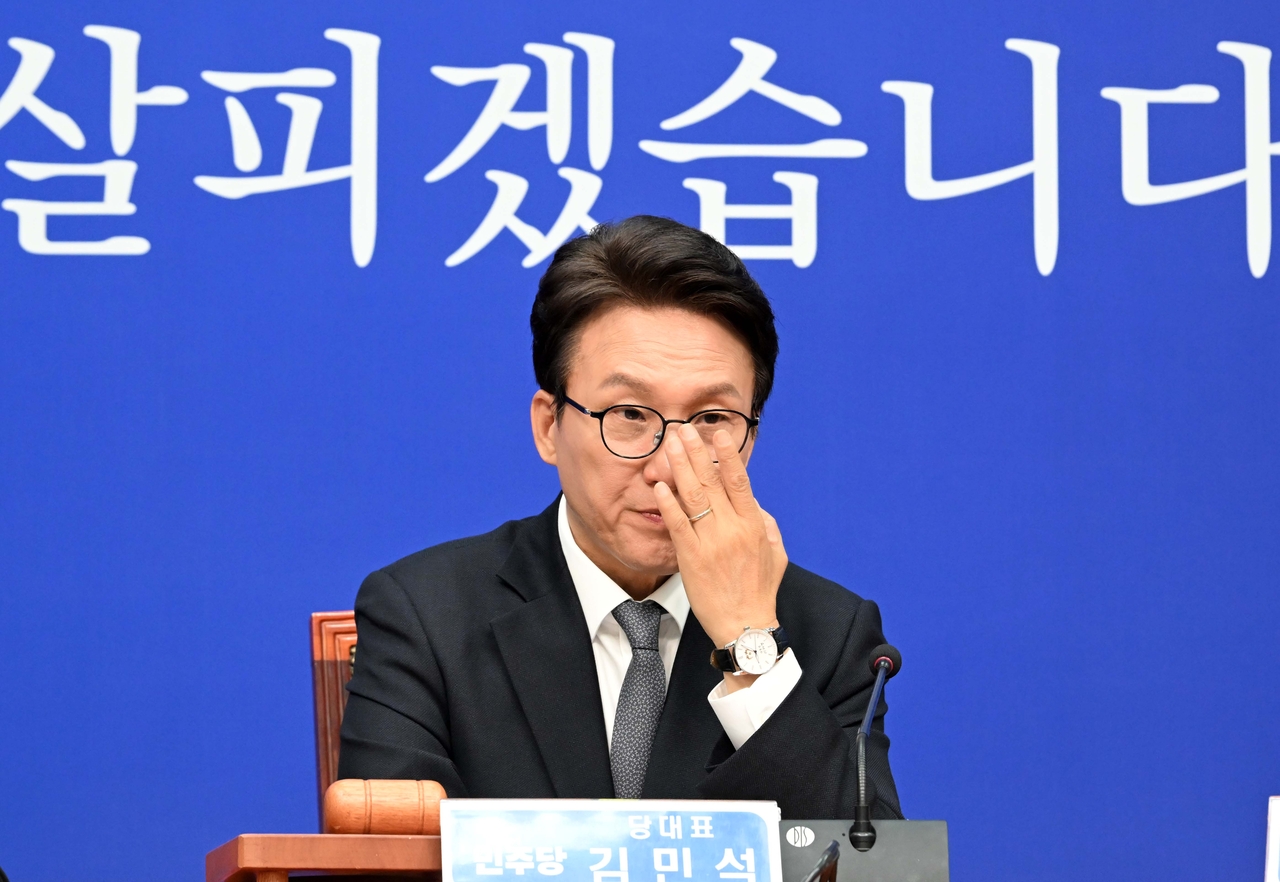
Democratic Party of Korea leader Kim Min-seok is expected to turn his full attention to a mounting pile of political challenges now that the annual national audit is wrapping up. Issues ranging from allegations of mass membership enrollment by followers of the Shinchonji Church of Jesus to a special prosecutor bill targeting fabricated indictments and the possible impeachment of Supreme Court Chief Justice Jo Hee-dae are all queued up for the party's attention. With sagging approval ratings and simmering factional tensions adding to the pressure, observers say Kim's political leadership is facing a genuine test.
According to political sources, the Democratic Party plans to take up the major political issues set aside during the national audit once the audit concludes Saturday. Because internal opinion is divided on each issue and the political stakes are high, the key question is how the party leadership will calibrate the timing and intensity of its response.
The most immediate headache for Kim is the allegation that Shinchonji church members enrolled en masse as party members. Both the pro-Jung Chung-rae and pro-Lee Jae Myung factions agree that the truth must be established and a conclusion reached quickly, but they differ on how the investigation should be conducted and how much of the findings should be made public.
The party leadership recently decided to take more time before announcing any findings on signs of Shinchonji involvement. Kim said testimony had been secured pointing to a pattern of mass enrollment by church members. He appears to be holding back for now, given that the investigation's conclusions could trigger demands for accountability within the party and calls for follow-up action.
The special prosecutor bill targeting fabricated indictments is also high on the party's post-audit legislative agenda. The Democratic Party has maintained that allegations of prosecutorial misconduct in past investigations must be examined. Voices within the party have been growing louder for the leadership to accelerate the special counsel push after the audit.
Supreme Council member Jeon Yong-gi has been pressing the leadership repeatedly to move the bill forward. Speaking on YTN Radio on Thursday, Jeon said the fabricated-indictment special counsel "could play a significant role in driving up support among the party's base," and announced that a reporting session on fabricated indictments would be held at the National Assembly on Oct. 28.
"We are preparing a discussion in the form of presenting fabricated-indictment cases," he said. "We plan to explain in detail to the public that because such cases existed, we must introduce the fabricated-indictment special counsel to hold those responsible accountable — and that this is the completion of prosecutorial reform."
There is a growing sense within the party that the special counsel bill should be passed before the end of the year. Some observers suggest the period around the passage of the December budget bill could be a key juncture for the legislative push. A lawmaker on the National Assembly's Legislation and Judiciary Committee said it "would be possible to pass the special counsel bill immediately after the budget is approved."
The question of impeaching Chief Justice Jo Hee-dae is also expected to emerge as a major political flashpoint after the audit. In a phone interview on the YouTube program "Minti07" on Thursday, Kim said, "Because broad calls for impeachment have already emerged, we have begun discussing all issues, options and paths."
He added that he had previously believed it was better "not to utter even the first syllable of the word 'impeachment' for a while, and instead go through the process of fully explaining the situation to the public and seeking their understanding — and that is how we have proceeded." He said the party was now "comprehensively compiling the reasons why resignation has become unavoidable." The remarks signal that the party leadership, which had maintained a cautious stance on impeachment, is now putting the issue squarely on the table for formal discussion.
Against this backdrop of overlapping political challenges, the party's sluggish approval ratings are adding to Kim's burden. At the party convention, Kim pledged to lift the party's approval rating by 10 percentage points within 100 days of taking office, but a clear rebound has yet to materialize.
Speaking to reporters, Kim said the party was "in a process of change aimed at halting the decline and achieving stability," and that "in about a month or two, we will be able to show the direction the Democratic Party under its new leadership is heading."
Meanwhile, a Gallup Korea survey released Friday — conducted Tuesday through Thursday as part of its third-week October polling — showed that "check the government" sentiment outpaced the "support the government" view when respondents were asked about their expectations for the next general election.
In the 23rd general election for National Assembly members, scheduled for April 2028, 47 percent of respondents said more opposition candidates should win to check the current government, compared with 34 percent who said more ruling party candidates should win to support it — a gap of 13 percentage points.
In Seoul, the gap was particularly wide: 55 percent favored checking the government against 30 percent who favored supporting it, a 25-percentage-point difference. In Incheon and Gyeonggi Province, the check-government view also led, at 52 percent versus 31 percent. Even among self-identified moderates, the check-government sentiment (44 percent) outpaced the support-government view (36 percent).
While the Democratic Party has maintained a lead over the People Power Party in party approval ratings since the current government took office, the general election expectations survey showed the reverse dynamic. Still, with roughly a year and seven months remaining before the election, some caution against reading too much into the current numbers. One first-term lawmaker said that if a Seoul mayoral election were held next year, "it would be an election right on the eve of the general election, so we would move nationally and in an organized way — but it's still too early to predict anything."
The survey was conducted through telephone interviews using randomly selected virtual numbers provided by three mobile carriers, with 1,003 eligible voters aged 18 and older nationwide. The response rate was 10.4 percent, with a margin of error of plus or minus 3.1 percentage points at a 95 percent confidence level. For further details, visit the website of the National Election Survey Deliberation Commission.
thanks@heraldcorp.com