5,224 foreign workers assigned to penalized workplaces last year
283 dormitory violations found; only 10 workers applied to change workplaces
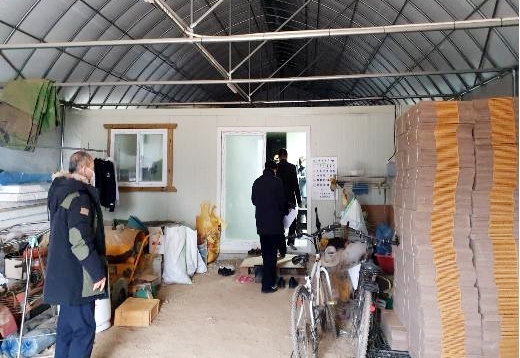
Workplaces that violated dormitory standards for foreign workers and received penalty deductions were still allocated foreign labor in the vast majority of cases, raising questions about the effectiveness of the deduction system. Last year, 98.2 percent of employment permit applications penalized for dormitory violations still received foreign worker allocations.
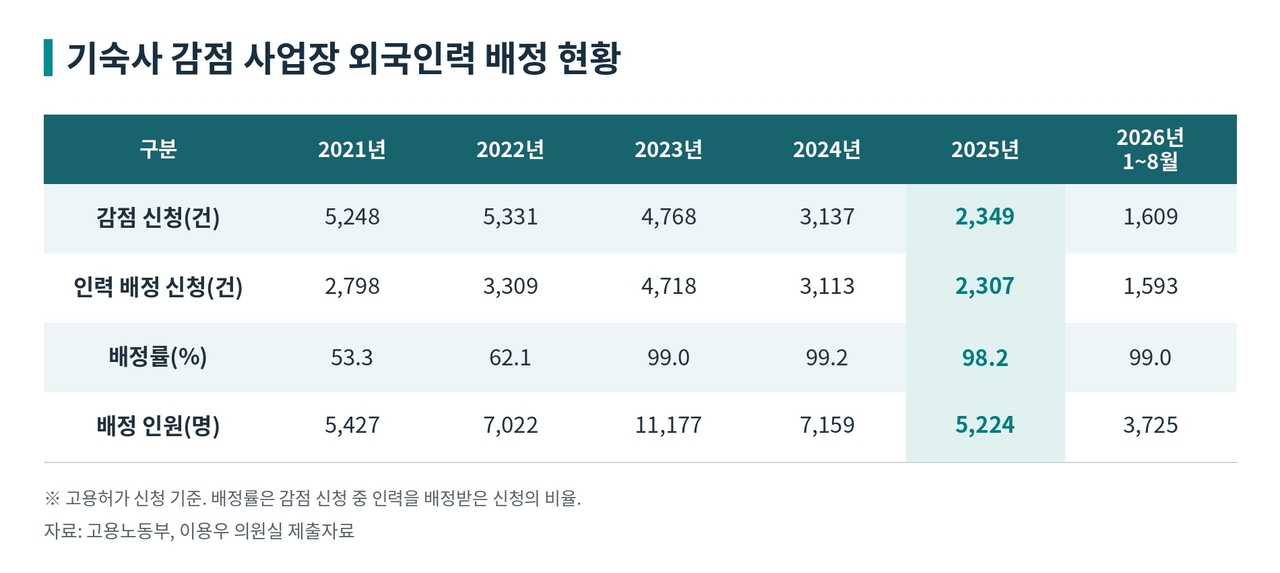
According to data submitted to Democratic Party of Korea lawmaker Lee Yong-woo of the National Assembly's Climate, Energy, Environment and Labor Committee by the Ministry of Employment and Labor, 2,307 of the 2,349 employment permit applications penalized last year for failing to meet dormitory requirements — or 98.2 percent — were still granted foreign worker allocations. A total of 5,224 foreign workers were assigned to those workplaces. Only 42 applications, or 1.8 percent, were denied allocations despite receiving deductions for substandard dormitories.
Under the employment permit system, workplaces that cannot find Korean workers may hire foreign nationals with government approval. The government evaluates applicants based on their need for labor and their employment management record, assigning workers in order of score. Points are deducted for violations of labor laws or failure to meet dormitory requirements.
In practice, receiving a deduction for dormitory violations carries little meaningful penalty when it comes to securing foreign worker allocations.
Ministry of Employment and Labor data show that in 2021, workers were allocated to 2,798 of the 5,248 penalized applications, an allocation rate of 53.3 percent. The rate rose to 62.1 percent in 2022, then climbed sharply to 99.0 percent in 2023 and 99.2 percent in 2024. Last year the figure was 98.2 percent, and through August this year, 1,593 of 1,609 penalized applications had received allocations — placing 3,725 workers — for a rate of 99.0 percent.
Breaking down last year's penalized applications by industry, manufacturing accounted for the largest share at 1,388 cases, of which 1,367 received allocations totaling 3,308 foreign workers. In fisheries, 685 of 698 penalized applications were granted allocations covering 1,131 workers, while in agriculture and livestock, 202 of 208 applications received 421 workers.
Separate from the employment permit scoring system, on-site inspections by regional employment and labor offices found 283 dormitory standard violations last year — 209 for breaches of installation and operating requirements and 74 for failing to provide workers with advance dormitory information. In the first half of this year, inspectors found another 158 violations, including 121 installation and operating breaches and 37 failures to provide advance information.
Yet the number of workers who applied to change workplaces citing housing problems was limited to just 10 last year. Four of those applications cited the provision of vinyl greenhouses or illegal temporary structures as housing, while six cited dormitory-related reasons. By industry, seven were in manufacturing and three in agriculture and livestock. In 2024, the combined total of workplace-change applications under both categories was 14.
A representative of a civic group in Pocheon, Gyeonggi Province, that supports foreign workers offered an explanation for the low number of applications. "It has become known that switching workplaces does not make it easy to find one that meets the requirements, so workers simply do not bother applying," the representative said.
fact0514@heraldcorp.com