Yu bows head at National Assembly culture committee audit
'Deeply sorry to museum staff as well,' director says
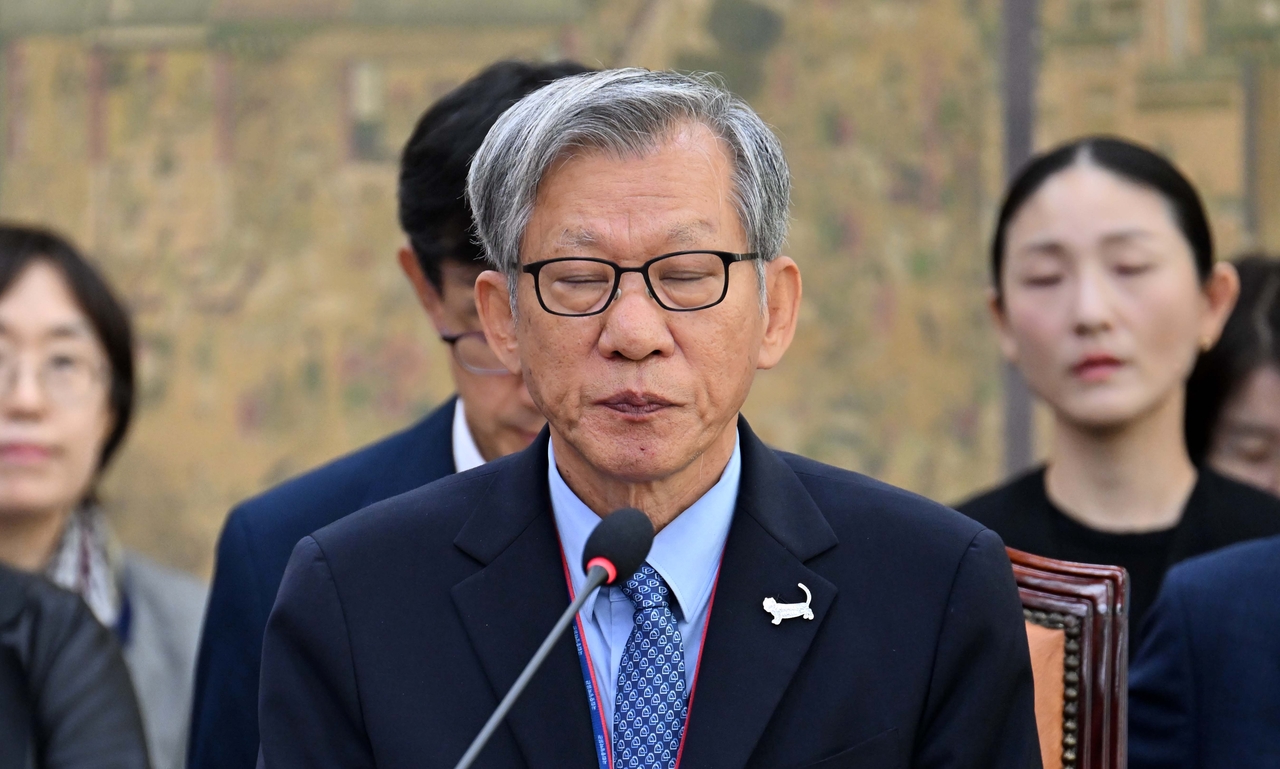
National Museum of Korea Director Yu Hong-jun issued a public apology Monday over a controversy in which a piece of calligraphy by a pro-Japanese collaborator from his personal collection was recommended by him for display at the museum and incorrectly attributed to a patriotic independence activist.
Appearing before the culture and sports committee's national audit at the National Assembly, Yu bowed his head and said the trust the public had placed in the National Museum of Korea, and the value built through the efforts of its staff, "collapsed in an instant due to my grave negligence."
Yu also extended his apology to the public, independence activists and their bereaved families. "Due to insufficient historical verification, a piece of calligraphy by a pro-Japanese collaborator was incorrectly displayed as a work by a patriotic independence activist, causing great distress to the public and to history," he said. "The error has deeply wounded the honor of the independence movement and the hearts of the bereaved families."
Yu also addressed the museum's staff directly. "I caused the museum to face public criticism through controversy surrounding my personal collection," he said. "I feel deeply sorry and apologetic toward the staff."
Yu then acknowledged that he had failed to be fully transparent when the museum first responded to the controversy. "When we withdrew the exhibit and announced the verification results, I did offer a public apology, but I did not forthrightly disclose that the piece was from my personal collection," he said. "My failure to publicly acknowledge my own mistake as an art historian is a grave error on my part. I apologize once again."
The controversy stems from a recent special exhibition at the National Museum of Korea in which a piece of calligraphy bearing the inscription "ilban siguge-un" — meaning "even a bowl of rice is a grace bestowed by the nation" — was incorrectly presented as the work of independence activist Park Won-geun (1912–1950).
After the activist's family raised doubts about the work's authenticity, the museum removed it on Aug. 10. Following further verification, the museum concluded that the calligraphy was in fact the work of Park Jung-yang, a known pro-Japanese collaborator.
The National Museum of Korea subsequently disclosed that the piece belonged to Yu's personal collection and had been included in the exhibition at his recommendation, setting off a wider controversy. Yu purchased the work at auction in 2019 for 50,000 won ($37).
bigroot@heraldcorp.com
raining@heraldcorp.com