Korea Aerospace Research Institute lends 129 types of assembly equipment to Hanwha Aerospace free of charge
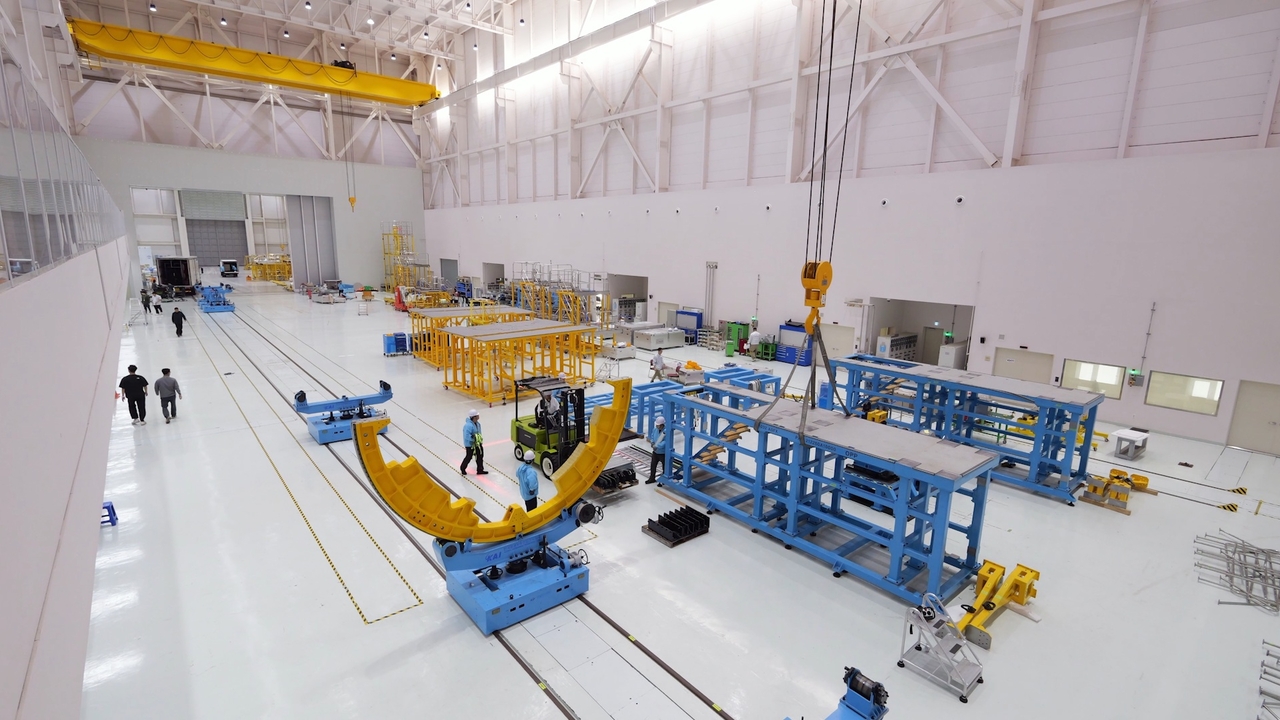
Assembly work on South Korea's homegrown Nuri rocket is set to shift fully to the private sector. Starting with the sixth Nuri launch vehicle, scheduled for liftoff in 2027, Hanwha Aerospace will handle first-, second- and third-stage assembly at its facility in Suncheon, South Jeolla Province.
The Korea Aerospace Research Institute announced Monday that it had completed the transfer of 129 types of assembly equipment to Hanwha Aerospace's Suncheon stage-assembly plant, a move designed to hand off stage-assembly operations to the company.
Until now, Nuri assembly had taken place at the Launch Vehicle Integration Building at the Naro Space Center in Goheung, South Jeolla Province. From the sixth vehicle onward, Hanwha Aerospace will assemble each of the three stages separately in Suncheon. The completed stages will then be transported by sea to the Naro Space Center, where the institute will carry out final integration — joining the stages into a single rocket — and launch preparations.
To support the transition, the institute selected 129 types of jigs and fixtures from the 204 it has used in Nuri assembly and lent them to Hanwha Aerospace at no cost. The remaining 75 types will stay at the Naro Space Center for use in final vehicle integration.
Jigs and fixtures are specialized tools used to move rocket components, hold them in precise positions and assemble them with high accuracy. They play a critical role in aligning mating surfaces correctly and maintaining consistent assembly quality.
The transferred equipment embodies the design and assembly expertise, as well as hands-on experience, that the institute accumulated during Nuri's development. By using existing equipment, the private company can avoid the cost of developing or manufacturing new tools while maintaining the same level of assembly precision and quality.
The institute plans to go beyond simply lending the equipment, providing technical oversight and on-site support to pass on its Nuri assembly know-how. It will work alongside Hanwha Aerospace to analyze and resolve issues that arise during actual assembly, helping the company build independent assembly capabilities.
The move is part of a broader effort to transfer the manufacturing and assembly technology developed under the government-led Nuri program to the private sector. With a private company now taking direct charge of stage-assembly work, the shift to industry-led development of domestic space launch vehicles is expected to accelerate.
"This equipment loan is a step in carrying forward the tools and experience accumulated during Nuri's development into the private sector's own launch vehicle assembly capabilities," Korea Aerospace Research Institute President Lee Sang-cheol said. "We will continue to provide technical support and share our know-how so that the private sector can carry out Nuri assembly reliably and build up its own field experience."
nbgkoo@heraldcorp.com