Forced liquidations have approached 300 billion won ($223 million) over just the first half of October as the Kospi shed more than 20 percent, while total margin debt outstanding remains near 33 trillion won — fueling growing concern over further compulsory sell-offs. Analysts at domestic brokerages say a short-term rebound will be difficult given sustained foreign net selling and weakening retail investor sentiment.
According to the Korea Financial Investment Association, cumulative forced liquidations against unsettled credit balances totaled 298.1 billion won from Oct. 6 through Thursday. On Wednesday and Thursday alone, forced liquidations reached 89.3 billion won and 80.5 billion won, respectively — the highest daily figures since July 31, when they hit 122 billion won.
The ratio of forced liquidations to unsettled credit balances has also climbed. On Wednesday, the ratio reached 7.2 percent, the highest since July 31, when it stood at 7.1 percent. After hovering around 2 percent at the start of the month, the ratio rose to 5.6 percent on Tuesday before continuing higher.
Forced liquidation occurs when an investor fails to repay a brokerage by a set deadline, allowing the brokerage to sell the investor's shares without consent. In unsettled-credit transactions, the process is triggered when the investor cannot cover the outstanding balance by the stock settlement date. When share prices fall sharply, the volume of forced sell-offs increases, pushing prices down further in a vicious cycle.
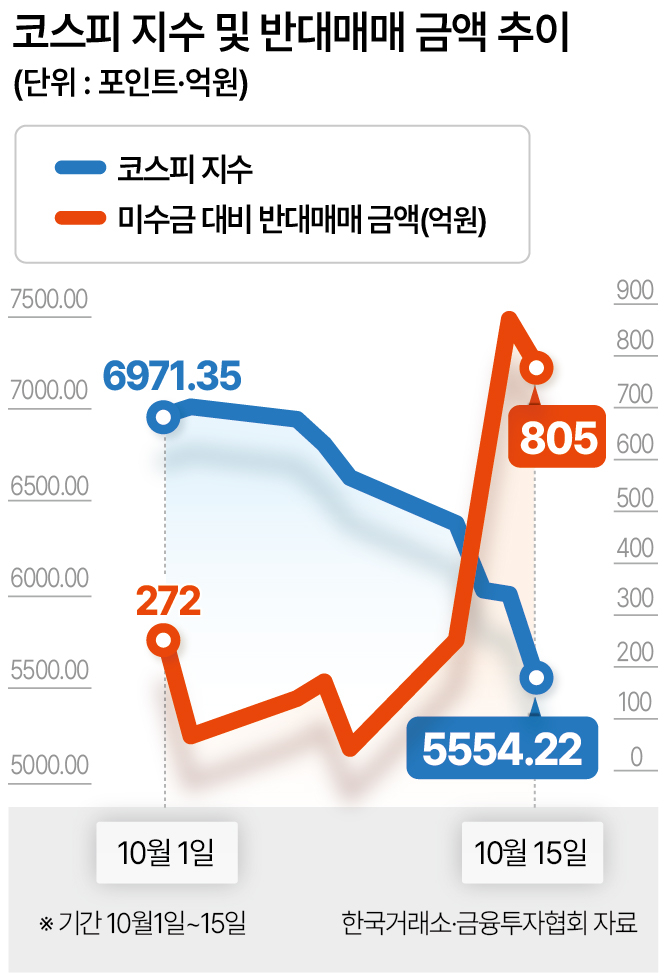
The Kospi tumbled 21 percent in just seven trading sessions through Friday this month. Since the 1980s, only three periods have seen a steeper decline over the same span: December 1997 (-25 percent), October 2008 (-31 percent) and March 2020 (-25 percent). The speed and depth of the drop have heightened fears of additional forced liquidations.
"The average Kospi level at which new margin purchases were concentrated is around 6,660 points, meaning estimated paper losses stood at roughly 17 percent as of Thursday," said Lee Jun-young, a researcher at Eugene Investment & Securities. "Assuming a margin requirement of 40 percent, collateral ratios would have fallen below 140 percent, making those positions subject to margin calls and forced liquidation."
A deeper concern is that margin loan balances have barely declined despite the market rout. According to the Korea Financial Investment Association, the outstanding balance of margin loans fell only 2.18 percent — by 730.9 billion won — from 33.48 trillion won on Oct. 1 to 32.75 trillion won on Thursday. Balances also hovered around 33 trillion won at the end of August and September, holding at similar levels for roughly three months.
"The buildup of margin positions suggests the near-term floor may not yet be in," said Kim Jun-young, a researcher at iM Securities. "Confirming a bottom will require watching for a peak-out in forced liquidations and a reduction in margin balances."
Analysts broadly expect the Kospi to struggle to stage a quick rebound, unlike in July. Persistent foreign net selling, deteriorating retail investor sentiment, and the end of share buyback programs at Samsung Electronics and SK hynix have all combined to weaken the buying support underpinning the market.
Circuit breakers were triggered on two consecutive days — July 28 and 29 — across both the Kospi and Kosdaq markets. The Kospi then surged 17 percent in a single session on July 31, staging a rapid recovery.
"When you factor in the decline in deposited funds and the slowdown in bargain-hunting inflows into ETFs, conditions have become less conducive to the same scale of buying participation seen before," said Kim Seok-hwan, a researcher at Mirae Asset Securities. "This suggests the market's buffer capacity to absorb foreign selling may have diminished."
Investor deposit balances — a closely watched gauge of money waiting to enter the market — have been shrinking. According to the Korea Financial Investment Association, total investor deposits fell 7.41 percent, from 104.66 trillion won to 96.91 trillion won, between Oct. 1 and Thursday. Compared with the end of June, the figure has dropped more than 20 percent.
"Rather than expecting a swift recovery like July's, investors should wait to confirm that the intensity of foreign selling is easing and that net purchases are returning," Kim said.
Hwang Su-wook, a researcher at Meritz Securities, said the Korean market — already down 21 percent from its recent peak — looks attractive on fundamental and valuation grounds, but cautioned that a swift V-shaped rebound is hard to predict. "With AI funding concerns at the center of the picture, investors need to weigh the risk of further deterioration against potential rebound triggers and position accordingly," he said.

moon@heraldcorp.com