Repair businesses concentrated in cities and towns, leaving rural villages severely underserved
Water, heating and electrical repairs top unmet-need list; resident-led service model urged
KREI calls for shift beyond facility expansion toward community-run service networks

About three in 10 rural residents need basic home repairs — such as replacing door handles or window screens — yet 94.4 percent of those who need such services cannot access them, a new report has found. Researchers point to poor living conditions in rural areas, where repair services are hard to find nearby. Service providers are concentrated in cities and towns, and population decline has further eroded the private-sector service base, leaving villages — known in Korean as "myeon" areas — with a particularly serious gap in everyday services.
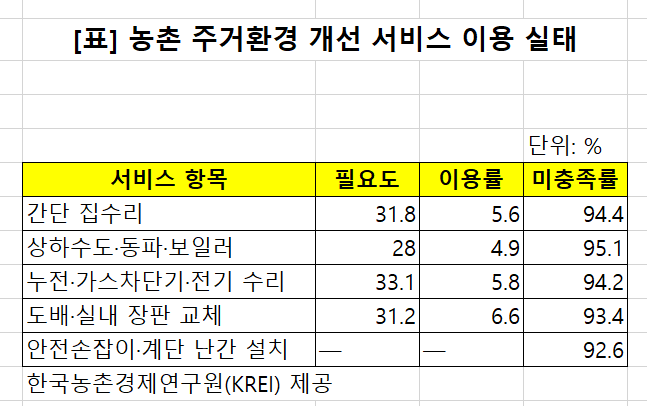
The findings come from a report released Tuesday by the Korea Rural Economic Institute, titled "Transforming Rural Policy in Response to Low Birth Rates and Super-Aging (Year 2 of 2)." An analysis of rural residents' service needs and usage found that unmet-need rates for residential environment improvement services exceeded 90 percent across nearly all categories.
Some 31.8 percent of residents said they needed basic home repairs, but only 5.6 percent had actually used such services, leaving an unmet-need rate of 94.4 percent. Basic home repairs include fixing door handles, window screens and washbasins, as well as replacing light bulbs and fluorescent tubes.
For water supply, drainage, pipe-freezing and boiler-related services, 28.0 percent of residents said they had a need, but only 4.9 percent used them. The unmet-need rate of 95.1 percent was the highest of any residential improvement category surveyed. Electrical repairs — covering short circuits, circuit breakers and general wiring — showed a need rate of 33.1 percent, a usage rate of 5.8 percent and an unmet-need rate of 94.2 percent.
Wallpapering and indoor flooring replacement told a similar story: 31.2 percent of residents said they needed the service, but only 6.6 percent had used it, for an unmet-need rate of 93.4 percent. For safety grab-bar and stair-railing installation, 92.6 percent of those who needed the service had been unable to use it.
The geographic concentration of service providers was identified as the main reason rural residents struggle to access home repair services. According to the report, 81.2 percent of businesses in major everyday service sectors are concentrated in urban areas. Even within rural regions, service facilities tend to cluster in town centers, making it difficult for village residents to access a range of everyday services. Population decline has also made it harder for private businesses to sustain operations, further weakening the rural service supply base.
The shortfall extended beyond home repairs to services needed for daily living. The unmet-need rate for waste and garbage disposal services stood at 87.2 percent, while banchan delivery and grocery shopping assistance came in at 86.0 percent. Cleaning and laundry services had an unmet-need rate of 83.6 percent, transportation and outing support 83.5 percent, and communal meal programs 80.4 percent.
Gaps between demand and usage were also evident in culture and leisure. Health and wellness classes had the highest need rate of any surveyed category, with 41.1 percent of rural residents saying they needed them, yet only 29.8 percent had used them. Cultural and leisure activity support showed a need rate of 35.2 percent against a usage rate of 29.7 percent, while library book lending stood at 27.5 percent and 16.3 percent, respectively.
The researchers said addressing the rural service shortage requires moving away from policies that rely solely on expanding physical facilities. In areas where population decline has made it difficult for private operators to sustain services, community organizations must directly run and deliver those services themselves.
To that end, the report proposed consolidating everyday social infrastructure and concentrating services at hub locations at the town and village level. It also called for stronger support covering not just facility construction costs but also ongoing operating expenses — including running costs and wages — so that community organizations can participate in service delivery on a stable basis.
Kim Jeong-seop, a senior research fellow at KREI, said rural policy in an era of low birth rates and super-aging must focus less on simply growing the population and more on ensuring that residents can access the care and everyday services they need even as the population shrinks — and on keeping agriculture and local communities viable for the long term. "It is urgent to shift policy to fit rural realities, including recognizing town- and village-level community organizations as policy partners and providing them with stable support," he said.
adastra@heraldcorp.com