Exports of Korean consumer goods to China rise 8.4% in first 8 months of year
KOTRA holds three-day K-consumer goods promotion event in Hangzhou
Partnership with Seji Lianhua, which operates 120 stores in Zhejiang Province
31 Korean firms take part; wanghong influencers and online marketing run in parallel
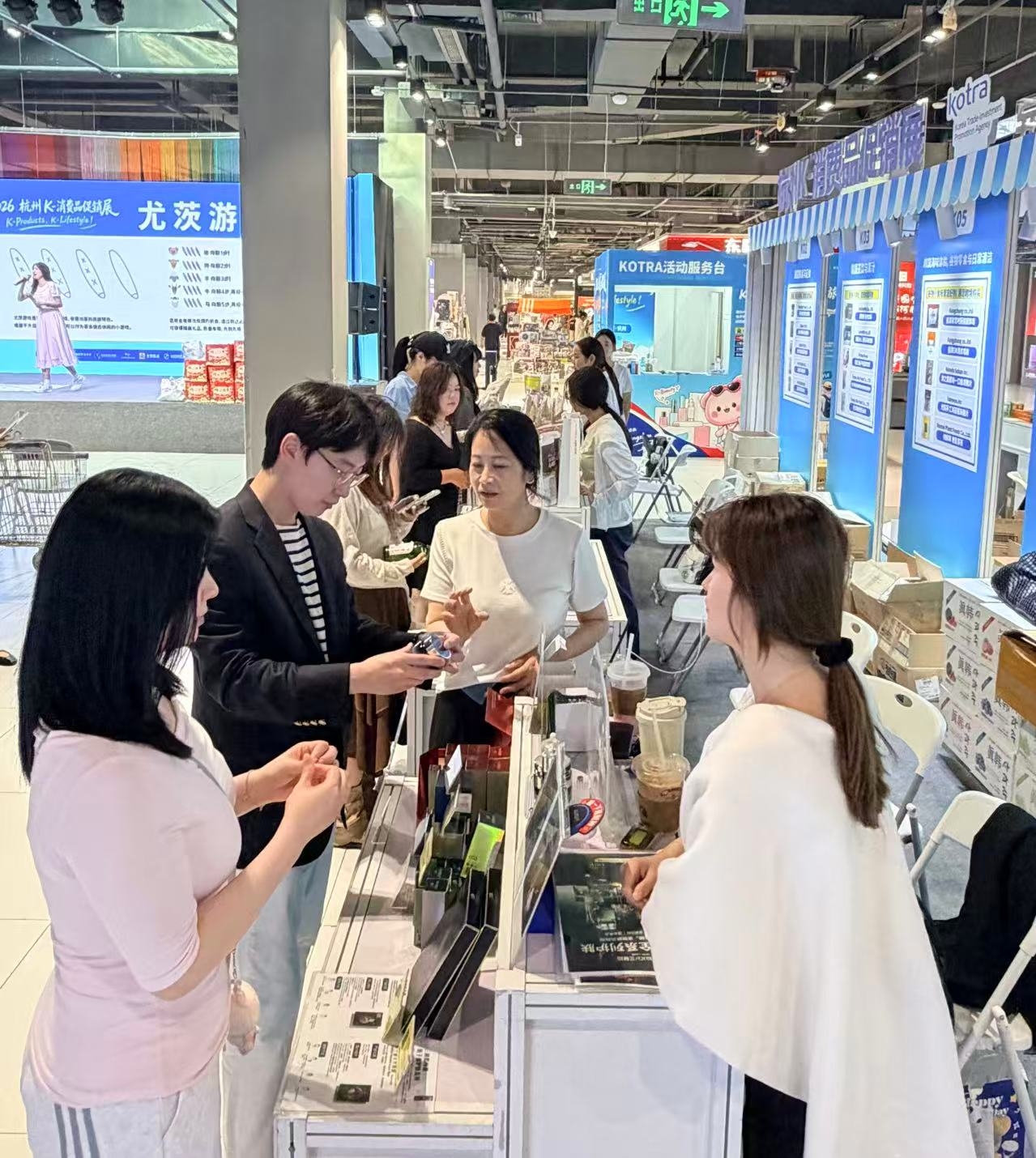
With Korean consumer goods exports to China returning to growth for the first time in five years, small and mid-sized Korean companies are moving to expand their foothold through major local retail networks. The push goes beyond online sales — firms are gauging consumer response at brick-and-mortar stores in key Chinese cities and seeking new retail distribution partners.
The Korea Trade-Investment Promotion Agency (KOTRA) said Tuesday it held the "Hangzhou K-Consumer Goods Promotion Event" at the Seji Lianhua Canal Square store in Hangzhou, Zhejiang Province, from Oct. 16 to 18.
The event brought together 31 Korean companies in partnership with Seji Lianhua, a major Chinese retail chain. Participating firms showcased food, cosmetics, household goods and fashion accessories to local consumers, while exploring opportunities for placement in offline retail outlets and expansion into online sales channels.
Seji Lianhua is a leading retail brand in Zhejiang Province with 120 stores. Its operator, Hangzhou Lianhua Commercial Group, runs a total of 546 retail outlets across major cities in the province. Its parent company, Lianhua Supermarket, ranked sixth in this year's list of China's top 100 supermarket chains by sales.
KOTRA chose Hangzhou for the event because of the high purchasing power of local residents. According to the Zhejiang Provincial Bureau of Statistics, per capita consumer spending in Hangzhou last year was 59,484 yuan ($8,910) — the highest among major Chinese cities. Wenzhou, Shaoxing and Ningbo ranked second, fourth and fifth respectively, meaning four of the top five cities were in Zhejiang Province.
Hangzhou is widely regarded as an ideal testing ground for foreign brands entering the Chinese market, given residents' openness to new consumption trends. KOTRA expanded its cooperation with large local retailers with that regional profile in mind.
Regionally distinctive Korean products also featured prominently at the event. Items on display included traditional fermented foods, bean sprout tea, dried seaweed snacks and other snack products from the South Jeolla Province and Gwangju area, as well as Jeju tangerine chocolate.
In cosmetics, products from Anua, Equalberry, Sambijo and Suazone were on show. In food, No Brand soft cone ice cream and heart-shaped tiramisu were available for visitors to sample on the spot.
Online marketing ran alongside the in-person event. Local Chinese influencers — known as wanghong — and consumer reviewers were enlisted to produce product-introduction content and drive purchases through online channels. Organizers also explored the potential of reverse cross-border e-commerce, a model in which Korean sellers ship goods directly to Chinese consumers from South Korea.
Beyond product sales, the event featured programs introducing Korean culture. Performances of the fan dance, along with games of yutnori and jegi chagi and a hangul quiz, gave visitors a chance to experience Korean products and culture together.
The Korea International Trade Association Shanghai branch, the Korea Tourism Organization's Shanghai office, the Jeju Island Shanghai representative office, the South Jeolla Province–Gwangju integrated special city, and Tianxin Global — a creator and e-commerce specialist firm — also took part.
The promotion came as Korean consumer goods exports to China have shown signs of recovery in recent months.
According to Kstat data, exports of five major consumer goods categories — cosmetics, food, fashion, pharmaceuticals and household products — to China totaled $4.52 billion in the January–August period this year, up 8.4 percent from the same period last year.
Korean consumer goods exports to China peaked at $8.98 billion in 2021 before falling for four consecutive years through last year. Annual exports came to $6.46 billion last year but have turned upward this year.
However, the broader Chinese consumer market is still recovering slowly. Retail sales in China rose 1.1 percent year-on-year in September, according to data the National Bureau of Statistics released Monday. Supermarket sales at above-scale retail companies for the January–September period grew 4.1 percent, with performance varying across retail formats.
KOTRA believes Korean companies seeking to enter the Chinese consumer market need to work not only with online platforms but also with locally influential retail networks in each region. Building on this event, the agency plans to follow up by helping participating companies assess consumer response and connect with opportunities for placement in offline stores and online sales channels.
"In China's consumer market, it is important to secure direct touchpoints not only through online platforms but also through large-scale local retail networks that have strong regional influence," said Jang Sang-hae, head of KOTRA's China regional headquarters. "We will continue to link regional retail networks with online channels to support small and mid-sized consumer goods companies in expanding their presence in the Chinese market."
kwater@heraldcorp.com