Kospi recovers from early plunge Monday to close higher for second straight session
Philadelphia Semiconductor Index rebounds; Nasdaq rises 1.11%
AI investment jitters persist as analysts warn of sector-by-sector divergence
All eyes are on whether the Kospi can extend its rebound Tuesday after staging a dramatic late-session reversal Monday — recovering from a sharp early plunge to close in positive territory. The overnight rebound in the Nasdaq Composite and the Philadelphia Semiconductor Index is expected to provide a tailwind, even as debate continues over the investment outlook for the AI value chain.
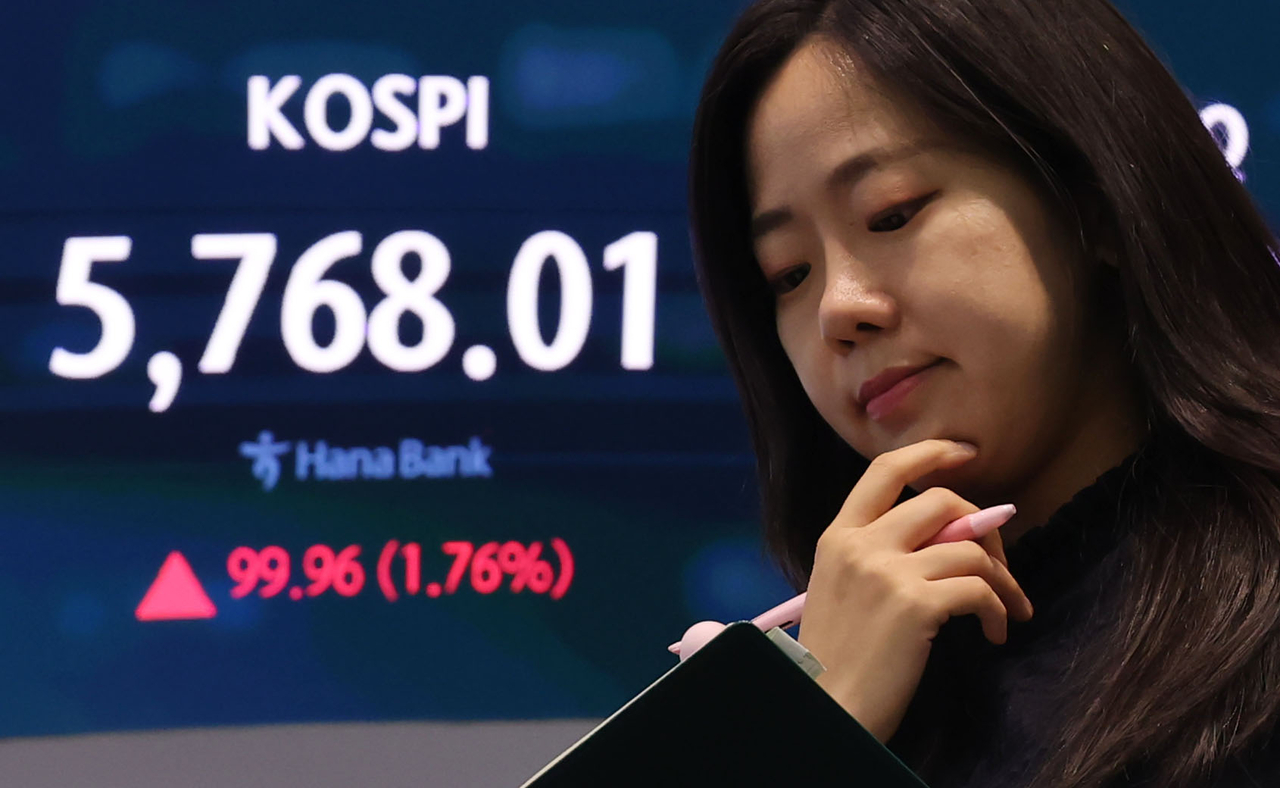
The Kospi finished Monday at 5,768.01, up 99.96 points, or 1.76 percent, from the previous session, marking its second consecutive gain.
The index opened down more than 3 percent in the 5,400 range but steadily pared losses as buyers stepped in. After hovering near the flat line for much of the session, the benchmark surged in the final minutes to close at its intraday high.
Foreign investors were net sellers of 36 billion won ($26.8 million) on the main Kospi market — a sharp pullback from the daily average net selling of 2.24 trillion won recorded over the previous week. Institutions were net buyers of 577 billion won, with pension funds accounting for 215.3 billion won of that total, lending support to the index. Retail investors were net sellers of 1.09 trillion won.
The Kosdaq rose 14.11 points, or 1.78 percent, to close at 808.89, reclaiming the 800 level for the first time in three sessions.
Relief spread through the market after the Kospi — which had tumbled a total of 20.7 percent over seven sessions from Oct. 6 to Oct. 15 — posted back-to-back gains of roughly 2 percent.
The session's two bellwether chip stocks offered only modest advances Monday: Samsung Electronics rose 1.16 percent and SK hynix gained just 0.39 percent.
"With a recovery in semiconductor investor sentiment still delayed, contrarian buying flowed into other sectors, making the divergence in performance quite pronounced," said Lee Kyung-min, an analyst at Daishin Securities.
Battery makers led the broader gains — Samsung SDI surged 11.7 percent and LG Energy Solution jumped 7.2 percent — while pharmaceutical and biotech stocks also rallied sharply, with Samsung Biologics up 9.9 percent and Yuhan advancing 8.7 percent. Retail names were similarly strong: Lotte Shopping climbed 10.1 percent, Hyundai Department Store rose 7.7 percent and Shinsegae gained 6.5 percent.
On Wall Street overnight, the Dow Jones Industrial Average edged down 0.07 percent while the S&P 500 rose 0.41 percent. The Nasdaq Composite, which had sold off sharply the previous week on concerns over AI value-chain profitability, rebounded 1.11 percent on contrarian buying.
The Philadelphia Semiconductor Index rose 1.61 percent, snapping a nine-session losing streak that had been its longest since October 2008.
Intraday price action, however, still reflected caution toward AI value-chain investments. The Philadelphia Semiconductor Index surged as much as 3.7 percent early in the session before giving back a large portion of those gains.
CoreWeave fell 0.4 percent after jumping nearly 8 percent at the open, with heavy volatility ultimately dragging it into the red. Other neo-cloud names such as Nebius (up 2.9 percent) and Iris Energy (up 2.7 percent) also swung sharply during the session.
AI chip stocks including Nvidia (up 1.4 percent), Broadcom (up 1.8 percent) and AMD (up 1.8 percent) pushed to intraday highs on contrarian buying before trimming some gains late in the day.
Memory and storage names held up relatively well: Micron rose 3.0 percent, SK hynix's American depositary receipts gained 4.7 percent, SanDisk advanced 5.5 percent and Western Digital climbed 6.1 percent.
The MSCI Korea ETF, a gauge of foreign investor sentiment toward Korean equities, rose 4.1 percent, while the MSCI Emerging Markets ETF gained 0.73 percent.
Oil prices were mixed. West Texas Intermediate for November delivery settled up 2.22 percent at $103.66 a barrel, while December Brent crude fell 0.28 percent to $109.55 a barrel.
"For Korean equities, while the short-term overselling in AI semiconductors has been confirmed, credit risks surrounding AI infrastructure remain unresolved," said Seo Sang-young, an executive director at Mirae Asset Securities. "Add to that fiscal uncertainty in Europe and upward pressure on interest rates from rising oil prices, and it becomes difficult to judge whether this rebound can be sustained."
He added that "until stability is confirmed — in foreign investor flows, global government bond yields and the easing of credit concerns at AI companies — gains will remain limited, and the market is likely to be a stock-picker's environment focused on individual names."
Han Ji-young, an analyst at Kiwoom Securities, said upside factors — including the Nasdaq's overnight rebound and continued oversold readings that are drawing in technical buyers — are competing with downside risks such as political uncertainty out of Europe and caution ahead of US big-tech earnings. "The market's upside will remain capped, with sector divergence continuing to define the trading landscape," she said.

yuni@heraldcorp.com