Overall parcel market share rises from 43% to 48%
First rebound after five-year slide
Share among top three carriers nears 60%
Parcel volume up 12% in first half of this year
Seven-day delivery and fulfillment drive volume growth
Profit to bottom out in Q3, rebound from Q4

CJ Logistics is closing in on a 50 percent share of South Korea's domestic parcel delivery market. Having reversed three years of market-share losses by rolling out seven-day delivery, dawn and same-day services, and e-commerce fulfillment, the company is now accelerating its push to translate higher volumes into profit through economies of scale.
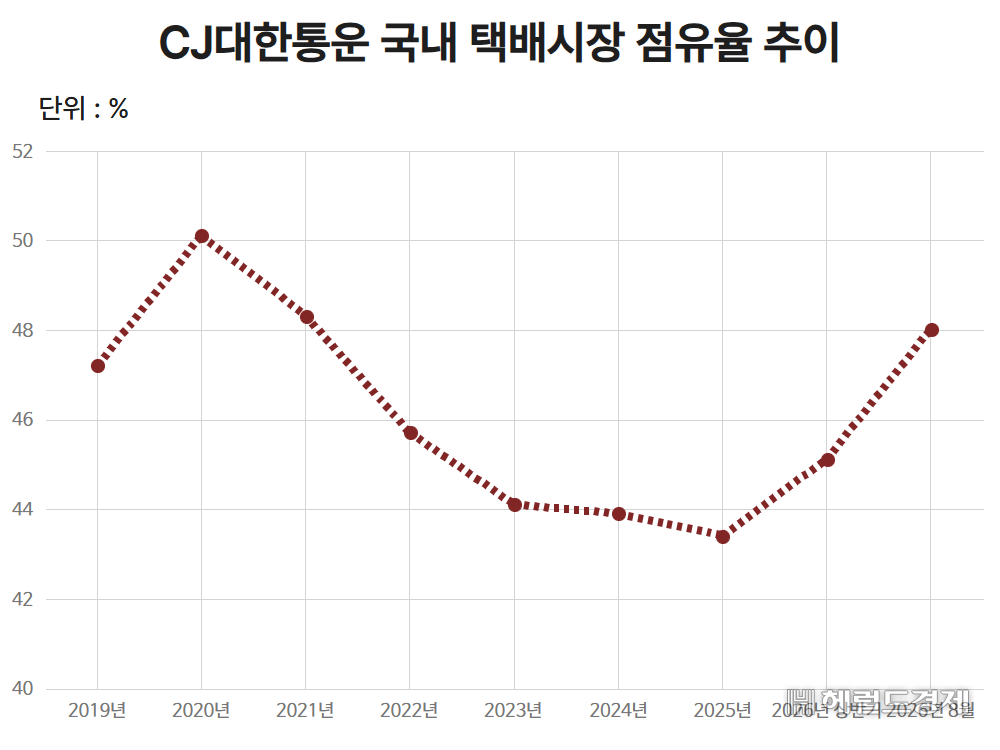
The company's share of the overall domestic parcel market reached 48 percent in August, up roughly 3 percentage points from about 45 percent a year earlier, according to industry data. CJ Logistics now handles nearly half of all parcels shipped in South Korea. The figure marks a sharp turnaround from a prolonged slump: after peaking at 50.1 percent in 2020, the company's market share fell for five consecutive years, bottoming out at 43.4 percent last year. It rebounded to 45.1 percent in the first half of this year and has continued to recover steadily since.
CJ Logistics is also tightening its grip in the three-way competition among South Korea's major parcel carriers. Its share of the combined volume handled by CJ Logistics, Lotte Global Logistics and Hanjin rose from the mid-50 percent range last year to around 60 percent in August.
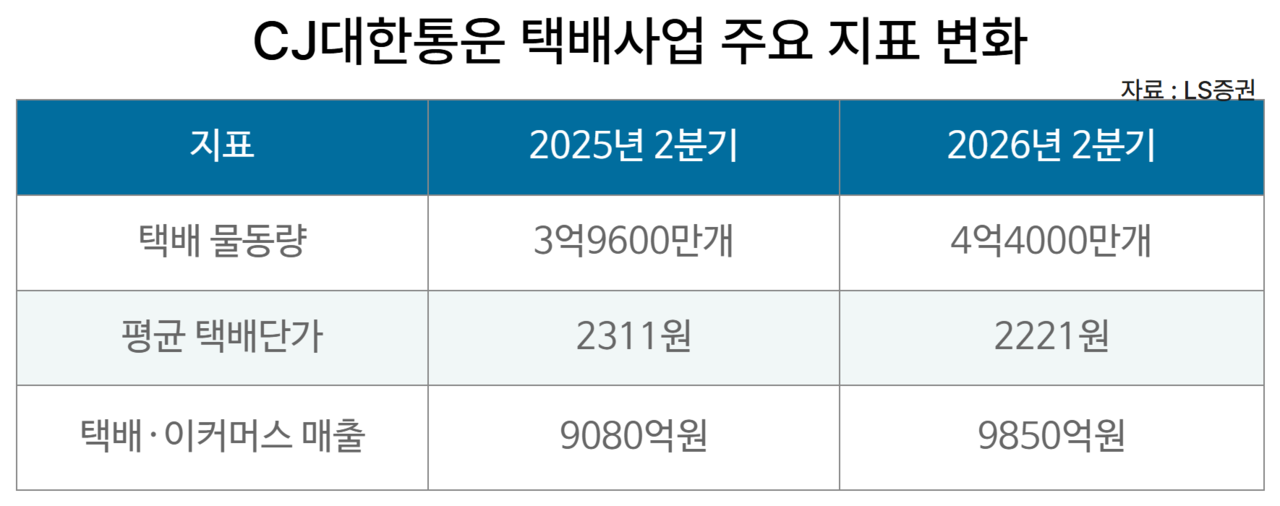
Raw volume figures tell the same story. CJ Logistics collected about 865 million parcels in the first half of this year, up roughly 12 percent from about 773 million in the same period last year.
The expansion of delivery services is widely credited as the main driver of the market-share gains. CJ Logistics launched its "Maeil-One" service in January last year, extending parcel delivery to Sundays and public holidays. By moving beyond the traditional weekday-only model to a full seven-day schedule, the company gave e-commerce platforms the infrastructure to sell and ship on weekends. It has since added dawn delivery, same-day delivery and half-day delivery options, capturing a broader range of shipping demand.
The integration of its e-commerce fulfillment business with its parcel network has also contributed to volume growth. Fulfillment covers the entire logistics chain on behalf of clients — storage, inventory management, order processing, packing and delivery. As the client base grows, goods leaving fulfillment centers feed directly into CJ Logistics' own delivery network, naturally pushing parcel volumes higher. Analysts say the company's expansion into new product categories — from fashion and household goods to fresh food — has also helped attract new clients.
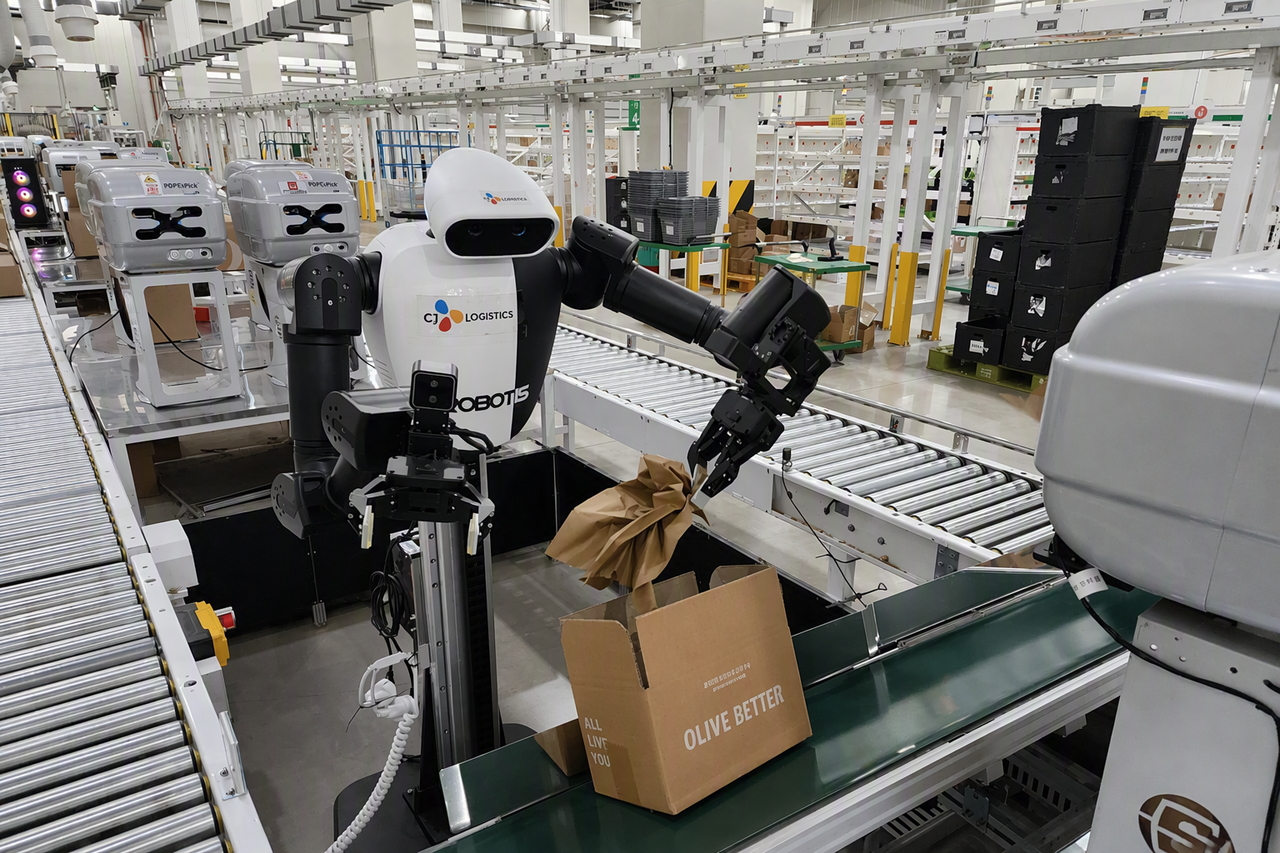
Automation investment has kept pace with the volume surge. CJ Logistics operates six hub terminals across the country, including the Gonjiam Mega Hub Terminal. It has a network of about 30,000 parcel collection points and roughly 23,000 delivery drivers, and its single-day record for parcels processed stands at about 9.2 million.
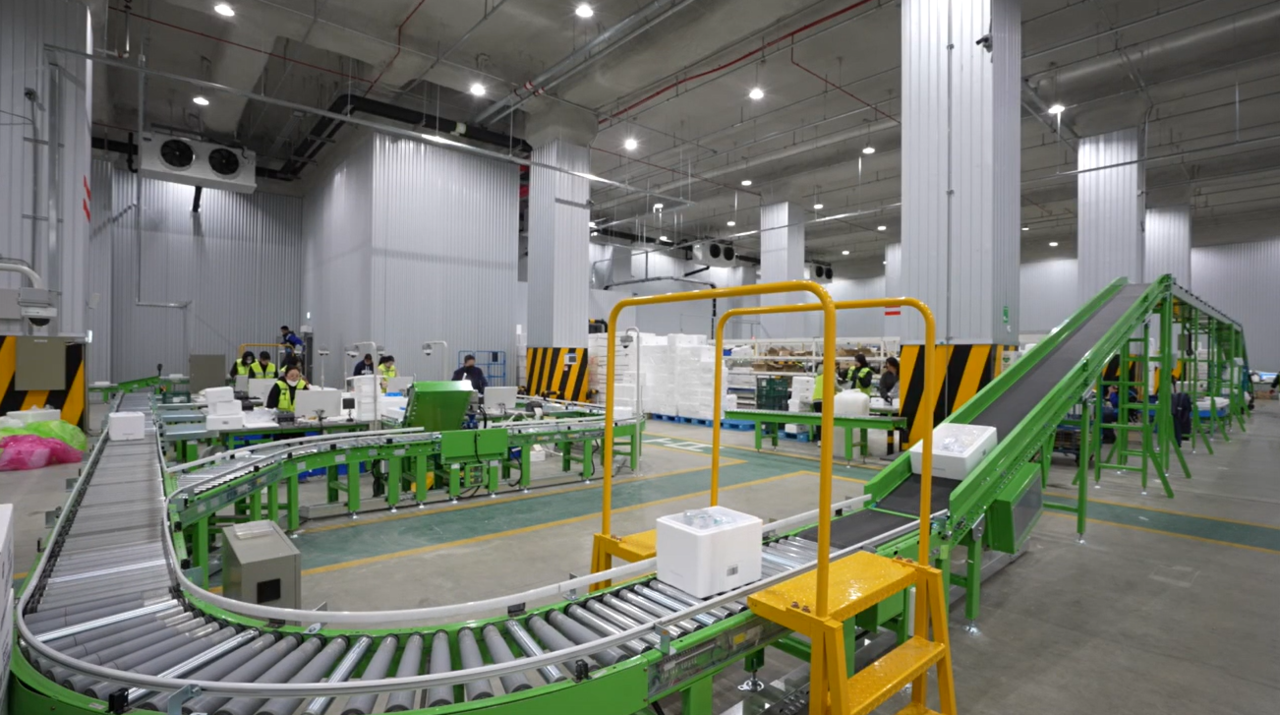
From late 2019 through the end of this year, CJ Logistics is investing a total of 134.1 billion won ($99.9 million) to install MP small-parcel automated sorting equipment. Late last year it rolled out a nationwide system that allocates freight vehicles to terminals based on parcel volumes, and in April it introduced AI technology to improve operational efficiency at logistics hubs. The strategy is designed to handle rising volumes efficiently while reducing the need for additional terminal expansion.
However, top-line growth has yet to translate fully into improved profitability. Sales in the parcel division rose 9.5 percent year-on-year to 1.95 trillion won in the first half of this year, but operating profit fell 6.2 percent to 75.1 billion won. The operating margin narrowed from 4.5 percent to 3.8 percent. Price competition to win new volume and the cost of running the delivery network are seen as the main drags on profitability.
A further profit decline looks unavoidable in the third quarter. According to FnGuide, the consensus estimate for CJ Logistics' third-quarter consolidated sales stands at 3.39 trillion won, up 10.5 percent from a year earlier, but operating profit is forecast to fall 22.1 percent to 115.2 billion won. The drop reflects four fewer parcel-delivery working days during the Chuseok holiday period compared with last year, as well as higher hub operating costs.
A more encouraging signal is emerging in average selling prices. According to LS Securities, CJ Logistics' average parcel rate was 3.9 percent below year-ago levels in the second quarter but is expected to be only about 2 percent lower in the third quarter. Analysts say easing price competition among carriers is slowing the decline in parcel rates. If rates stabilize, growing delivery volumes are more likely to flow through to actual profit growth.
A full recovery is expected to begin in the fourth quarter. The consensus estimate for fourth-quarter consolidated operating profit is 155 billion won, roughly 35 percent above the third-quarter forecast. Sales are projected to reach 3.49 trillion won, up 10 percent year-on-year. Fourth-quarter operating profit would, however, still be 2.9 percent below the same period last year.
Next year is when profit growth is expected to accelerate in earnest. Annual operating profit for next year is forecast at 530 billion won, up 12.6 percent from this year's projected 470.5 billion won. Analysts say lower fixed-cost pressure from higher volumes, stabilizing parcel rates and returns from automation investment will together drive a shift from top-line growth to genuine margin improvement.
"Third-quarter earnings will likely disappoint, but the trend of gaining market share on the back of delivery competitiveness will continue," said Ahn Do-hyeon, an analyst at Hana Securities. "With the decline in parcel rates also easing, we expect profit improvement to gain real momentum from next year as rate increases and volume growth reinforce each other."
kwater@heraldcorp.com