Dubai crude up 36% as won-dollar rate falls 12%
Dollar index rises but won advances anyway
Foreign investors net-sold $76.84 billion over four months
Record current-account surplus floods market with 'semiconductor dollars'
Preemptive rate hikes add to won strength; authorities see room for further gains
Something unusual is happening in South Korea's foreign exchange market: the won is strengthening sharply even as oil prices climb, the dollar gains ground globally and foreign investors continue to sell Korean assets — three forces that would normally push the won lower.
Behind the trend is a surge in dollar supply driven largely by semiconductor exports. A record-breaking current-account surplus is flooding the market with dollars at an unprecedented scale. Preemptive rate hikes by the Bank of Korea have added further downward pressure on the exchange rate, and monetary authorities say the won has room to strengthen further. The trajectory of the global semiconductor cycle is seen as the decisive variable going forward.
Won hits 2-year low despite high oil, strong dollar and foreign selling
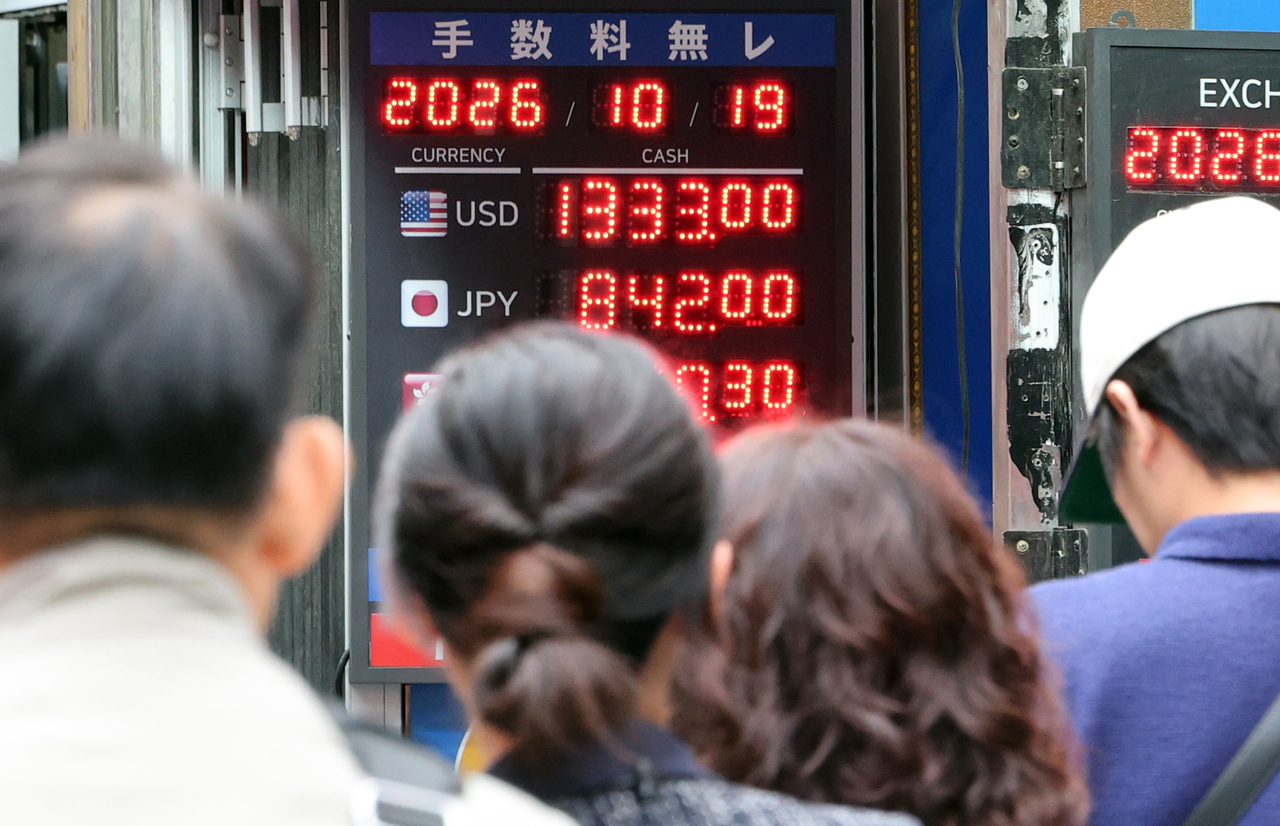
The won-dollar rate closed at 1,330.3 won on Monday, down 1.1 won from the previous session, according to the Bank of Korea — its lowest level in about two years since Oct. 2, 2024, when it stood at 1,319.3 won. Compared with the late-June level of 1,549.4 won, the rate has tumbled 219.1 won, or 14.1 percent, in less than four months. The intraday low of 1,327.6 won was also the weakest dollar reading since Oct. 2, 2024, when it touched 1,317.1 won. As of 9 a.m. Tuesday, the rate was trading at 1,330.7 won.
At its most basic, a falling won-dollar rate means more people want to buy won than dollars. The exchange rate is simply the price at which the two currencies trade against each other. The more demand there is for won, the cheaper it becomes to buy won with dollars — that is, the rate falls. When demand shifts the other way, toward dollars, the rate rises. A declining rate, in short, reflects greater demand for won than for dollars.
What makes the current move unusual is that all three classic drivers of a weaker won are pointing in the wrong direction — yet the rate keeps falling.
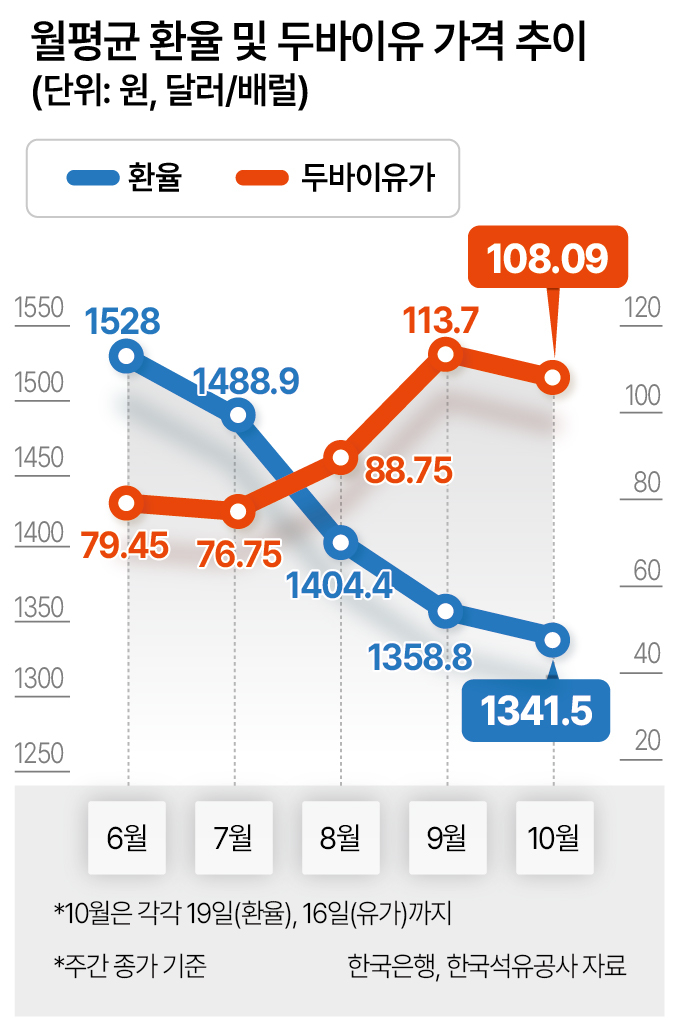
The first is oil prices. Because South Korea relies heavily on imported crude, a sharp rise in oil prices typically weakens the won: dollar outflows increase and investor sentiment sours on recession fears. Yet the recent data tell the opposite story. While the average price of Dubai crude jumped 35.8 percent — from $79.45 per barrel in June to $108.09 in October (through Oct. 16) — the won-dollar rate fell 12.2 percent, from 1,527.95 won to 1,341.48 won (through Monday).
A rising dollar would normally put upward pressure on the won-dollar rate as well, since stronger global demand for dollars reduces the relative appeal of won. Yet even as the monthly average exchange rate fell 12.2 percent between June and October, the dollar index actually rose 1.9 percent, from 100.32 to 102.19 (Oct. 1–16).
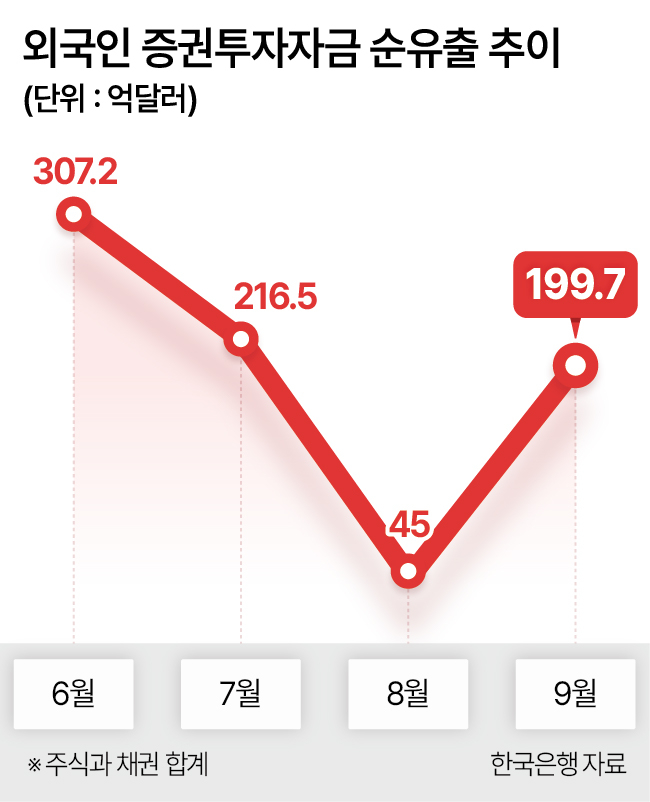
The persistent selling by foreign investors in domestic financial markets tells a similar story. When foreigners sell Korean stocks or bonds and convert the proceeds into dollars, the exchange rate typically rises. According to the Bank of Korea, foreign securities investment funds recorded net outflows for four consecutive months from June through September, with a total of $76.84 billion leaving the country. Yet over the same period, the monthly average won-dollar rate fell 11.1 percent, from 1,527.95 won to 1,358.75 won.
'Semiconductor dollars' overwhelm headwinds; preemptive tightening bolsters won
Each of those three factors would normally lift the exchange rate by boosting dollar demand or eroding the appeal of the won. That the rate has fallen anyway points to an even larger supply of dollars entering the market from the other side.
The main source is what analysts are calling "semiconductor dollars." A semiconductor-led export boom has pushed the current-account surplus to record levels. The current account measures the net flow of money from everyday economic transactions between a country and the rest of the world; a surplus means the country is earning more from abroad than it is paying out.
The current-account surplus reached $46.11 billion in August, the second-largest monthly figure on record. The cumulative surplus through August this year hit $279.2 billion — more than double the full-year record of $123.1 billion set last year. The Bank of Korea projects the annual surplus will reach $450 billion this year, a target that looks well within reach at the current pace.
Dollar sales by Korean companies in the foreign exchange market have also surged. Data the Bank of Korea submitted to the office of Democratic Party of Korea lawmaker Kim Nam-jun show that net spot and forward dollar sales by non-financial private companies in the first half of this year totaled $186.9 billion — 3.2 times the $58.49 billion recorded in the same period last year. Market analysts say companies that had been holding off on selling dollars in anticipation of further rate gains are increasingly converting their holdings.
Dollar deposits at banks are also piling up, suggesting further room for the exchange rate to fall. The balance of foreign-currency deposits held by residents at foreign exchange banks reached $140.62 billion at the end of August, the highest since records began — up $12.28 billion from the end of the previous month ($128.34 billion) and a record for the second straight month. Corporate dollar deposits alone hit $105.64 billion, surpassing $100 billion for the first time.
The Bank of Korea's tightening monetary policy has also supported won strength. The central bank raised its benchmark interest rate in both July and August, narrowing the gap with US rates from 1.25 percentage points to 1 percentage point. A wider Korea-US rate differential typically strengthens the dollar and weakens the won, putting upward pressure on the exchange rate. Bank of Korea Governor Shin Hyun-song told a national audit session on Oct. 12 that the two rate hikes in July and August had "considerably stabilized" the exchange rate.
Authorities see further downside for rate; semiconductor cycle a key risk
Monetary authorities believe the exchange rate has room to fall further. Shin told the national audit that while the rate was in the 1,330-won range, it remained above historical norms and that "there is room for additional strengthening going forward." At an International Monetary Fund annual meeting panel discussion the following day, he said the won had been "very weak in the first half of this year" but had "appreciated considerably" since the shift to a tightening stance, adding that he saw room for further appreciation and that "some additional appreciation would also be desirable."
Finance Minister Lee Hyung-il said at a press briefing in Bangkok on Friday (local time) that the rate's climb to the 1,550-won range in July had been "a departure from our economic fundamentals" and that the current level represented "a process of returning to those fundamentals."
The key variable is the semiconductor cycle. If demand cools, the current-account surplus would shrink and the supply of dollars entering the market could dry up quickly. Some observers have already raised doubts about the durability of global semiconductor demand. Debate over the return on AI investment has weighed on sentiment, and the Philadelphia Semiconductor Index fell for eight consecutive trading sessions recently. Former Bank of Korea Governor Lee Chang-yong, appearing on a YouTube channel, said he worried that a semiconductor cycle "said to last a decade" could "end in just a few years," and expressed concern about the government's expansionary fiscal stance.
Other near-term factors could also add to exchange rate volatility: a rise in dollar demand from foreign investors converting dividend payments from Korean companies in November, and the outcome of US midterm elections.
The Bank of Korea's Monetary Policy Board will hold its policy rate meeting on Thursday to set the benchmark interest rate. Markets widely expect the board to hold rates steady at this meeting before raising them at next month's meeting.
kimstar@heraldcorp.com