Regulators weigh long-term fixed mortgage as rates climb
New COFIX rise pushes variable rates past fixed-rate products
Banks resist, citing high funding costs and uncertain demand
Korea Housing Finance Corp. purchase of covered bonds eyed as possible solution

A salaried worker identified only as A recently received a notice from his bank that the interest rate on his home mortgage would be adjusted this month. He had borrowed 300 million won ($225,000) last April at an annual rate of 4.7 percent on a six-month variable-rate loan, but rising market rates pushed his rate up to 5.32 percent per year. His monthly principal and interest payment climbed from about 1.56 million won to 1.67 million won — an increase of roughly 115,000 won. He asked his bank whether there was any way to lock in a rate for an extended period to shield himself from further increases, only to be told that five years was effectively the maximum.
Financial regulators have been examining the introduction of long-term fixed-rate mortgages to ease the repayment burden on borrowers during a rising-rate cycle, but the discussions have made little headway. Banks have pushed back, arguing that funding maturities of 10 years or more would be costly to secure while demand would likely be thin given the higher rates such products would carry. Industry observers say a launch before year-end now looks unlikely.
According to financial industry sources, regulators have set the promotion of long-term fixed-rate mortgages as a policy goal and are continuing talks with banks. At a household debt review meeting last September, the authorities said they would encourage lenders to introduce long-term fixed-rate products.
President Lee flags risk of payments rising 2.5-fold as spotlight falls on 10-year fixed mortgages
A long-term fixed-rate mortgage is a product whose interest rate is locked in for 10 years or more. It differs from an "ultra-long mortgage" with a maturity of 30 to 40 years or beyond. Major banks currently sell what they label "fixed-rate" products tied to the five-year bank bond benchmark, under which the rate is fixed for five years before converting to a variable rate. Variable-rate loans use the six-month financial bond rate or the new COFIX as their benchmark. Among major banks, only Shinhan Bank currently offers a 10-year fixed-rate mortgage.
Long-term fixed-rate mortgages have long been a priority for financial regulators. South Korea's household debt as a share of GDP stood at 90.5 percent at the end of 2024, the fifth highest in the world. Every time the rate cycle turns upward, soundness risks surface, squeezing household disposable income and weighing on the broader economy. Regulators want to give borrowers a way to hedge against that rate-rise risk over an extended period.
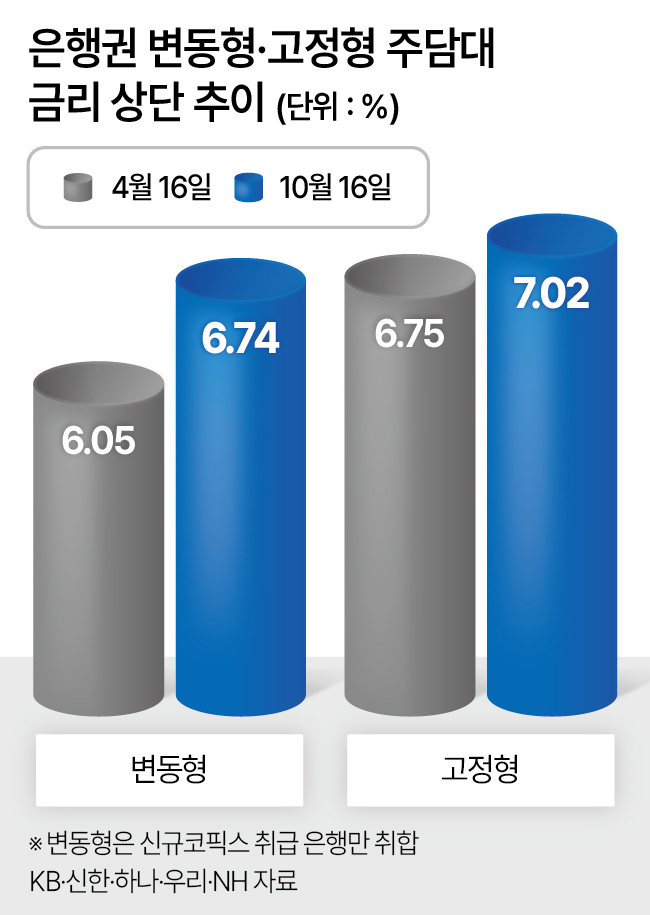
This year, a sharp rise in market rates has renewed calls for long-term fixed products. The new COFIX — the benchmark for variable-rate mortgages — has risen 0.62 percentage points over six months, meaning borrowers who took out variable-rate loans are now paying more than they would have under a fixed rate set six months ago. As of Friday, the upper end of banks' fixed-rate mortgage range stood at 7.02 percent per year, while variable rates had also climbed to 6.74 percent, approaching the 7 percent threshold. With the Bank of Korea keeping the door open to further benchmark interest rate increases to tame inflation, borrowers' interest burden is expected to grow heavier still.
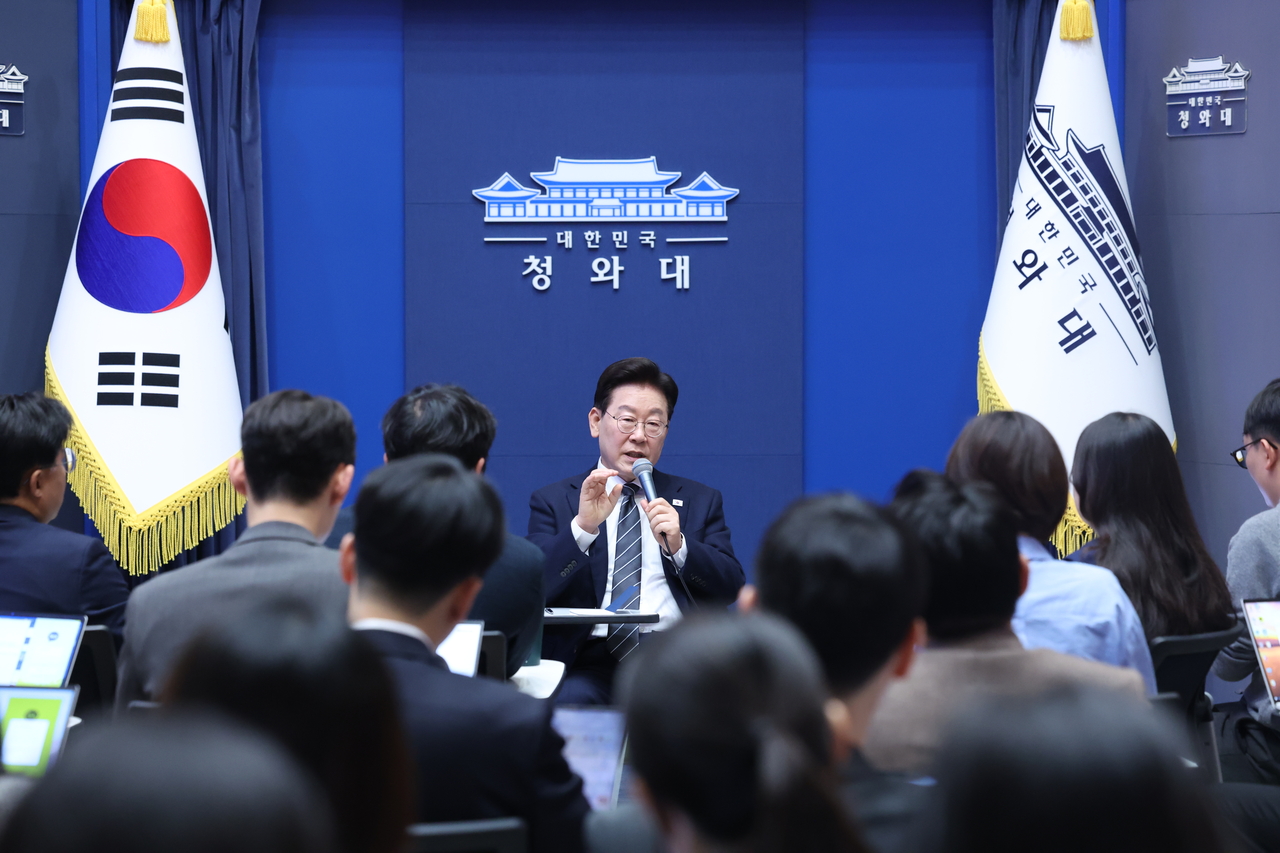
President Lee Jae Myung also appeared to flag this rate-rise risk when he said at a press briefing Monday at Cheong Wa Dae's Chunchugwan that "if the rate on a fixed-rate mortgage is converted to a variable rate, some borrowers could end up paying 2.5 times what they used to."
Despite growing need, talks stall as banks say demand won't materialize
Even as the case for long-term fixed-rate products grows stronger, the push to make them widely available has stalled. Banks have signaled they are reluctant to launch such products, and multiple lenders are said to have voiced opposition at the household debt review meeting last September.
The biggest obstacle banks cite is demand. Because long-term fixed-rate products must reflect the cost of securing long-dated funding, their rates would inevitably be higher than those of products currently on the market — and banks question whether consumers would actually choose them.
Banks typically fund their lending operations through bank bonds and deposits, and basic asset-liability management requires matching the maturity of funding to that of the loan. To offer a 10-year fixed-rate mortgage, a bank would first need to issue 10-year bank bonds.
According to the Korea Financial Investment Association's bond information center, the five-year bank bond yielded 4.339 percent per year and the 10-year bond yielded 4.637 percent per year as of Monday — a gap of roughly 0.3 percentage points. Because the cost of funds is higher, the retail lending rate would have to be set even further apart. By comparison, the new COFIX — the funding benchmark for variable-rate loans — currently stands at 3.43 percent.
The problem is that even five-year fixed products attract little interest because of their higher rates. Data from the Bank of Korea's economic statistics system show that fixed-rate loans accounted for just 31.9 percent of bank mortgage balances as of last July. "No matter how good a product is, it means nothing if borrowers don't choose it," a commercial bank official said. "There's really no reason to put it out there."
Banks also argue that without sufficient demand for long-term fixed-rate products, they would inevitably face negative margins. Offering such loans requires securing 10-year funding at a premium upfront, and if the product fails to sell, the bank is left holding the operational risk. "Borrowers can refinance once the early repayment fee waiver kicks in after three years, but the bank has no way to unwind the funding it has already taken on," one commercial bank official said. "The customer gets to hedge against rising rates, but the bank ends up absorbing all the risk."
On top of that, there are concerns that long-term fixed-rate mortgages — which carry lower annual principal and interest payments — could be used to circumvent the debt service ratio, the financial authorities' primary household debt regulation.
To promote long-term fixed-rate lending, regulators unveiled a "covered bond activation plan" in 2024. Covered bonds are debt instruments secured by mortgage loan assets and carry relatively lower funding costs than standard bank bonds. Under the plan, regulators offered incentives such as additional balance allowances for covered bonds with maturities of 10 years or more, but the measures proved insufficient to motivate banks.
"To issue covered bonds, a bank first needs to have originated a certain volume of mortgage loans," an official at one regulatory body said. "It's not a familiar process, and it's hard to guarantee customer demand, so banks seem to be taking a passive stance."
Regulators weigh additional incentives; covered bond re-securitization floated
Regulators are reviewing additional incentive measures to encourage banks to launch long-term fixed-rate products, though a comprehensive plan is not expected to emerge until formal consultations with the banking sector get underway. Industry observers say a year-end launch has become unlikely. "The institutional conditions still need to be put in place, and they aren't there yet," a financial regulatory official said. "A launch in the near term would be difficult."
That said, a resolution is not out of the question. Regulators are preparing to introduce a covered bond re-securitization program under which the Korea Housing Finance Corp. would purchase 10-year covered bonds issued by banks. If adopted, the program would reduce the funding risk banks face. "There needs to be either an overall cap on long-term fixed-rate products, or a structure that allows risks to be distributed through securitization," a banking industry official said.

hyuk@heraldcorp.com