Rubin urges US-China cooperation on AI risks, likening them to nuclear weapons
Warns of rising returns to capital, falling labor income
Sees low risk of AI investment bubble burst
Says AI safety concerns outweigh financial risks
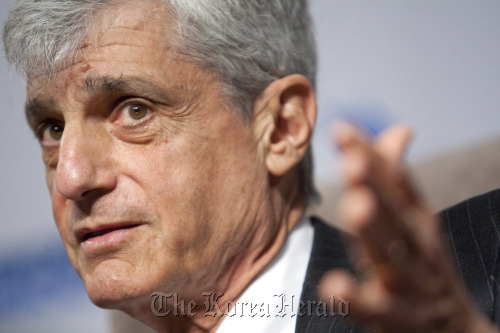
Former US Treasury Secretary Robert Rubin has warned that advances in artificial intelligence are highly likely to cause large-scale unemployment among knowledge workers. He said AI could dramatically boost productivity while simultaneously reducing labor income and deepening income inequality, and urged the United States and China to cooperate on AI safety — much as Washington and Moscow managed nuclear risks during the Cold War — even as competition between the two powers over AI intensifies.
According to the South China Morning Post and Chinese financial outlet Yicai, Rubin made the remarks Monday (local time) while participating via video link in an event held in Shanghai.
Rubin, who served as Treasury secretary under President Bill Clinton from 1995 to 1999, made the comments during a conversation with Huang Yiping, dean of the National School of Development at Peking University. "The impact of AI on economic growth is highly uncertain," he said.
He said AI has the potential to significantly raise productivity but also carries the risk of triggering large-scale structural unemployment. He assessed the likelihood of knowledge workers losing their jobs as "very high."
Rubin also expressed concern that even if AI raises corporate productivity, the gains may not be distributed evenly to workers. As AI replaces human tasks, he said, returns to capital could grow while compensation for labor declines.
That shift could affect not only income inequality but also government finances. Because labor income is typically taxed at higher rates than capital income, a shrinking share of labor income could erode the government's tax base, he said.
Rubin said the United States and China must cooperate to address the risks AI could bring.
"Just as we did with SALT and nuclear issues, we need to set aside distrust and mutual hostility and cooperate on issues that could have enormous, powerful, negative and serious consequences for both countries," he said.
Just as the United States and the Soviet Union pursued arms control negotiations to reduce the risk of nuclear war despite their military rivalry during the Cold War, Rubin argued, a framework for US-China cooperation on AI safety is now necessary.
He particularly warned of the potential for AI-enabled cyberattacks. The spread of AI technology through open-source channels has made advanced tools accessible to more people, and continued progress toward artificial general intelligence is compounding the potential dangers, he said.
The two countries are competing for dominance in AI technology while maintaining dialogue channels to discuss safety issues. Their leaders agreed at last month's summit to establish an AI dialogue channel, with a second round of talks expected next month.
However, the two leaders differ in their positions on AI regulation.
Chinese President Xi Jinping said at the Sept. 24 US-China summit that "both the US and China are major AI powers with the capability and responsibility to develop and regulate AI well," stressing that AI development must remain under human control.
US President Donald Trump, by contrast, signaled on social media the same day that he preferred to keep AI regulation as it is. He has since suggested that, given America's significant lead in AI, it would be better not to align the two countries' regulatory frameworks.
China's Ambassador to the United States Xie Feng also said in a Newsweek interview this month that "both the US and China, as major AI powers, bear special responsibilities," and argued that instead of an arms race or erecting technological barriers, the two sides should put in place safeguards and guardrails for AI.
Meanwhile, Rubin offered a relatively optimistic view on concerns that the flood of investment into AI companies could end in a bubble collapse.
While acknowledging that expanding AI investment and lending could build up risks in the financial system, he assessed the likelihood of an actual bubble burst as "very low."
"There is significant exposure in AI-related lending, but the probability of a collapse is quite low," Rubin said.
He cited the sound health of the US financial system and the adequate capital held by major banks. Large banks that have funded AI companies have enough capital to absorb losses, he said, while regional banks have not been heavily involved in AI-related lending.
"What worries me more than the financial risks AI could bring is the question of AI safety," he said.
sjy@heraldcorp.com