Cabinet approves amendment to special act on decentralization and balanced regional development; Ministry of Interior and Safety to pre-announce index guidelines covering 229 cities, counties and districts across four zones

Starting next year, the government will formally roll out a regional preference index that directs more public funding to areas farther from Seoul. The index was created to give the state a legal basis for providing preferential support to local governments as part of efforts to advance decentralization and balanced growth.
The Ministry of Interior and Safety said Tuesday that the cabinet approved an amendment to the enforcement decree of the Special Act on Local Autonomy, Decentralization and Balanced Regional Development, which establishes the framework for the index.
The ministry will begin a 12-day public pre-announcement period starting Wednesday for a draft notice setting out the specific calculation criteria and application guidelines for the index.
The ministry had earlier worked with the Ministry of Planning and Budget, the Ministry of Trade, Industry and Energy, and the Presidential Committee on the Era of Local Governments to design the index in response to the concentration of resources in the greater Seoul area and the threat of regional depopulation. The process included consultations with local governments and expert advisory reviews. The committee approved the index framework at its 32nd meeting on Monday.
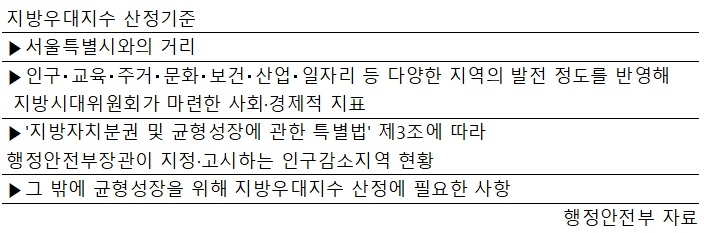
The index divides all 229 cities, counties and districts into four zones by comprehensively weighing distance from Seoul, the level of regional development, and whether an area has been designated as a population-decline zone.
The index first accounts for spatial distance from Seoul, reflecting the reality that key functions — including population, employment and infrastructure — are concentrated in the greater Seoul area.
On top of that, the index incorporates 44 balanced-development indicators prepared by the Presidential Committee on the Era of Local Governments to factor in each region's social and economic development level. Areas designated as population-decline zones, where the risk of regional extinction has become acute and immediate action is needed, will receive additional preferential weighting.
The draft notice includes the criteria for applying and managing the index, along with the results of the index calculation that divide the 229 cities, counties and districts into four zones.
The Ministry of Interior and Safety plans to continuously brief central government ministries on the purpose and application of the index so it can be fully integrated into government policy from 2027. The ministry will also support each ministry in identifying region-sensitive preferential policies that use the index not only in fiscal programs but also across areas such as taxation, regulation and procurement.
"The government has, for the first time, developed a regional preference index that provides stronger support for local areas in order to overcome the single-pole dominance of the greater Seoul area and strengthen the foundation for locally driven growth," Interior and Safety Minister Yun Ho-jung said. "The ministry will work actively with related ministries to ensure the index is applied broadly across national policy, so that it can serve as a practical foundation for balanced national development and locally led growth."
thlee@heraldcorp.com