Kospi falls 3.73%, giving back all of Monday's gains
Foreign, institutional net selling tops 1.5 trillion won; 29 of top 30 stocks decline
Samsung Electronics down 2.98%, SK hynix down 4.23%; Kosdaq drops 3.33%
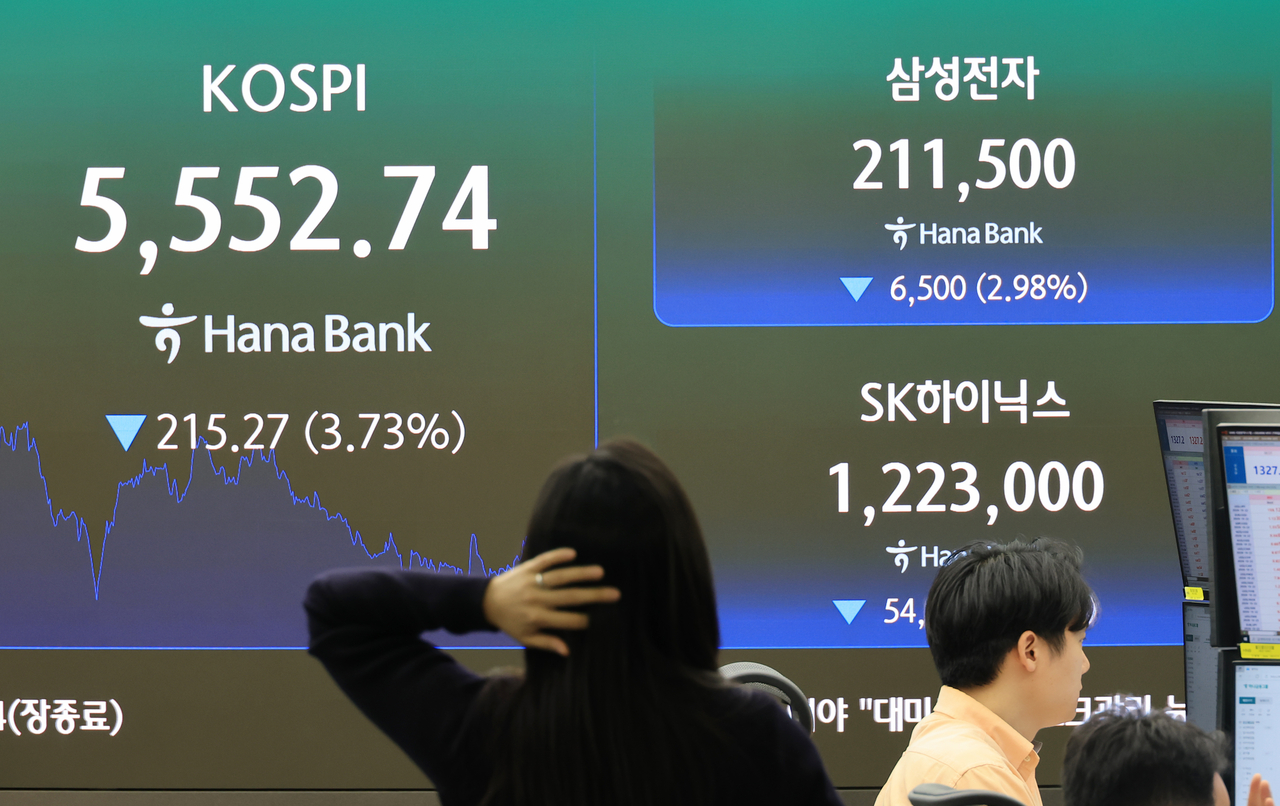
The Kospi plunged more than 3% on Tuesday, erasing all of Monday's rebound in a single session. Foreign and institutional investors combined to net sell more than 1.5 trillion won ($1.13 billion) on the main board, pushing the index down to the 5,550 level. Investor sentiment soured again as concerns over AI sector credit quality and profitability persisted, compounded by rising US Treasury yields and geopolitical tensions in the Middle East.
According to Korea Exchange, the Kospi closed down 215.27 points, or 3.73%, at 5,552.74. The index opened 34.44 points, or 0.60%, lower at 5,733.57 and extended its losses through the session, at one point sliding to 5,493.24 and briefly breaking below the 5,500 level before paring some of the decline.
Simultaneous selling by foreign and institutional investors drove the index lower. Institutions net sold 1 trillion won on the Kospi market, while foreign investors net sold 537.7 billion won, bringing their combined net selling to 1.54 trillion won. Retail investors absorbed the selling pressure with net purchases of 903.1 billion won.
The selloff spread broadly across the market, hitting large-cap stocks particularly hard. Of the top 30 stocks by market cap on the Kospi market, 29 finished lower — only Woori Financial ended in positive territory. Just 118 stocks advanced while 773 declined. Two stocks hit the upper limit and 24 finished unchanged.
Samsung Electronics, the largest stock by market cap, closed at 211,500 won, down 6,500 won, or 2.98%. SK hynix fell 54,000 won, or 4.23%, to close at 1.22 million won.
Samsung Electronics preferred shares (-2.93%), SK Square (-5.00%), LG Energy Solution (-4.17%), Samsung Electro-Mechanics (-1.28%), Samsung Biologics (-2.52%), Hyundai Motor (-4.91%), KB Financial Group (-1.11%) and Samsung Life Insurance (-3.07%) also fell across the board.
The Kosdaq also dropped more than 3%, retreating to just above the 780 level. The index closed down 26.92 points, or 3.33%, at 781.97, after opening 3.52 points, or 0.44%, lower at 805.37 and widening its losses through the day.
On the Kosdaq, foreign investors net sold 183.8 billion won and institutions net sold 110.6 billion won, while retail investors net bought 294.2 billion won. Declining stocks numbered 1,348 — more than four times the 310 that advanced. Barunson Entertainment & Arts and Foodnamoo hit the lower limit.
Among top Kosdaq stocks by market cap, Ecopro BM (-9.15%) and Ecopro (-7.74%) posted the steepest losses. Jusung Engineering (-5.44%), Wonik IPS (-4.88%), EO Technics (-3.77%), Alteogen (-3.35%), Sam Chun Dang Pharm (-2.61%) and Rainbow Robotics (-1.72%) also declined. HLB edged up 0.12%.
Market analysts attributed the renewed decline to a combination of factors: a failure to restore AI-related investor confidence, rising US Treasury yields and ongoing geopolitical instability in the Middle East.
Lee Kyung-min, an analyst at Daishin Securities, said AI credit concerns stemming from CoreWeave had been weighing on semiconductor investor sentiment, and that Monday's rebound had been driven by bargain hunting after the index was seen as oversold. "However, as credit and profitability concerns surrounding AI were not fully resolved, the rebound proved short-lived," he said.
Lee added that European government bond yields had risen on fiscal and political uncertainty in France and the spread of large-scale protests in Italy, while the US 10-year Treasury yield climbed back above 5.1%, adding downward pressure on equities. "The burden from rising crude oil prices tied to geopolitical uncertainty in the Middle East also continues," he said.
Lee also noted that the won had recently strengthened to the 1,330 won range against the dollar, raising concerns about the earnings of export-oriented companies and weighing on export stocks broadly. "The shipbuilding sector in particular faced heightened pressure from foreign exchange losses tied to the won's appreciation," he said.

hajun825@heraldcorp.com