Ceremony held at Jung-gu headquarters in Seoul
Kim emphasizes 'accountability investigation' system
'I see this as the position most responsible, not the highest'
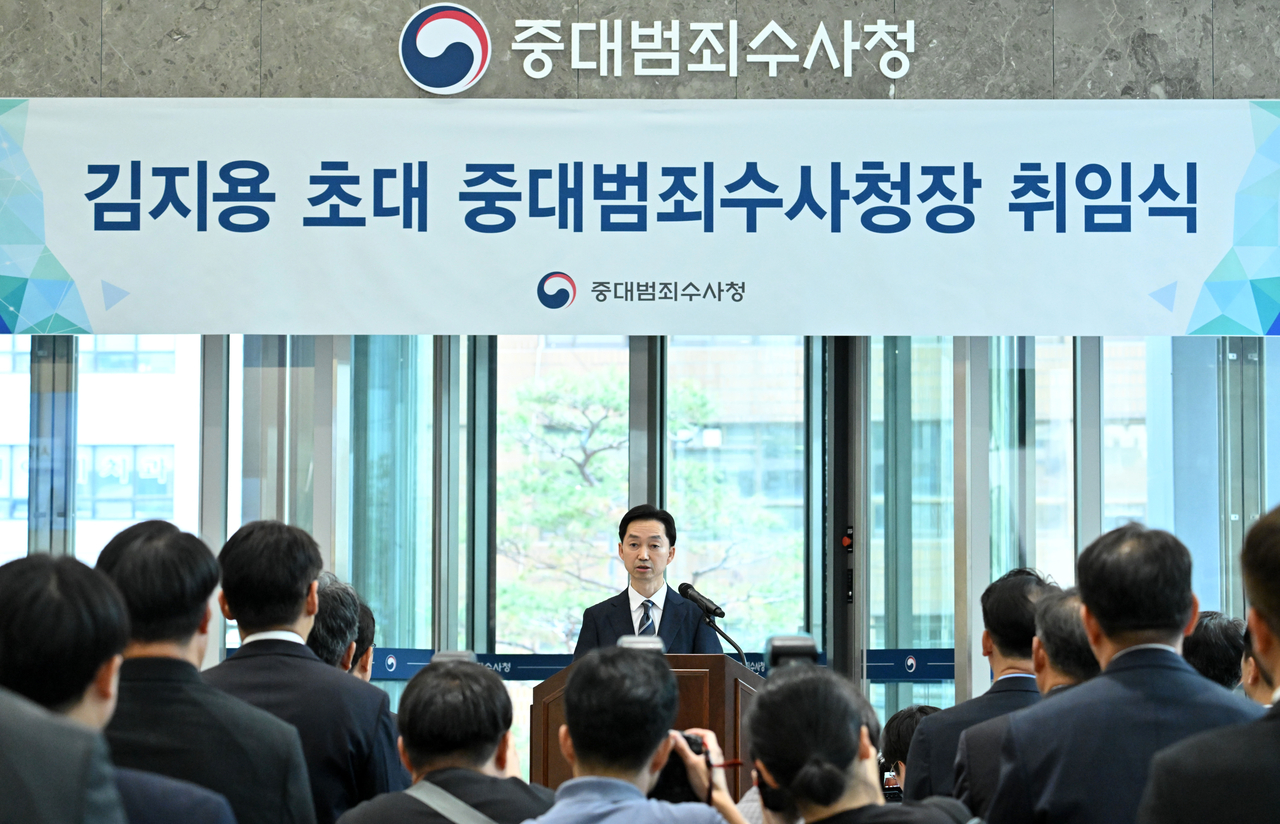
Kim Ji-yong, chief of the Serious Crimes Investigation Agency, pledged at his inauguration Tuesday to apply the same principles and standards regardless of a suspect's status or identity, reaffirming his commitment to political neutrality and investigative independence.
Speaking at the ceremony held that afternoon at the agency's headquarters in Jung-gu, Seoul, Kim said the agency stood "at an important starting point in the history of South Korea's criminal justice" and had been entrusted with "a weighty mission to respond firmly to serious crimes."
Kim outlined five principles and directions for the agency: upholding political neutrality and investigative independence; making procedural justice a foundational principle; protecting the rights of the public and listening to crime victims; conducting accountable investigations grounded in strong personnel and expertise; and establishing a horizontal and fair organizational culture.
At his first doorstep briefing Monday, Kim said he would "prove to the public why the agency is necessary," and mentioned the agency's early stabilization, eliminating the politicization of investigations, and protecting socially vulnerable people and crime victims.
At the inauguration, Kim said: "Whatever case we handle, whoever the subject of investigation, regardless of status or identity, we will apply the same principles and standards. We will not be swayed by any unjust external pressure, and will investigate fairly based solely on the law and evidence." He added: "We will respect democratic oversight under the Constitution and laws, and humbly accept public criticism. We will investigate independently, but not unilaterally."
Kim also stressed procedural justice, saying the agency would reach fair conclusions when criminal charges are not sufficiently supported. "We will be strictly on guard against investigations targeting specific individuals, investigations on separate charges, and dragnet-style investigations," he said. "We will investigate according to principles based on objective evidence and scientific methods, and if criminal charges are not sufficiently supported, we will reach the appropriate fair conclusion."
Kim said that being suspected of a crime was not grounds for treating a person's human rights or right to defense lightly. "Respecting the rights guaranteed by law is an obligation that investigative agencies must uphold," he said. He added that the agency would work closely with relevant institutions to ensure that the division of roles between agencies does not leave gaps in victim protection or cause inconvenience to the public.
Noting that serious crimes are becoming more sophisticated, organized and complex, Kim stressed the need for expertise and said he would establish an "accountability investigation" system. "To respond effectively to crime, we must bring together capable people with extensive investigative experience and experts from diverse fields," he said. "I will establish the accountability investigation system and give those in charge sufficient authority and responsibility."
Kim also spoke to organizational stability, saying that an employee's home institution or past rank should not be the basis for evaluation or personnel decisions. "I will create a fair workplace where only expertise, diligence, a responsible attitude and results are properly evaluated," he said. He added that the agency would quickly review and improve its work systems to ensure the public experiences no inconvenience.
"As the inaugural chief, I will never take that responsibility lightly," Kim said. "I will approach my work thinking of this not as the highest position, but as the position most responsible — the one at the front." He called on agency staff to do their best so that the agency becomes one the public can trust and rely on, promising to answer public expectations with results and performance.
Kim, a former prosecutor, was nominated as the inaugural agency chief last month, but the appointment process was delayed amid criticism from hardline members of the ruling camp who labeled him a "pro-Yoon Suk Yeol prosecutor." His confirmation hearing was eventually held Wednesday after a series of setbacks, and President Lee Jae Myung approved his appointment Thursday, officially beginning his tenure. Kim ordered the formation of an early-stabilization TF on Friday and began work in earnest.
Kim attended a Cabinet meeting chaired by President Lee on Tuesday, marking his first such participation. However, his attendance has drawn criticism given his repeated emphasis on political neutrality and investigative independence.
bell@heraldcorp.com