Selected as outstanding entry in Korea Research Institute of Local Finance research proposal competition
- Applied to 2,564 elevator installation and replacement records, uncovering 135 cases of unreported acquisition tax totaling 180.46 million won
A local tax research club made up of tax civil servants in Gangnam-gu is turning real-world problems into working solutions — and drawing attention for it.
The club, called 426Labs, developed an AI-powered program that automatically cross-references tax data from two government systems, earning recognition as an outstanding entry in a research proposal competition run by the Korea Research Institute of Local Finance. The group has also been producing video content to help residents better understand local tax rules.
426Labs was formed in April by six Gangnam-gu tax civil servants who wanted to study local tax administration and fix inefficiencies they encountered on the job. The name comes from the district office's street address, 426 Hakdong-ro. Members identify their own research topics and apply new technologies, including AI, directly to their daily work.
The project that drew the most attention focuses on linking Seoul's integrated tax management system with the Ministry of Interior and Safety's standard local tax information system, known as LTIS. Although both systems cover the same taxable subjects, one organizes records by road-name address while the other uses lot numbers and property management codes — forcing staff to manually reconcile the two, a time-consuming process.
To solve the problem, 426Labs built a program that converts addresses from both systems into a common format and matches them automatically. By standardizing road-name and lot-number addresses and then linking records from the two systems by administrative district and lot number, the program lets staff check filing status across both databases in a single step.
The program has already been put to practical use. Installing or replacing an elevator can trigger an acquisition tax filing obligation, but because the address formats in elevator installation records and acquisition tax records differ, reconciling them manually had taken considerable time. The program flags cases where an elevator installation or replacement is confirmed but no corresponding acquisition tax filing appears, allowing staff to prioritize those for follow-up. A civil servant then reviews each flagged case before any final tax assessment is made.
Gangnam-gu applied the program to 2,564 elevator installation and replacement records from the first half of this year, identifying 135 cases of unreported acquisition tax totaling 180.46 million won ($135,000). Residents found to have missed filings were sent notices giving them the opportunity to file voluntarily. The district said the significance lies in replacing a process that had depended on individual staff members' manual checks with one that can be run repeatedly and consistently.
The research has also earned external recognition. The 426Labs project was selected as one of 11 outstanding entries among local tax research club submissions from across the country. The club will present its research process and application cases at the 2026 Local Tax Research Club Presentation Competition, hosted by the Korea Research Institute of Local Finance on Nov. 4.
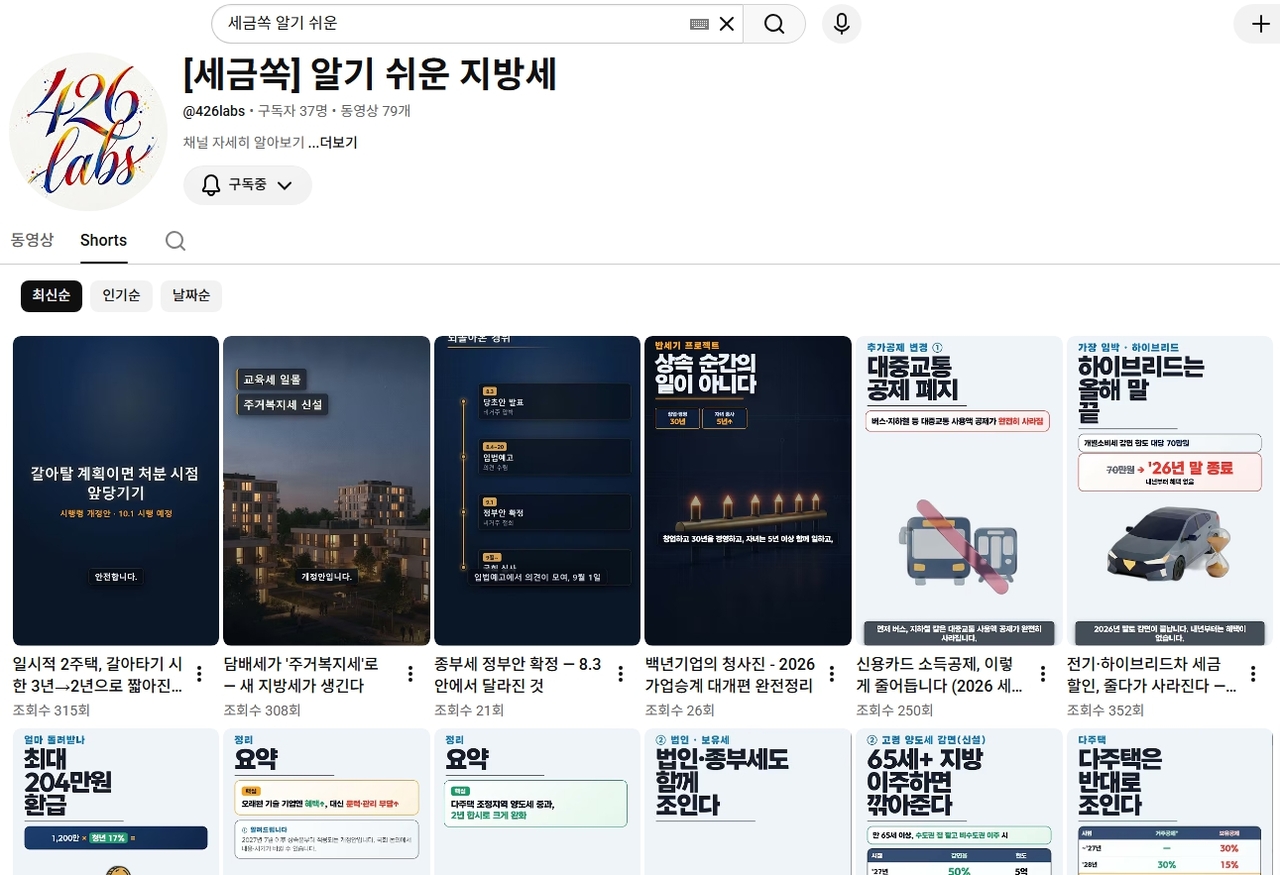
426Labs' work extends beyond tax administration reform. In May, the club launched a YouTube channel called "Segeum Ssok — Understanding Local Taxes Made Easy," which has published 71 videos to date. Tax civil servants plan, script and produce the videos themselves, covering topics residents frequently ask about, such as the 2026 tax reform proposals and acquisition tax on real estate transfers between family members.
Gangnam-gu plans to expand use of the program beyond elevator records to other taxable asset categories. The district aims to develop it into a model that other local governments can adopt, using automated cross-referencing to improve the accuracy and efficiency of tax base audits across administrative data sets that were previously difficult to reconcile because of mismatched addresses or record formats.
Gangnam-gu District Mayor Kim Hyun-ki said the staff had taken problems they encountered firsthand and turned them into solutions through their own research. "We will actively support employees' drive to take on challenges and conduct research so that small ideas can lead to genuine administrative innovation," he said.
seouldream01@heraldcorp.com