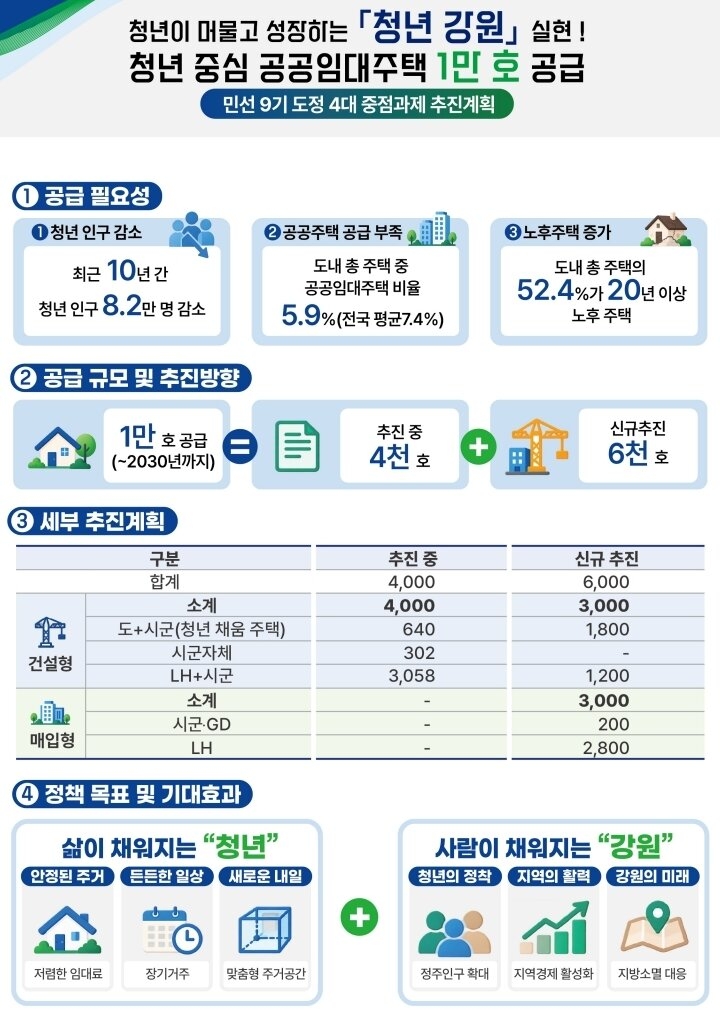
Gangwon Special Self-Governing Province plans to supply 4,000 public rental housing units already in the pipeline and add 6,000 more, in a bid to stem the outflow of young residents and encourage them to settle in the region.
According to the provincial government Wednesday, the 4,028 units currently under development consist of 640 units across seven Gangwon-type complexes, 302 units across six complexes led independently by individual cities and counties, and 3,086 units across 21 complexes developed jointly by the Korea Land and Housing Corporation and local governments.
The remaining 6,000 units will be added through a partnership among the province, cities and counties, the Korea Land and Housing Corporation (LH) and Gangwon Development Corp., split evenly between newly constructed units and purchased units — 3,000 each.
The plan is a follow-up to a public rental housing supply announcement made Aug. 5, under which the province, local governments, LH and Gangwon Development Corp. will jointly deliver both construction-based and purchase-based housing.
The province intends to focus particularly on its own "Gangwon-type youth public rental housing" initiative, led by the province and local governments, to ease housing costs for young people and draw them to settle in the region.
Six sites totaling 442 units have been selected as new projects for 2027. Of these, 342 units across five locations fall under the Gangwon-type youth public rental housing program: 100 units in Hoengseong, 84 in Yeongwol, 60 in Hwacheon, 50 in Inje and 48 in Goseong. The remaining 100 units will be senior welfare housing in Taebaek, developed jointly by LH and the local government.
Yeongwol-gun offers a representative example of how the program works. Under the Gangwon-type youth public rental housing initiative, the county is set to receive 7 billion won ($5.25 million) in provincial funding. The support is expected to significantly ease the county's fiscal burden from the Yeongwol Deokpo district public rental housing project, which was selected in June for the Ministry of Land, Infrastructure and Transport's 2026 first-half specialized housing competition.
The project carries a total budget of 24.7 billion won. The original plan called for 7 billion won in national government funding and 17.7 billion won from the county, but with the new program designation, costs will be shared among the national government at 7 billion won, the province at 7 billion won and the county at 10.7 billion won.
The project site is at 801-13 Deokpo-ri, Yeongwol-eup — the former Korea Electric Power Corp. staff housing compound — where 84 public rental units will be built. The project will go through preliminary administrative procedures including an investment review and design work in 2027, break ground in 2028, and target completion and move-in in the second half of 2030.
Priority tenants will include workers relocating to the Deokpo-ri replacement site, employees in locally specialized industries, people returning to farming or rural life, and rural exchange students, as well as youth, newlyweds and senior citizens eligible under the general supply category. The complex is designed as tailored public rental housing that reflects local conditions and residential demand.
For the 49.6-square-meter units at the Yeongwol Deokpo district, deposits will range from 7 million to 18 million won and monthly rent from 50,000 to 280,000 won.
The youth population in Gangwon Province fell from 410,000 in 2015 to 330,000 last year, a decline of roughly 80,000 over a decade. Some 404,000 units — 52.4 percent of all housing stock in the province — are more than 20 years old, and the province says the shortage of quality public housing for young people must be addressed.
The Gangwon-type youth public rental housing program targets people aged 18 to 39, newlyweds married within the past seven years, and military families, all of whom must be non-homeowners. Rental deposits will be set at around 35 percent of the prevailing market rate, with monthly rents at 23 to 59 percent of market levels.
Each complex will also include spaces tailored to local characteristics — such as startup incubators, shared offices and study cafes — to link housing with employment opportunities.
To reduce the fiscal burden on cities and counties and broaden participation, the province will also strengthen financial support. Previously, provincial subsidies were capped at 4 billion won per project regardless of scale. Starting next year, support will be pegged to the level of national government funding, with the ceiling doubled to 8 billion won.
abc@heraldcorp.com