Top scores across 9 benchmark categories vs. Big Tech models
Supports Korean document understanding, image question-answering research
Released under 'Kanana Open License' for commercial use
Kakao has released its in-house vision encoder — the component that serves as the "eyes" of an AI system — as open source. The company said internal benchmarks show the model outperforms leading vision encoders from global tech giants including Google, Meta and Apple.
Kakao published two variants of its Kanana-2-vision-encoder on Hugging Face on Wednesday.
The two models are the "medium," with 426 million parameters, and the "tiny," with 98 million parameters. Kakao had previewed the open-source release during the keynote of its if(kakao)26 developer conference on Oct. 13.
A vision encoder is the technology that acts as an AI's "eyes," enabling it to understand images. It extracts visual features — objects, text, positions and shapes — from an image, which a language model then interprets to generate a response. Practical applications include reading food items and prices from a menu, parsing the contents of a document, or understanding what is happening in a photograph. Accurate image information is considered critical to maintaining response quality in multimodal AI systems.
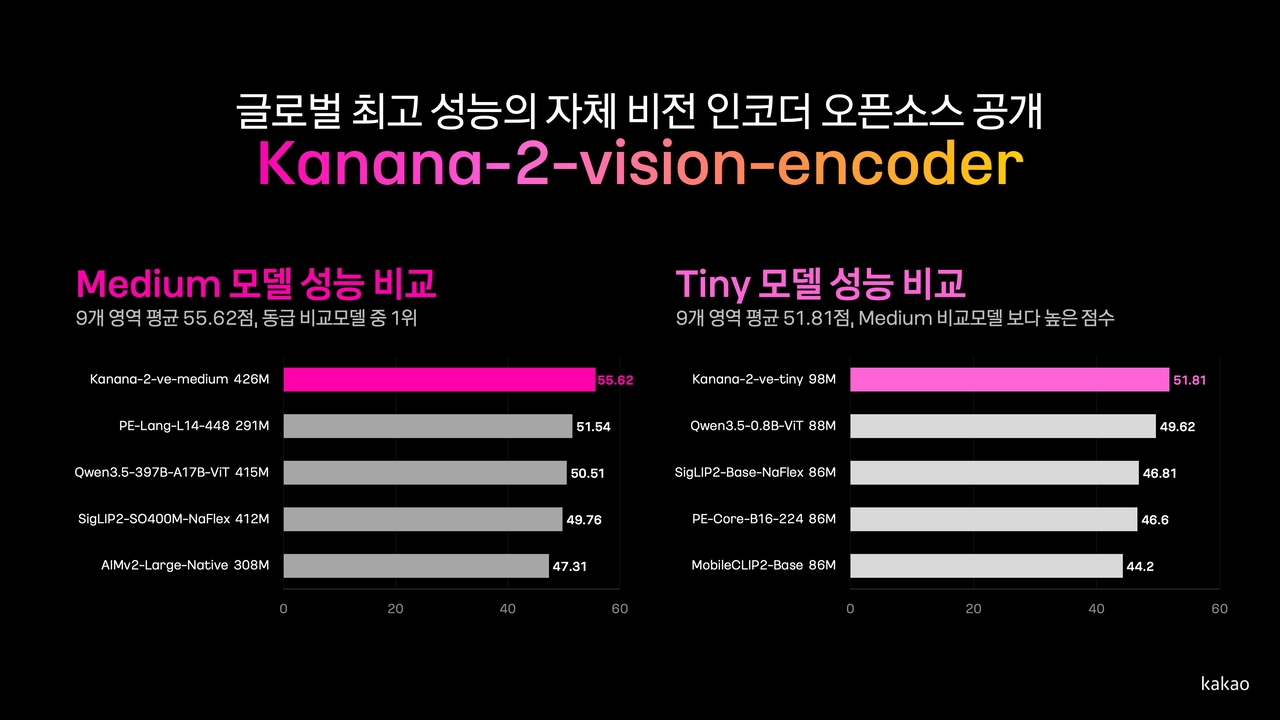
Kakao said its evaluation of the Kanana vision encoders showed they surpassed Big Tech rivals. The company tested the models across 42 benchmarks spanning nine categories — general visual question answering, English text recognition and document understanding, Korean text recognition and document understanding, and spatial localization and fine-grained recognition within images, among others. Both models outperformed major global vision encoders including Google's SigLIP 2, Meta's Perception Encoder, Apple's AIMv2 and Alibaba's Qwen3.5-ViT.
According to Kakao, the tiny model — a lightweight design with fewer than 100 million parameters — matched or exceeded the performance of global models with more than 400 million parameters. The performance gap was particularly pronounced in spatial localization, Korean-language evaluation, and Korean text recognition and document understanding.
Kakao attributed the results to improvements in optical character recognition and document comprehension, which it described as core capabilities for vision-language models. The company said its proprietary training techniques preserved fine-grained visual detail in small text and complex document layouts.
In addition, Kakao used its in-house Kanana-2 language model to improve training efficiency for the vision encoder by roughly four times compared with previous methods, while also enhancing the model's ability to extract fine-grained visual information. The company said this created a virtuous cycle in which advances in its language model feed directly into improvements in its vision encoder.
The encoders are also optimized for high-resolution image processing, cutting latency by more than 60 percent compared with leading global vision encoders. Kakao applied knowledge distillation and model compression techniques across both variants, from the medium model to the tiny model designed with on-device use in mind.
Kakao released both models under its "Kanana Open License," which permits commercial as well as research and development use. The company said it aims to lower the barrier to entry for researchers and businesses at home and abroad and to advance the broader multimodal AI research ecosystem.
"As the agentic AI era arrives, 'computer use' technology — which directly understands and interacts with PC and mobile screens — is drawing growing attention, and the role of vision encoders capable of accurately analyzing high-resolution images is expanding," said Noh Byeong-seok, performance leader for unified foundation models at Kakao. "We will consistently strengthen the competitiveness of our in-house AI models and contribute to the development of the AI ecosystem by continuing to open-source our technology."
chami@heraldcorp.com