While apartment prices surged 35.6%, small commercial buildings fell 2.9%
Average transaction price hits four-year low amid high interest rates, weak domestic demand
Vacancy rates among mid- to large-sized retail spaces vary by as much as 65-fold across districts
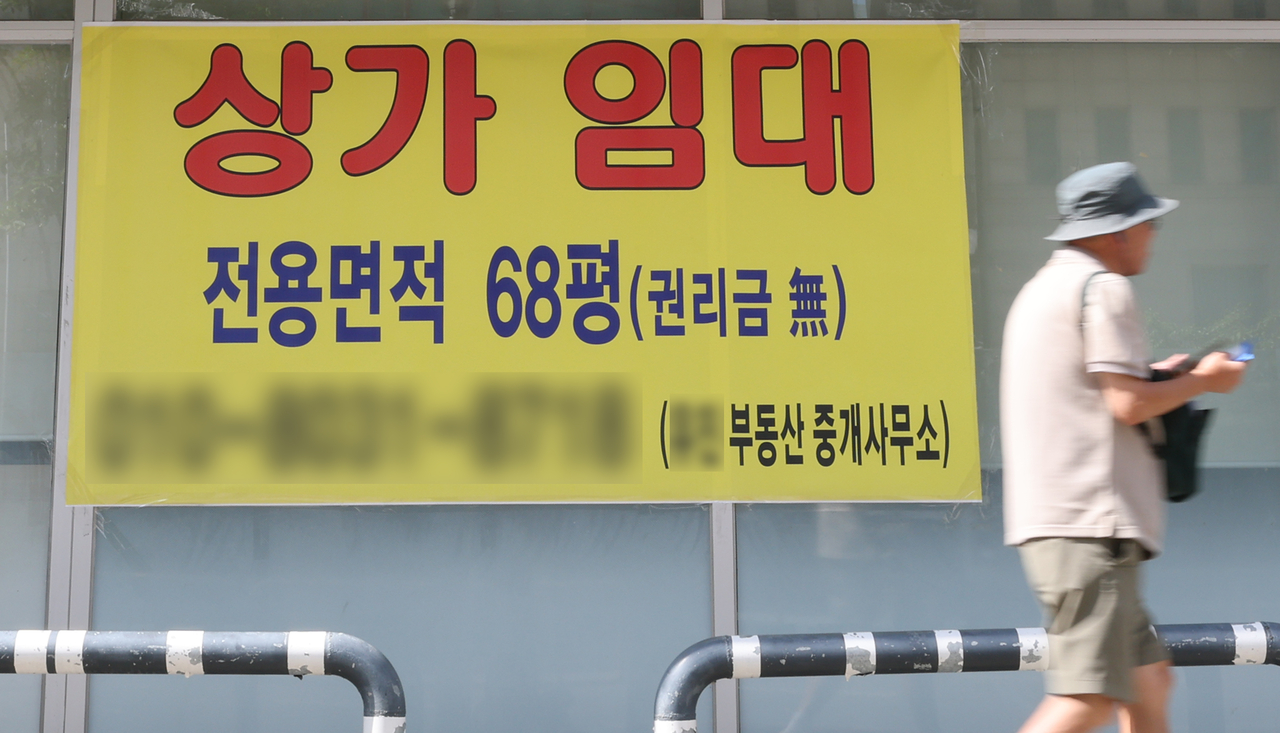
The average transaction price of Seoul's small commercial buildings — known locally as "kkoma buildings" — has fallen to around 4.4 billion won ($3.3 million), the lowest level since 2022, extending a three-year consecutive decline. The drop stands in sharp contrast to Seoul apartment prices, which surged more than 35 percent over the same period. Analysts point to rising financing costs from prolonged high interest rates, sluggish domestic consumption that has made rental income harder to secure, and a widening gap in vacancy rates and investment demand across commercial districts.
Average small-building price this year at 4.44 billion won — below Banpo apartment prices
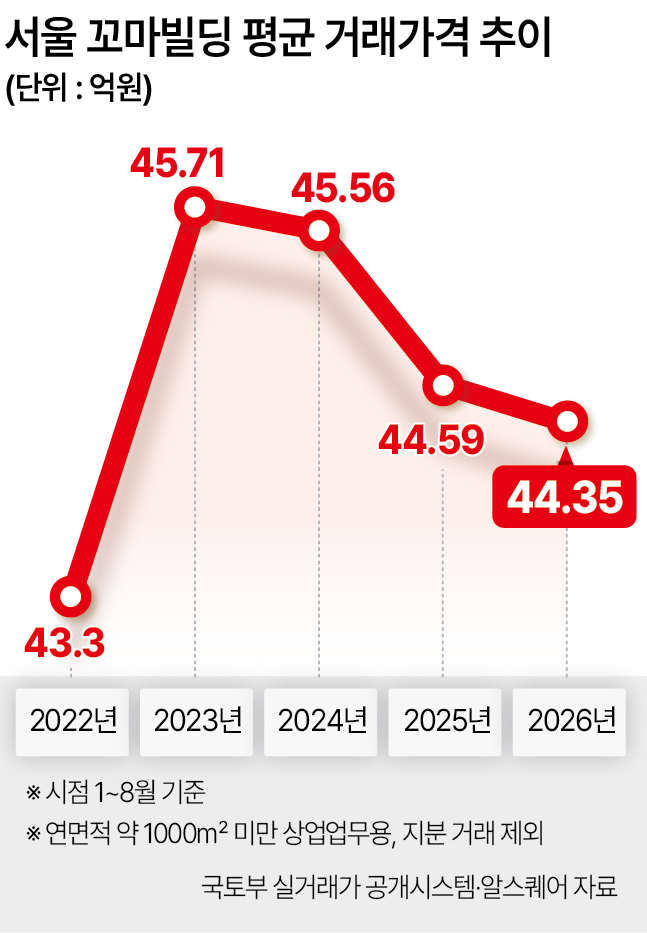
An analysis of the Ministry of Land, Infrastructure and Transport's actual transaction price disclosure system, conducted by commercial real estate services firm R Square, found that the average transaction price of general commercial and business buildings with a total floor area of 1,000 square meters or less traded in Seoul from January through August this year — excluding partial-stake deals — came to 4.44 billion won. That is the lowest since 2022 and represents a 2.9 percent decline from the 2023 peak.
The average price of Seoul's small commercial buildings rose from 4.34 billion won in 2022 to 4.57 billion won in 2023. Although interest rates were already elevated and transaction volumes were subdued at the time, a surge of foreign tourists into Seoul's major commercial districts after the end of the pandemic drove high-priced sales in neighborhoods such as Tongin-dong and Anguk-dong.
Since then, however, a prolonged slump among self-employed business owners — combined with continued gains in Gangnam apartment prices, which investors prize as a concentrated single-asset bet — has cooled enthusiasm for small commercial buildings. Average transaction prices have fallen for three consecutive years: 4.56 billion won in 2024, 4.46 billion won in 2025 and 4.44 billion won this year.
This trend runs counter to the trajectory of Seoul apartment prices. According to KB Real Estate, the average Seoul apartment price as of August stood at 1.28 billion won in 2022 and dipped to 1.19 billion won in 2023, before recovering to 1.22 billion won in 2024, 1.42 billion won in 2025 and 1.61 billion won this year — a 35.6 percent gain compared with 2023.
High-end apartments in the Gangnam area now routinely exceed the price of an entire small commercial building, even at smaller unit sizes. According to the Ministry of Land, Infrastructure and Transport's transaction data, a 59-square-meter unit at Raemian One Bailey in Banpo-dong, Seocho-gu — widely regarded as Seoul's most expensive apartment complex — sold for 4.85 billion won on Sept. 12. The 84-square-meter unit, considered the standard family size, recorded an actual transaction price of 5.63 billion won on June 24; the same unit type had previously sold for 7.2 billion won in June last year.
Small commercial buildings: 'Business loans harder to get, rental yields falling'
Experts attribute the diverging price trends between small commercial buildings and apartments to their fundamentally different return structures. Apartment prices are underpinned by owner-occupier demand and expectations of capital gains, whereas small commercial buildings are valued on a combination of rental income, vacancy risk and financing costs.
Persistently high interest rates and tighter lending conditions have further eroded the investment appeal of small commercial buildings. As borrowing costs rise, rental income becomes insufficient to cover interest payments, and the expected return on investment after purchase falls. A licensed real estate agent in Sillim-dong, Gwanak-gu, said business loans have become considerably harder to obtain and, even when approved, come with tight limits, making it difficult to find buyers. "Rental yields are falling below interest rate levels, and more buildings are ending up in foreclosure auctions," the agent said.
Vacancy rate disparities across commercial districts are also stark. According to the Korea Real Estate Board's commercial real estate rental trend survey, the vacancy rate for mid- to large-sized retail spaces in Seoul in the second quarter of this year reached 32.4 percent at Bangsan Market, 27.0 percent in Cheongdam, 18.2 percent near Sinsa Station and 17.4 percent in Dongdaemun. By contrast, Nakseongdae recorded just 0.5 percent, Oryu-dong Station 1.4 percent, and both Wangsimni and Mangwon Station 1.8 percent. The gap between Bangsan Market and Nakseongdae amounted to roughly 65-fold.
These differences in rental demand are reflected in building prices. Ministry of Land, Infrastructure and Transport data show that while the average small commercial building price in Seoul slipped from 4.46 billion won in the January-to-August period last year to 4.44 billion won over the same stretch this year, prices in Seongsu-dong climbed from 5.75 billion won to 7.54 billion won over the same period. Investment demand has concentrated in areas that draw heavy foot traffic and foreign visitors.
Rental yields trail interest costs; expert warns of oversupply
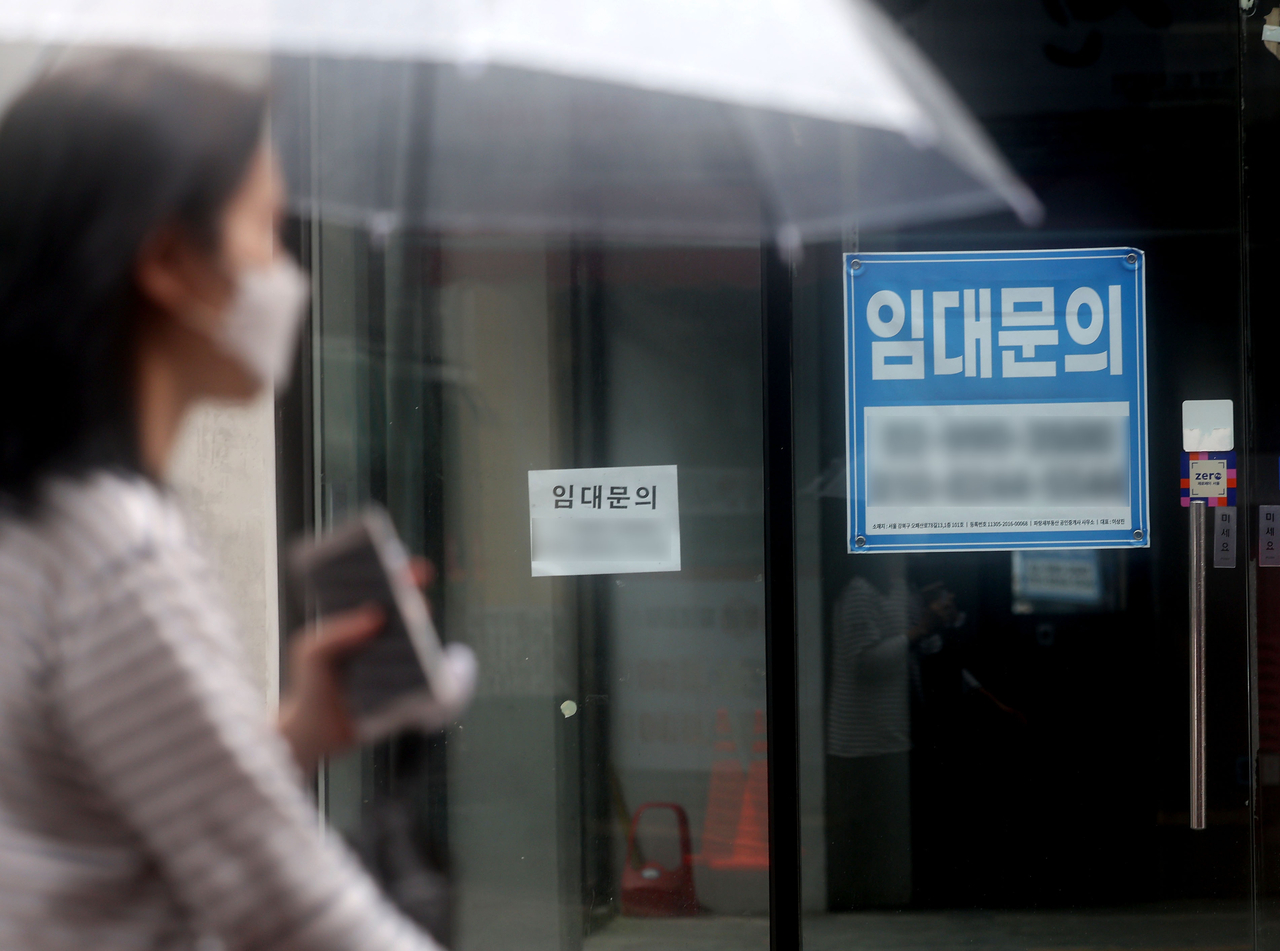
Weak domestic demand is another obstacle to a rental income recovery. When operating conditions deteriorate for self-employed business owners and small and medium-sized enterprises — the primary tenants of small commercial buildings — landlords find it harder to raise rents, and filling vacancies after a tenant leaves takes longer. Prolonged vacancies reduce rental income while simultaneously depressing a building's investment value, potentially triggering a vicious cycle of shrinking buyer demand.
Kim Yong-nam, chief executive of Global PMC, said that even a short walk to Jonggak these days turns up building after building with "for rent" banners on the ground floor. "Loan interest rates are running at 6 to 7 percent, yet securing a rental yield of even 5 percent is a stretch — so negative leverage has set in," he said. Negative leverage refers to a situation in which borrowing costs exceed the return generated by the investment asset, meaning that greater use of debt worsens the investor's profitability.
Kim also said a contraction in new business formation and corporate activity is feeding directly into weaker demand for commercial space. "Startups and new businesses need to keep emerging for space demand to exist," he said. "Vacancies need to fall before rents can rise and investment demand can follow — but that starting point is blocked, and the market is shrinking."
Some observers point to the supply structure of commercial real estate as a root cause. They argue that tighter regulations on owning multiple residential properties have pushed capital and development activity away from rental housing and toward commercial buildings such as retail spaces.
"Compared with Japan, South Korea simply has too many small commercial buildings," Kim said. "In Japan, residential buildings on back streets are used as rental housing, but here, strict multi-home ownership regulations have tilted supply relatively heavily toward commercial retail space."
hss@heraldcorp.com