Hanwha General Insurance '2026 Korea Women's Report'
Women's financial satisfaction trails men's by 6.3 percentage points
Women do twice as much housework per week as men
Finance ranked as the most important area of life for women in South Korea, yet it also recorded the lowest satisfaction score — and the widest gender gap of any category measured.
According to the "2026 Korea Women's Report: Discovering a New Women's Lifestyle," released Wednesday by Hanwha General Insurance's FemTech Research Institute, 53.2 percent of the 3,000 women surveyed nationwide between the ages of 20 and 69 identified finance as the most important area of their lives. Physical health came second at 42.4 percent, followed by mental health (32.1 percent), relationships (29.9 percent), time and lifestyle (25.4 percent), and personal growth (11.6 percent). A separate survey of 500 men produced similar results, with finance topping the list at 54.6 percent.
Women's satisfaction scores by category ranked relationships highest at 58.1 percent, followed by mental health (56.1 percent), time and lifestyle (55.2 percent), physical health (45.8 percent), personal growth (45.0 percent), and finance lowest at 40.7 percent. The financial satisfaction gap between women and men was particularly wide, at 6.3 percentage points.
Within the finance category, women said the most important subcategories were maintaining a stable daily life, preparing for retirement and the future, and building assets through savings and investment. Satisfaction scores for women fell below those of men in most subcategories, with the largest gaps in asset-building through savings and investment (minus 3.2 percentage points) and retirement and future preparation (minus 3.1 percentage points).
The one exception was spending and expense control, where women's satisfaction exceeded men's by 2.0 percentage points — the only subcategory in which women scored higher. The findings suggest that while women manage day-to-day spending well, they feel less confident about growing their assets and preparing for the future.
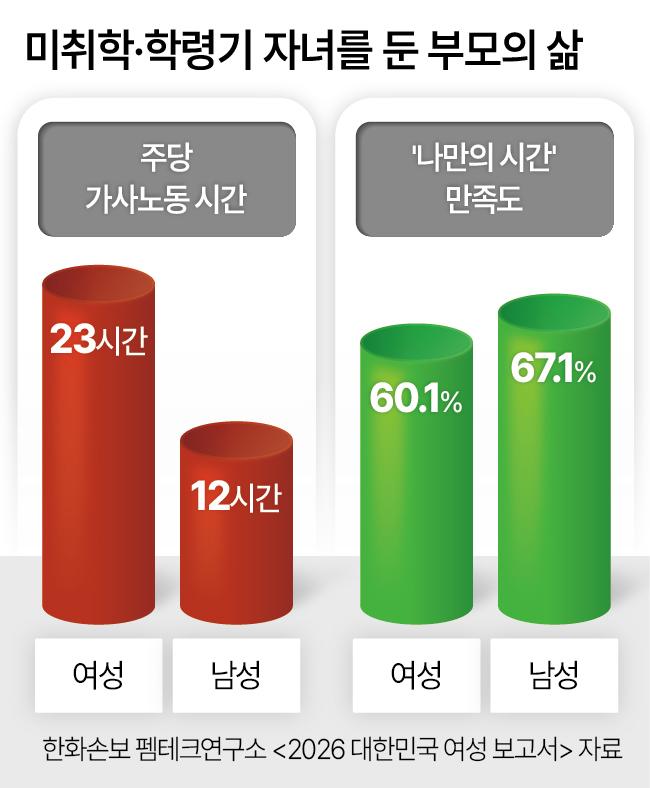
The report also found that in dual-income households with preschool-age children, women spent 23 hours a week on housework — roughly twice the 12 hours reported by men. Against that backdrop, only 60.1 percent of women said they were satisfied with having time to themselves, compared with 67.1 percent of men, a gap of 7 percentage points. Women who were pregnant, had recently given birth, or were raising infants and toddlers were particularly affected: 53.7 percent said they lacked enough time for themselves, a figure 13.6 percentage points above the overall respondent average of 40.1 percent. Among that group, 44.4 percent said caregiving and housework left them without enough time for themselves.
On social attitudes, 82.0 percent of women agreed that "a life without children should be respected." High proportions also agreed that "marriage and childbirth are personal choices" (78.3 percent) and that "housework and childcare should be shared responsibilities among all family members" (76.4 percent).
Yet a significant gap emerged between the lives women aspire to and the social expectations they perceive. Women reported a difference of more than 10 percentage points between their personal values and perceived social expectations across every subcategory measured, while men's gaps remained within 10 percentage points in most areas. The widest gap — 23.8 percentage points — was recorded for "choosing to live life at one's own pace and on one's own terms."
"Women's wellness cannot be explained simply by physical health or self-care," the report concluded. "It requires looking at the relationships in which they live, how much control they have over their own time, whether they have the financial foundation to choose the life they want, and how much they feel the possibility of growth and change."
The FemTech Research Institute was established by Hanwha General Insurance in June 2023 with the goal of becoming the insurer that best understands women. It conducts research on women's health management and the diverse needs they encounter in daily life.
won@heraldcorp.com