K-UAM One Team members conduct demonstration flight on Tuesday
Incheon route spans Yeongjongdo, Deokjeokdo and Wangsan Marina
Airline's in-house ACROSS system manages flight control and traffic
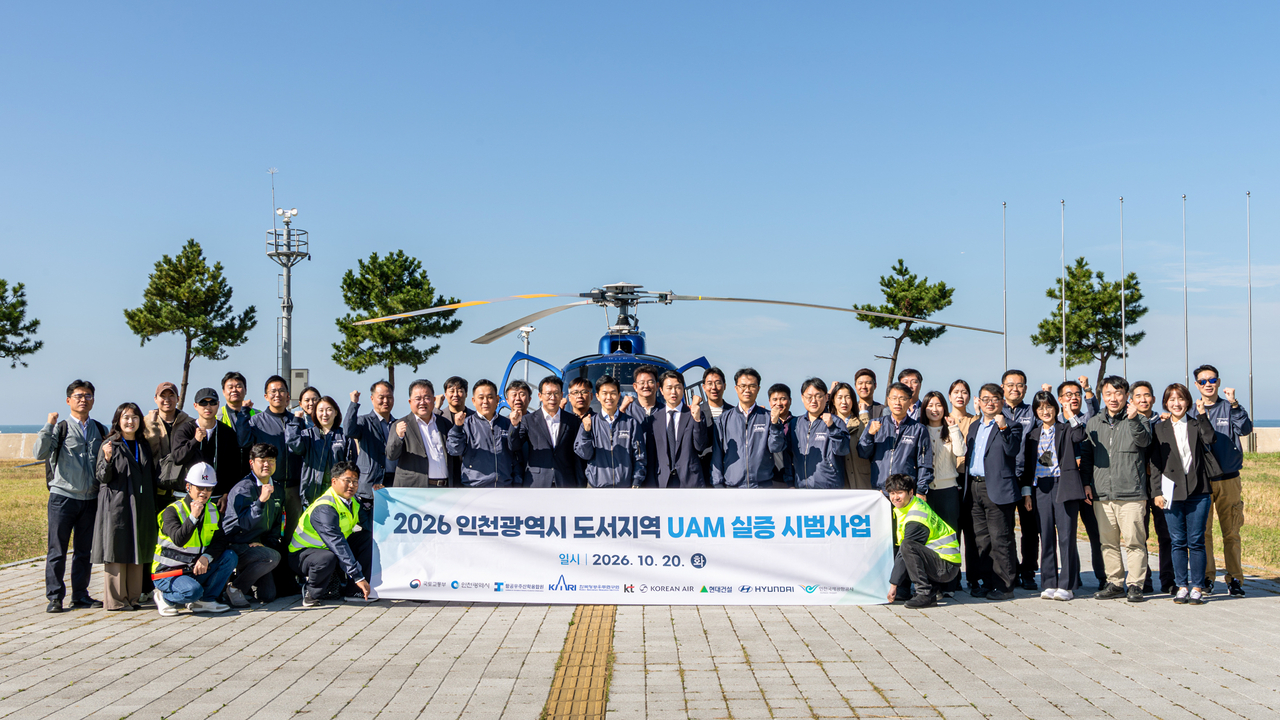
Korean Air said Wednesday it successfully completed an urban air mobility (UAM) demonstration flight over Incheon's island waters on Tuesday as part of the K-UAM One Team consortium, which it formed with Incheon International Airport Corp., KT Corp., Hyundai Motor Company and Hyundai Engineering & Construction (Hyundai E&C).
The demonstration is being recognized as South Korea's first UAM test conducted in partnership with a local government, bringing together the central government, a municipal authority and private companies to carry out the full process — from identifying public-service use cases and designing flight routes to conducting on-site verification.
The Ministry of Land, Infrastructure and Transport and Incheon Metropolitan City led the project, with the Aviation and Aerospace University Industry Convergence Institute and the Korea Aerospace Research Institute also taking part. The demonstration was designed to verify the feasibility of integrated UAM operations in Incheon's island environment, drawing on technologies and operational experience gained through the government's K-UAM Grand Challenge (GC) program.
The demonstration flight used surrogate aircraft along a route starting from Geojampo on Yeongjongdo, passing through Deokjeokdo and ending at Wangsan Marina. Korean Air led the consortium's integrated operations using its in-house UAM integrated control system, ACROSS, to handle flight control and traffic management. The exercise confirmed that technologies and procedures validated during the GC program could be applied to island flight environments, pointing to the potential for expanding UAM operations beyond urban centers.
ACROSS, developed entirely in-house by Korean Air, is an integrated control solution designed to enable multiple UAM aircraft to fly safely and efficiently over urban airspace. It was selected as the UAM integrated control system for Incheon's urban air mobility infrastructure development project this year, with a separate contract signed, and the first phase of deployment is scheduled for completion in December.
Korean Air has been building up UAM integration expertise through earlier GC demonstrations. In the GC Phase 1 test conducted in Goheung, South Jeolla Province, in April 2024, the K-UAM One Team verified integrated operability among UAM aircraft, operating systems and a 5G aeronautical communications network. In the GC Phase 2 test last October along the Cheongna–Gyeyang corridor in Incheon, the team successfully completed procedures including mutual handover of flight control authority and responses to abnormal situations to support multiple operators flying simultaneously.
Korean Air has continued to refine ACROSS on the basis of that accumulated experience. The latest demonstration again showcased the system's integrated operational capabilities across varied flight environments.
"We plan to continue working closely with our K-UAM One Team partners to develop the technology and operational foundations needed to commercialize UAM in South Korea," a Korean Air official said. "We will also keep advancing ACROSS — including system automation and flight control and traffic management functions — through Ministry of Land, Infrastructure and Transport research and development projects, with the goal of building a safe and efficient integrated UAM operating framework capable of handling diverse flight environments."
Meanwhile, Korean Air posted record quarterly sales in the third quarter despite high fuel prices. Preliminary standalone sales for the quarter reached 5.04 trillion won ($3.8 billion), up 26 percent from the same period last year and an increase of 1.04 trillion won — the highest figure ever recorded for a single quarter. Operating profit rose 12 percent to 421.2 billion won. Net profit for the period surged 912 percent to 929.7 billion won, partly reflecting the impact of a weaker won-dollar exchange rate at the end of the quarter.
likehyo85@heraldcorp.com