Security threats include advancing North Korean missile capabilities and gray-zone provocations
Commander says alliance cannot rely solely on twice-yearly joint exercises
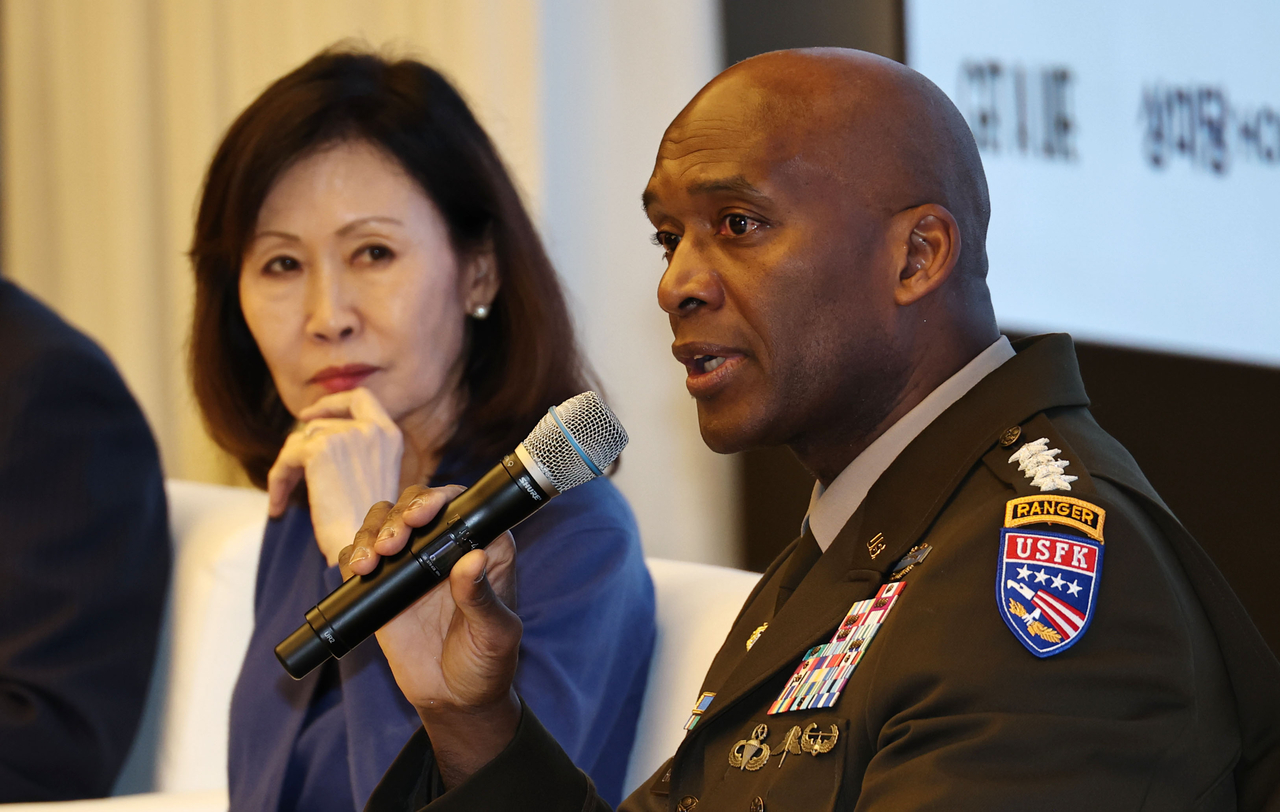
Gen. Xavier Brunson, commander of United States Forces Korea, warned Wednesday that defense cooperation between North Korea and Russia has advanced to a dangerous level, while reaffirming that USFK's core mission — defending South Korea and maintaining the armistice — remains unchanged.
Speaking at a special luncheon hosted by the American Chamber of Commerce in Korea at Mondrian Seoul Itaewon in Yongsan-gu, Brunson cited North Korea's advancing ballistic and cruise missile capabilities and deepening North Korea-Russia defense cooperation as key shifts in the security environment. "Gray-zone provocations designed to test our resolve and regional stability continue without pause," he said.
He said the combined military capabilities of the US-South Korea alliance exist to deter war before it begins. The goal, he said, is to ensure that any adversary, after weighing the costs of provocation, concludes that "today is not the day." He added that "'Fight Tonight' must be more than a slogan — it must be a standard."
On USFK's future role, Brunson said his obligations under the Mutual Defense Treaty would remain the same in one year or five. "My responsibility is to protect the people of the Republic of Korea," he said.
However, he said the way that mission is carried out must evolve with the changing security environment. "When the environment itself changes and new opportunities arise, we too must adapt to meet the challenges," he said, adding that the nature of training on the Korean Peninsula and how readiness is maintained both need to change.
Brunson said joint exercises must also be updated to match current threats. "We need to adapt our training to keep pace with those threats," he said. He noted that he had recently discussed first-half training with the South Korean chairman of the Joint Chiefs of Staff, and said the alliance cannot afford to rely solely on two combined exercises per year.
He also outlined a concept of "in-theater sustainment" that would draw on South Korea's manufacturing capabilities. Rather than shipping equipment and parts back to the continental United States for repair and maintenance, keeping forces combat-ready within the operational theater would significantly improve operational endurance, he said.
"We cannot simply wait for ships to cross the Pacific to repair critical equipment," Brunson said. He said closing gaps in the defense posture requires industry and allied forces to operate as a single system, with manufacturing and maintenance capabilities extending all the way to the front lines.
"Credible deterrence starts not with a specific weapons system, but with people," Brunson said, adding that an industrial and technological base must continuously underpin that deterrence. Addressing the business leaders in attendance, he said, "You do not represent only the business and industrial community — you are an indispensable element of the combined defense system."
On the possibility of diplomatic engagement, including talks between Washington and Pyongyang, Brunson said any leader-level dialogue would be built on a foundation of military readiness. "Our only mission is to ensure our forces are ready to support their efforts," he said, adding that leaders on both sides would expect the same from their militaries.
The event, held to mark the 250th anniversary of the United States, was attended by US Ambassador to South Korea Michelle Park Steel and some 200 business representatives from domestic and foreign companies, including AmCham member firms. Following their keynote addresses, Brunson and Steel took part in a conversation moderated by AmCham Chairman James Kim, discussing shifts in the security environment and the direction of US-South Korea cooperation.
rimsclub@heraldcorp.com