Kospi has plunged 39% from its peak, deepening losses for leveraged investors
Forced selling kicks in when collateral ratio falls below 140%
Waiting for a rebound is costly with margin loan rates at 9.5% per year

Imagine a stock falls 20%, but you lose 40% of the money you put in. Or your collateral is short by just 300,000 won ($226), yet 1.37 million won worth of your shares are forcibly sold. These are not hypothetical worst cases — they are the predictable consequences of buying stocks on borrowed money. When share prices fall, the leverage effect turns against investors, squeezing them far harder than the market decline alone would suggest. The key questions are: how far does a stock have to drop before forced selling begins, and how much extra cash does it take to avoid it?
According to Korea Exchange, the Kospi fell 39.08% from its record closing high of 9,114.55 set on June 22 to 5,552.74 on Tuesday.
Heo Jae-hwan, a researcher at Eugene Investment & Securities, said the recent Kospi decline is exceptional even by historical crisis standards. "The Kospi fell 21% in just seven trading sessions after Oct. 2," he said. "Since the 1980s, the only times it fell more over the same period were December 1997 (minus 25 percent), October 2008 (minus 31 percent) and March 2020 (minus 25 percent)."
The market rout has also sharply reduced the balance of margin financing. According to the Korea Financial Investment Association, the outstanding balance of margin loans fell from 33.63 trillion won to 31.11 trillion won between Oct. 2 and Monday, a drop of 2.52 trillion won ($1.9 billion).
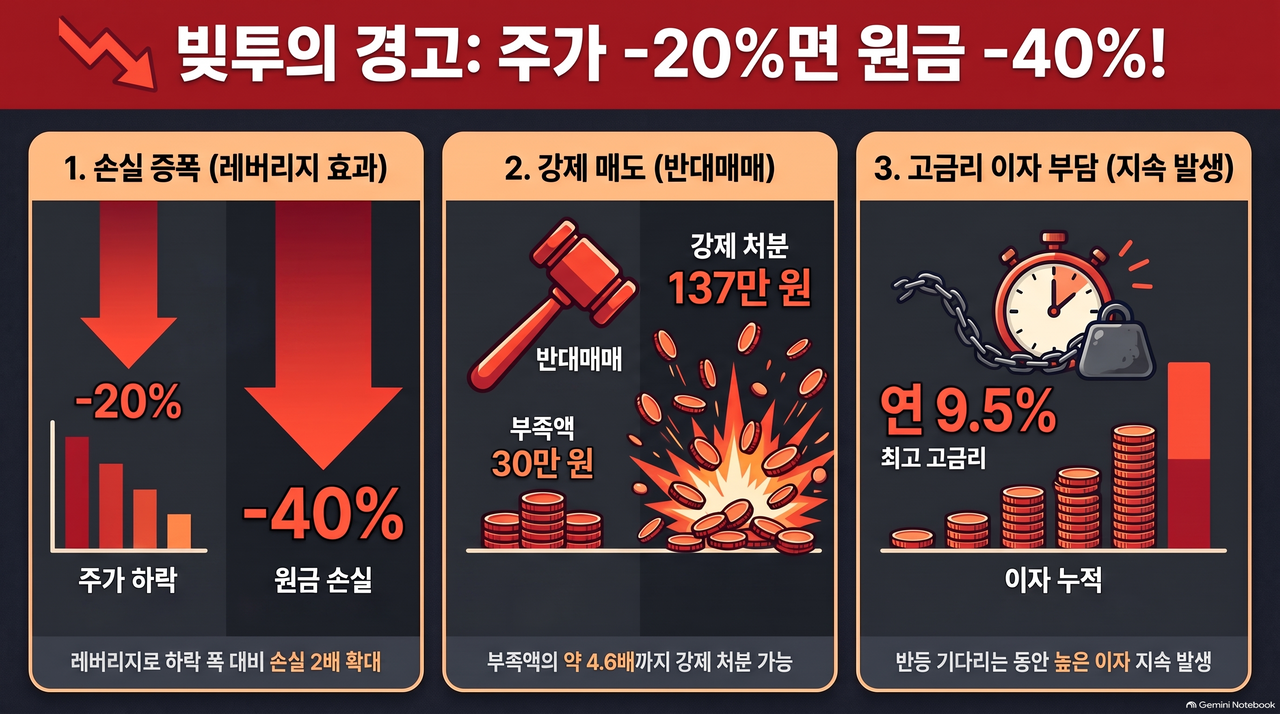
Stock falls 20%, but principal loss hits 40% — here's why
Margin financing is a form of stock trading in which an investor borrows money from a brokerage to buy shares. Because the investor can purchase more stock than their own capital allows, gains are amplified when prices rise — but so are losses when prices fall.
Consider an investor who combines 5 million won of their own money with 5 million won borrowed from a brokerage to buy 10 million won worth of shares. If the stock falls 20%, the portfolio is worth 8 million won. But the 5 million won loan still has to be repaid in full, leaving the investor with just 3 million won.
The stock dropped 20%, but the investor lost 2 million won of their original 5 million won — a 40% loss on principal. Had the same investor bought the stock with only their own 5 million won and no debt, the loss would have been just 1 million won. These figures exclude interest and transaction costs.
The flip side is equally stark: a 20% rise in the stock price would deliver a 40% return on the investor's own capital. This practice of using borrowed money to scale up investment exposure is known as leveraged investing. In practice, the amount an investor can borrow on margin varies by stock and by the deposit rate set by each brokerage.
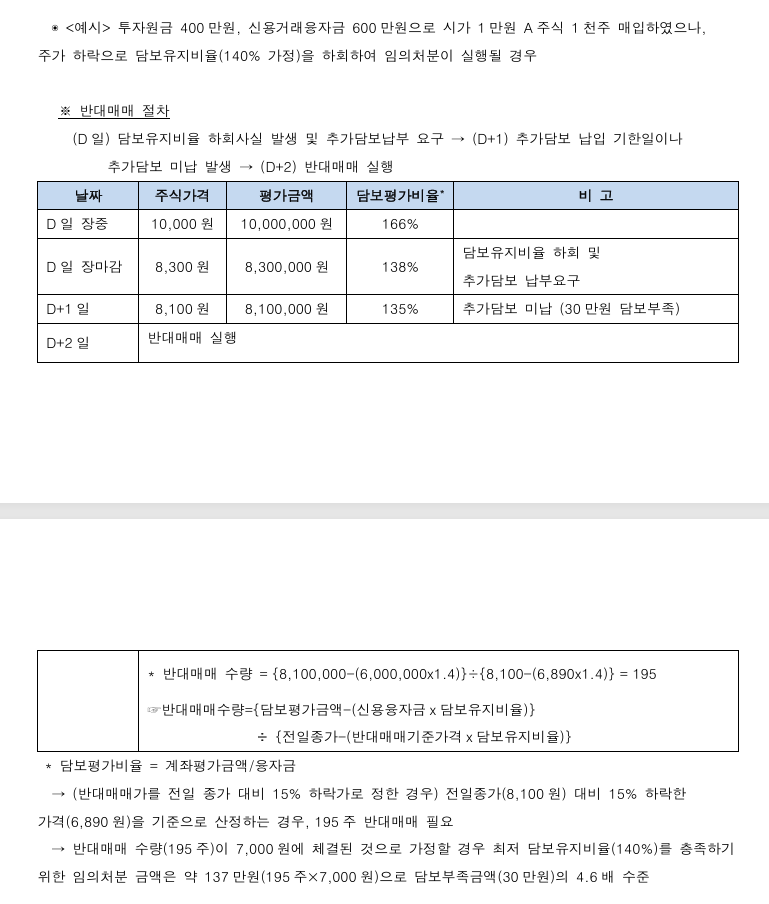
Collateral short by 300,000 won — so why are 1.37 million won in shares force-sold?
The problem is that investors cannot simply wait for a rebound whenever share prices fall. If the value of the shares pledged as collateral drops below a certain threshold and the investor cannot make up the shortfall, the brokerage will initiate forced selling.
According to the margin trading disclosure document of Kiwoom Securities, which holds the top market share among retail investors in Korea's stock market, the minimum collateral maintenance ratio is 140%. This means that if an investor borrowed 10 million won from a brokerage, the assets recognized as collateral must be worth at least 14 million won at all times.
The disclosure document provides a worked example. Suppose an investor buys 1,000 shares at 10,000 won each — a total of 10 million won — using 4 million won of their own money and a 6 million won loan. If the share price falls to 8,100 won, the portfolio is worth 8.1 million won. The investor must maintain collateral equal to 140% of the 6 million won loan, or 8.4 million won, but the actual portfolio value is only 8.1 million won — leaving a shortfall of 300,000 won.
Yet a 300,000 won collateral shortfall does not mean only 300,000 won worth of shares will be sold. Kiwoom Securities calculates the forced-sale quantity by accounting for the possibility of further price declines. The disclosure document sets the reference price for the forced sale at 6,890 won — 15% below the Tuesday closing price of 8,100 won — and arrives at a forced-sale quantity of 195 shares. If those shares are sold at 7,000 won each, roughly 1.37 million won worth of stock is forcibly liquidated — about 4.6 times the original collateral shortfall.
Brokerages build in a buffer when selling shares to guard against further price drops. Even if an investor wants to hold on and wait for a rebound, a portion of their holdings may be forcibly sold before that happens.
According to the Kiwoom Securities disclosure, when the collateral maintenance ratio falls below the required level, the brokerage issues a margin call. If the investor fails to restore the shortfall by the next business day, forced selling is executed on the following business day. However, the specific collateral maintenance ratio, the deadline for meeting a margin call, and the timing of forced selling vary by brokerage and transaction type.
Even investors who avoid forced selling and hold onto their shares must still service their loan interest. Margin financing rates differ by brokerage and loan duration.
Among major brokerages for non-face-to-face transactions, KB Securities, NH Investment & Securities, Mirae Asset Securities and Korea Investment & Securities all charge a maximum annual rate of 9.5%. The threshold at which that rate kicks in differs, however: NH Investment & Securities and Korea Investment & Securities apply it from 16 days of borrowing, while KB Securities and Mirae Asset Securities apply it from 31 days.

Forced selling surges in market rout — investors urged to exercise caution
Separately from margin financing, forced selling tied to unsettled trades — where investors fail to pay for shares by the settlement deadline — has also surged. According to the Korea Financial Investment Association, the value of forced sales from unsettled trades jumped from 27.1 billion won on Oct. 12 to 89.3 billion won on Oct. 14, roughly tripling in two days. It then came in at 80.5 billion won on Thursday, 57.2 billion won on Friday and 54.2 billion won on Monday.
Hong Ji-yeon, a senior researcher at the Korea Capital Market Institute, said margin trading amplifies market swings in both directions. "Margin financing expands buying demand during upswings, but during downturns it magnifies selling pressure through forced liquidations — a procyclical dynamic," she said. She added that given Korea's retail-investor-dominated market structure and limited hedging tools, volatility is likely to increase as leverage is unwound, making sustained risk management and policy responses essential.
For investors who bought stocks on borrowed money amid the current market rout, the immediate priorities are clear: assess how much of their original capital remains, calculate how much additional collateral is needed to avoid forced selling, and weigh whether they have enough staying power — factoring in loan interest and margin call deadlines — to hold on until prices recover.

hajun825@heraldcorp.com