Non-destructive evaluation technology for blue phosphorescent OLEDs could cut the time and cost of lifespan testing
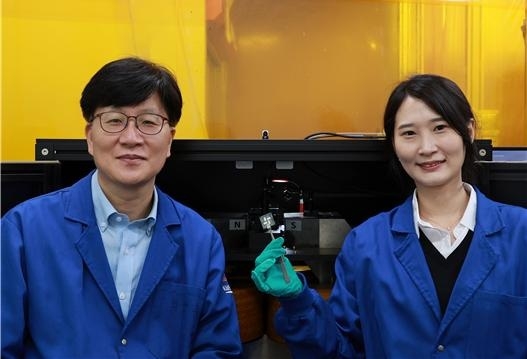
Researchers have developed a technology that uses magnetic fields to predict the lifespan of organic light-emitting diodes, or OLEDs, used in smartphone and television screens — without running the devices for the tens to hundreds of hours required by conventional testing. The advance is expected to accelerate development of next-generation, high-efficiency, long-lasting displays.
KAIST announced Thursday that a research team led by Professor Yoo Seung-hyup of the School of Electrical Engineering, working jointly with Kyung Hee University, Hanbat National University and display analysis firm ASTA, had developed a technique to predict the lifespan of blue phosphorescent OLEDs by analyzing how their brightness changes under a magnetic field.
OLEDs are display components that emit light on their own when current flows through them, combining red, green and blue light to produce a full range of colors. Among these, blue phosphorescent OLEDs can achieve high energy efficiency, but maintaining brightness over extended use has remained a central challenge.
Conventional lifespan testing required leaving an OLED device switched on for tens to hundreds of hours while measuring how much its brightness declined. The process was not only time-consuming but also degraded the device's performance in the course of measurement.
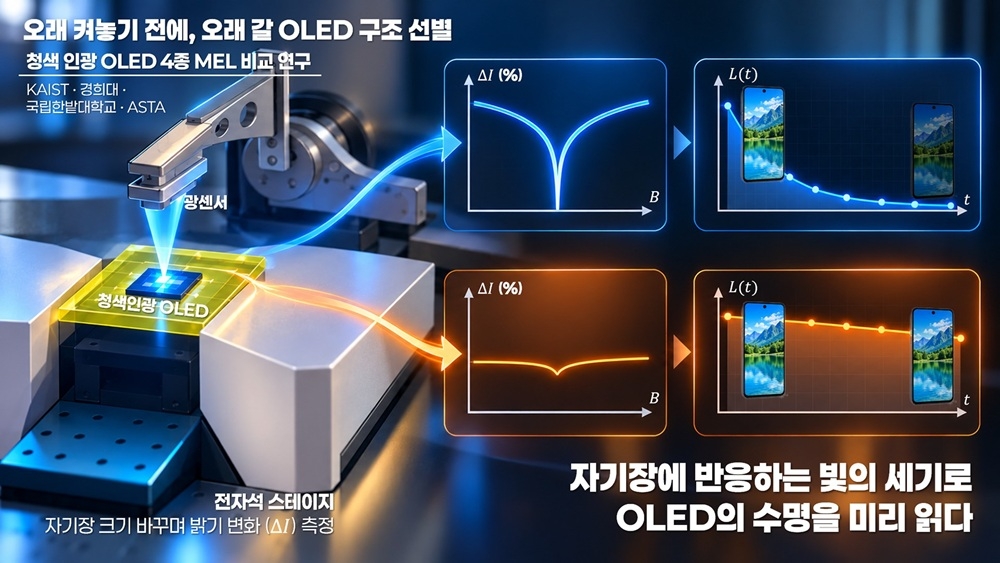
The research team focused on a phenomenon in which a magnetic field subtly alters an OLED's brightness by influencing its internal light-emission process.
With a steady current flowing through the device, the team used an electromagnet to vary the magnetic field strength while precisely measuring the resulting brightness changes. They then isolated the component of the magnetic field response most closely linked to lifespan degradation and used it as an evaluation indicator.
The team compared four types of blue phosphorescent OLEDs built from the same light-emitting material but with different internal structures. Devices that showed a smaller initial magnetic field response also maintained their brightness longer in actual extended-operation tests.
The technique does not extend OLED lifespan directly through the magnetic field; rather, it allows researchers to identify long-lasting devices in advance by analyzing how their brightness responds to a magnetic field.
Through molecular simulations, the team also found that defects arising from broken bonds between organic molecules inside an OLED can affect both the light-emission process and the device's magnetic field response.
If commercialized, the technology would allow display companies to screen candidate devices for long lifespan at an early stage of OLED development, then focus detailed lifespan testing on the most promising candidates — reducing the time and cost of research and development.
Applying the technique in actual industrial settings will require standardizing test conditions such as measurement current, brightness levels and magnetic field range. Additional verification will also be needed to confirm that predictions remain consistent across a variety of light-emitting materials and device structures.
"This achievement can be used to rapidly identify materials and device structures with superior lifespan at an early stage of OLED development," Professor Yoo said. "Once validated under a range of conditions, we expect it to serve as a non-destructive evaluation technology that supports the development of high-efficiency, long-lasting blue OLEDs."
The findings, with KAIST researcher Ji Jeong-min as lead author, were published in the international journal Nature Communications.
nbgkoo@heraldcorp.com