- Korea Research Institute of Bioscience and Biotechnology maps growth-signaling pathway in cells surrounding tumors
- Existing anticancer drug shown to suppress proliferation; findings point to blood-based diagnostic tool

Korean researchers have identified a new mechanism driving the growth of triple-negative breast cancer, one of the most difficult-to-treat and relapse-prone forms of the disease. The culprit, they found, is not the cancer cells themselves but a small RNA transmitted from surrounding cells that spurs tumor proliferation.
The Korea Research Institute of Bioscience and Biotechnology said Thursday that a research team led by Dr. Cho Hyun-su of its Stem Cell Convergence Research Center, working jointly with a team led by Professor Heo Geun of Kyungpook National University, had mapped the pathway by which microRNA miR-1290 — secreted by cancer-associated fibroblasts — promotes the growth of triple-negative breast cancer.
Triple-negative breast cancer accounts for roughly 10 to 15 percent of all breast cancer cases. It is characterized by the absence of estrogen receptors, progesterone receptors and HER2 protein in cancer cells, which means conventional hormone therapies and HER2-targeted treatments offer little benefit. Treatment options are limited and the risk of recurrence is high.
The research team focused on fibroblasts, cells that surround tumors and normally help maintain tissue structure and support wound healing. In a cancer environment, however, these same cells can switch roles and actively promote tumor growth.
The team analyzed exosomes — tiny vesicles involved in transferring material between cells. They found that miR-1290 contained in exosomes secreted by cancer-associated fibroblasts is a key factor driving cancer cell proliferation.
When miR-1290 delivered from fibroblasts enters cancer cells, it reduces levels of TBC1D4, a protein that normally suppresses tumor growth. This activates growth-signaling pathways within the cancer cells while also increasing miR-1290 concentrations, further accelerating proliferation.
The research team also confirmed a potential therapeutic avenue for blocking this cancer growth pathway.
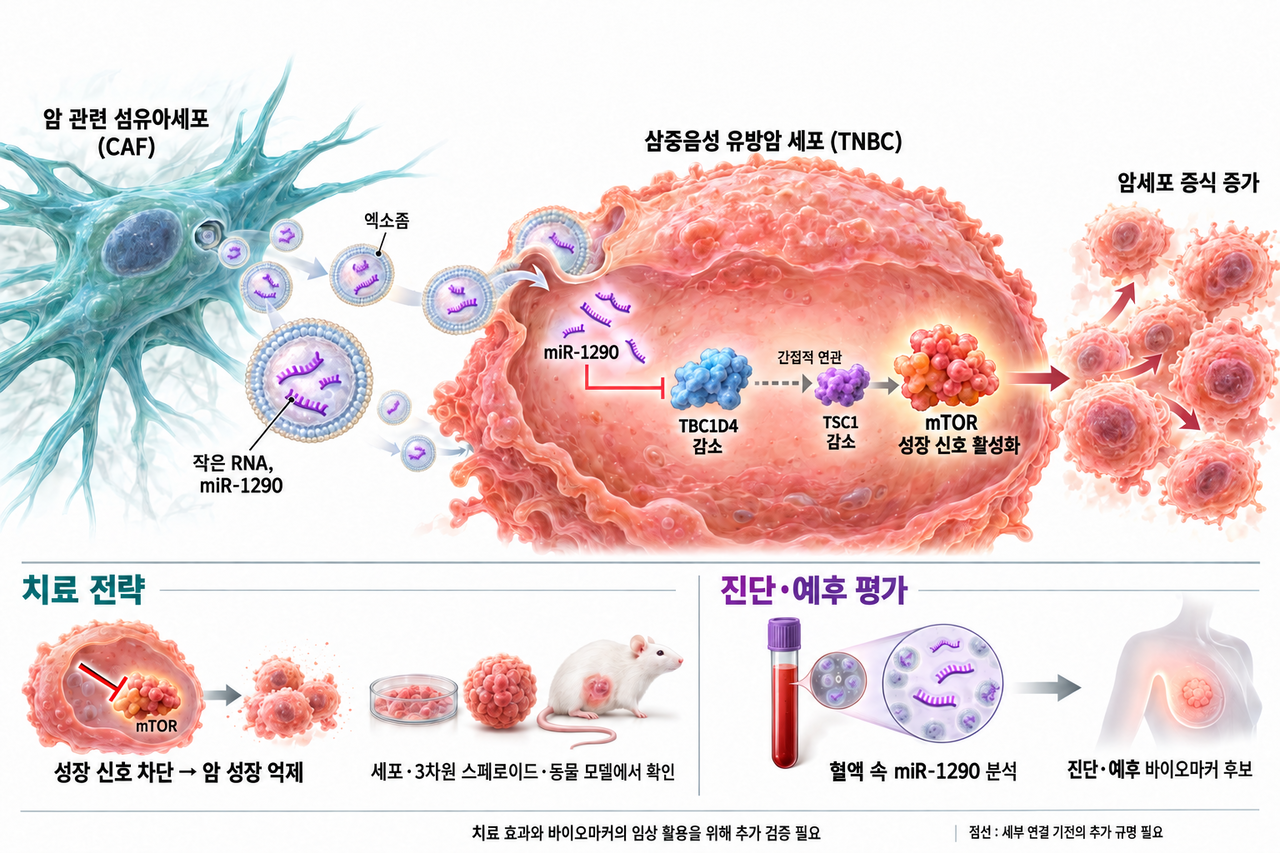
When the team administered everolimus — a drug already approved for treating other cancers — it suppressed the cancer cell proliferation driven by miR-1290. The effect was confirmed in three-dimensional cell models and in animal experiments.
The findings suggest a path toward developing new treatments for triple-negative breast cancer using an already-approved anticancer drug. However, therapeutic efficacy and safety in actual patients will need to be verified through further clinical research.
The research also pointed to the possibility of predicting cancer progression through blood tests. Analysis of blood data from breast cancer patients showed that higher concentrations of miR-1290 were associated with faster disease progression and poorer prognoses.
The researchers expect that miR-1290 could also be used to develop a biomarker capable of predicting cancer progression and treatment outcomes by analyzing specific substances in the blood.
"This research has uncovered the signaling pathway through which cells surrounding a tumor stimulate cancer cells," Cho said. "We expect it will contribute to providing new targeted treatment options and more precise diagnostic criteria for patients with triple-negative breast cancer, who currently have very limited treatment choices."
The findings were published Sept. 20 in the international journal Signal Transduction and Targeted Therapy.
nbgkoo@heraldcorp.com